Joby Mathew
Indian international arm wrestler
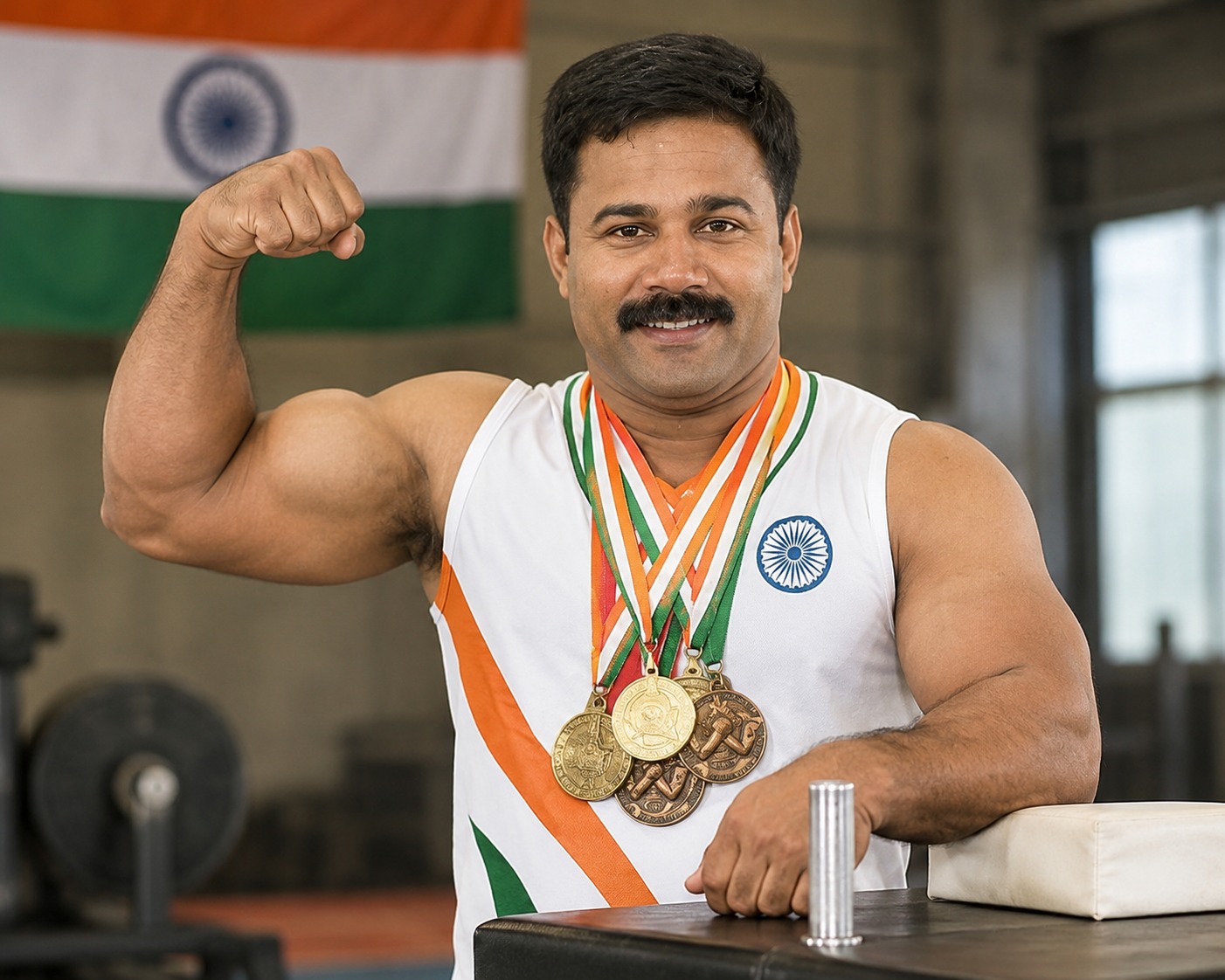
Joby Mathew is an Indian international arm wrestler. Mathew has won gold medal for India in 29th World Arm Wrestling Championship held at Hispanico, Spain. He has also won five gold medals in World Dwarf Games 2013 in Michigan, organized by Dwarf Athletic Association of America. Joby Mathew is a physically challenged person by birth with 60% disabilities Mathew has a height of 3 feet 5 inches and stunted legs, which is a condition caused by proximal femoral focal deficiency (PFFD)
Key Factors
Full Name: Joby Mathew
Birth Year: 1976
Native Place: Adukkom, Kerala, India
Occupation: Sports Trainer at Bharat Petroleum Corporation
Sports Disciplines: Arm wrestling, fencing, karate, swimming, parasailing, paragliding, athletics
Known For: International arm-wrestling champion and multi-sport athlete
In a world obsessed with physical scale, strength is often misunderstood. It is measured in height, muscle, speed, or dominance. Yet the life of Joby Mathew forces a different definition entirely. Standing just three feet five inches tall, born with a rare medical condition that left his legs severely underdeveloped, the Kerala-born athlete built an outstanding international sporting career not through sympathy or spectacle, but through relentless discipline, competitive ferocity, and an almost defiant belief in possibility.
Inside crowded arm-wrestling arenas in Spain, Japan, and the United States, Joby Mathew became known not as a differently abled competitor, but as a champion capable of defeating even non-disabled athletes. Beyond arm wrestling, he moved through life with unusual intensity, becoming India’s first wheelchair fencer, a brown belt in karate, a parasailing enthusiast, swimmer, rock climber, and a man who once openly dreamed of climbing Mount Everest.
But statistics alone cannot explain why his story resonates so deeply across Kerala and beyond. What makes Joby Mathew unforgettable is not simply that he overcame hardship. It is the way he transformed adversity into identity, and physical limitation into a form of personal freedom.
A Childhood Built on Challenges
The village roads of Adukkom in Kerala were never designed for a child like Joby Mathew.
Long before medals and international competitions entered his life, survival itself demanded effort. Born with Proximal Femoral Focal Deficiency, a rare condition affecting the development of the legs and hips, Joby grew up without knee joints and with severely shortened lower limbs. According to medical assessments, his legs were nearly 60 percent underdeveloped.
But medical language rarely captures the emotional reality of childhood.
His home stood atop a hill, far from the main road. For an able-bodied child, the walk itself would have been exhausting. For Joby, it became nearly impossible. In interviews over the years, he recalled how his mother physically carried him to school during his early years because the terrain was too difficult for him to navigate alone.
That image, a mother carrying her son across rough village pathways while other children cycled freely to school, remains central to understanding his emotional journey.
He watched football matches from the sidelines. He watched classmates run, jump, compete, and move naturally through games that felt physically unreachable to him. Like many children with disabilities, he experienced isolation not only from infrastructure, but from ordinary childhood participation.
Yet somewhere inside those difficult years, another instinct quietly emerged.
He began noticing the unusual strength in his upper body.
Discovering Strength Through Arm Wrestling
Children often discover identity accidentally.
For Joby Mathew, it happened across classroom desks and informal schoolyard challenges. Unable to participate in many sports, he began arm wrestling classmates during free time. What initially started as playful competition slowly transformed into revelation.
He kept winning. Again and again.
The boy who struggled physically in conventional games possessed extraordinary arm strength and endurance. Soon, students across campus reportedly began recognizing him as one of the strongest arm wrestlers in school.
That discovery changed something psychological.
Until then, disability had largely defined the boundaries of his life. Arm wrestling reversed the equation. Suddenly, his body was not merely a limitation. It was also a source of power.
The sport gave him something deeper than victory, it gave him visibility.
More importantly, it restored agency.
Instead of dwelling on activities he could not do, he began focusing intensely on the abilities he did possess. It became an early lesson that would define the rest of his life: resilience often begins not by denying weakness, but by maximizing strength.
The Turning Point
Every athlete remembers the first moment when sport stopped feeling like pastime and began feeling like destiny.
For Joby Mathew, that moment arrived during the Kottayam District Sports Meet in 1983.
Competing in the disabled category, he won gold medals in running and throwball. The victories may have appeared modest in scale compared to his later global achievements, but emotionally they were transformative.
For the first time, competition placed him at the center rather than the margins.
Success created momentum. Momentum created ambition.
Arm wrestling, however, remained his true obsession.
Through the years, he trained relentlessly, developing immense upper-body strength while refining technique and endurance. Unlike athletes who emerge from structured academies with sponsorship and institutional support, Joby’s growth came largely through personal determination and improvisation.
Kerala’s sporting ecosystem during the 1980s and 1990s offered limited infrastructure even for mainstream athletes. For differently abled competitors, opportunities were far narrower. International exposure, sponsorship, coaching systems, and financial backing remained inconsistent.
Yet Joby persisted.
What separated him from many others was not merely physical toughness, but psychological refusal. He rejected the idea that disability should dictate ambition.
Rise to International Recognition
By the early 2000s, Joby Mathew had evolved into one of India’s most remarkable arm-wrestling athletes.
The international breakthrough came during the World Arm Wrestling Championships in Japan in 2005. Competing against elite athletes from around the world, he won three bronze medals, including one in the general category against non-disabled competitors.
That distinction mattered enormously.
It demonstrated that his achievements could not be reduced to inspirational symbolism alone. He was succeeding in genuinely competitive environments against physically larger opponents.
Then came Spain in 2008.
At the 29th World Arm Wrestling Championship held in Hispanico, Joby reached the peak of his career by winning gold for India in the general category, alongside a silver medal in the disabled event. The achievement carried enormous symbolic weight within Indian disability sports.
A differently abled athlete from rural Kerala had become world champion through one of the most physically demanding strength sports imaginable.
Yet perhaps the most emotionally resonant chapter of his career unfolded during the World Dwarf Games.
Often described as the “Olympics of Little People,” the event gathers athletes from across the world in an atmosphere combining elite competition with profound solidarity. At the 2013 World Dwarf Games in Michigan, organized by the Dwarf Athletic Association of America, Joby won five gold medals.
He returned again at the 2017 edition, contributing significantly to India’s medal tally with two gold medals, three silver medals, and one bronze.
But what makes these achievements remarkable is their range.
He competed not just in arm wrestling, but across badminton, shot put, javelin throw, discus throw, and powerlifting. The versatility revealed something essential about his personality: sport for Joby was never a single discipline. It was a philosophy of existence.
Beyond Arm Wrestling
Most athletes dedicate their lives to mastering one sport.
Joby Mathew seemed determined to challenge that logic entirely.
He became India’s first wheelchair fencer. He earned a brown belt in karate. He joined the Kerala parasailing and paragliding team. He developed passion for swimming and rock climbing. At one point, he even publicly declared his ambition to climb Mount Everest.
The dream sounded impossible to many.
To Joby, it sounded natural.
Perhaps the most striking aspect of his personality is his appetite for risk and movement. Rather than avoiding physically demanding experiences, he consistently pursued them. Interviews reveal a man deeply resistant to being categorized by limitation.
He once remarked that while the world might classify him as handicapped, he never allowed that definition to govern his own mind.
That philosophy shaped his daily life.
He reportedly followed a strict fitness routine, waking at 5 a.m., training in the gym, swimming regularly, and practicing climbing exercises. He also drove a specially modified car designed for hand-only operation, another symbol of his determination to retain independence.
Philosophy, Mindset, and Public Inspiration
What distinguishes Joby Mathew from many inspirational public figures is the absence of self-pity in his narrative.
He rarely speaks like a victim.
Instead, his interviews consistently reflect pragmatic resilience. He acknowledges hardship openly, but without romanticizing suffering. His worldview appears rooted in adaptation rather than complaint.
That mindset deeply resonates with people.
In Kerala, where stories of migration, labour, struggle, and perseverance remain woven into social consciousness, Joby became more than an athlete. He became a symbol of psychological courage.
The admiration he inspires extends beyond disability communities because his life confronts a universal fear, the fear of limitation itself.
Watching him compete forces audiences to reconsider their assumptions about strength, masculinity, ambition, and possibility.
Recognition and Legacy
Over the years, Joby Mathew received recognition from sports organizations, social institutions, and public groups across Kerala. In 2013, the Rotary Club of Cochin Knights honoured him with its Vocational Excellence Award, acknowledging not just his sporting achievements but his broader impact as a motivational public figure.
Professionally, he worked with Bharat Petroleum Corporation as a sports trainer, balancing career responsibilities alongside international competition.
His legacy within Indian disability sports remains significant.
Long before disability inclusion became mainstream public conversation, Joby was already competing globally, winning medals, and forcing visibility for athletes often ignored by institutions and media structures alike.
Importantly, he represented Kerala internationally without losing connection to his local identity. His story remained rooted in village roads, family sacrifice, and small everyday struggles even while competing on world stages.
Conclusion
There are athletes who win medals, and there are athletes who permanently alter the emotional imagination of a society.
Joby Mathew belongs firmly to the second category.
His life cannot be reduced to statistics, gold medals, or motivational slogans. The deeper significance of his journey lies in how he confronted physical limitation without allowing it to define the scale of his ambition. Standing barely taller than a child, he entered arenas built for giants and emerged victorious through sheer discipline, endurance, and mental force.
In Kerala, where stories travel quickly through memory and conversation, Joby Mathew has become something larger than a sportsman. He represents the outstanding possibility that human strength is ultimately psychological before it is physical. His journey reminds us that greatness is not measured in inches, but in the refusal to surrender to the boundaries life imposes.
Awards & Recognitions
2012 World Arm Wrestling Champion
2008 World Arm Wrestling Champion
2017 Bronze Medal in World Dwarf Games Badminton Singles
2017 Gold Medal in World Dwarf Games Badminton Doubles
2013 World Dwarf Games Gold Medal in Singles and Doubles
2012 All India Super Six badminton Tournament
2011 “RYLA” National paralympic badminton Tournament
2010 Israel open international paralympic badminton tournament
2012 All India Tabel Tennis Tournament
2011 GOLD MEDAL IN SWIMMING National Para Games
2017 Silver Medal in World Dwarf Games Discuss Throw
2017 Silver Medal in World Dwarf Games Javelin Throw
2017 Silver Medal in World Dwarf Games Short Put Throw
2017 Gold Medal in World Dwarf Olympic Games Power Lifting
2013 World Dwarf Games Gold Medal in Shot Put
2013 World Dwarf Games Gold Medal in Javelin throw
2013 World Dwarf Games Gold Medal in Discus Throw
2010 5th National paralympic javelin throw