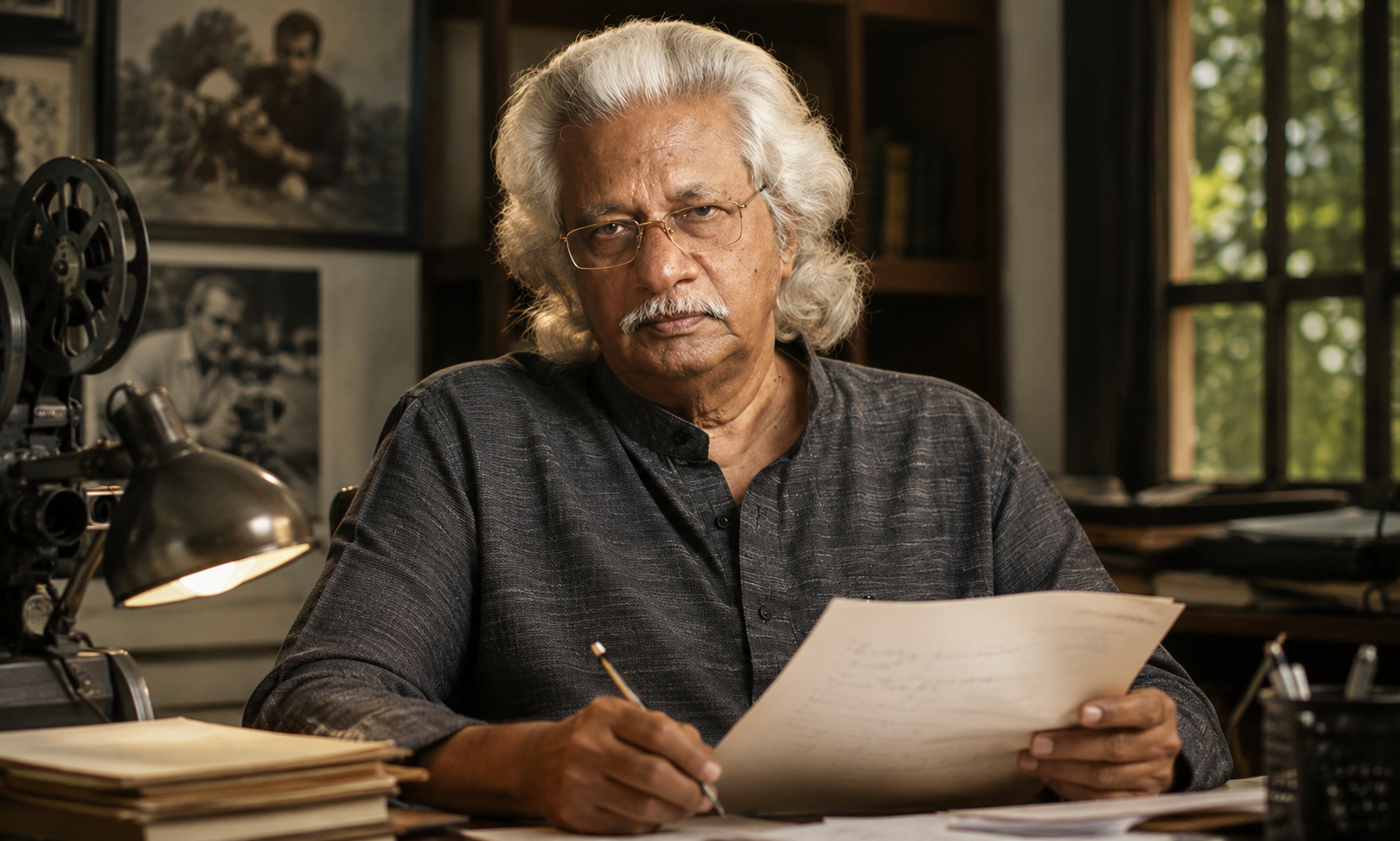
Adoor Gopalakrishnan
Indian film director and screenwriter
Mouttathu Gopalakrishnan Unnithan (born 3 July 1941), known professionally as Adoor Gopalakrishnan, is an Indian film director, screenwriter, and producer who works in Malayalam cinema. With the release of his first feature film Swayamvaram (1972), Gopalakrishnan pioneered the “new wave” in Malayalam cinema during the 1970s. In a career spanning over five decades, Gopalakrishnan has made 12 feature films. His films often depict the society and culture of Kerala. Nearly all of his films premiered at Venice, Cannes and Toronto film festivals. Along with Satyajit Ray and Mrinal Sen, Gopalakrishnan is one of the most recognized Indian film directors in the world cinema.
Key Factors
Full Name: Mouttathu Gopalakrishnan Unnithan
Professional Name: Adoor Gopalakrishnan
Date of Birth: 3 July 1941
Birth Place: Pallickal near Adoor, Kerala
Profession: Film Director, Screenwriter, Producer
Known For: Pioneer of Malayalam New Wave cinema
Years Active: 1970s to present
International Recognition: Cannes, Venice, Toronto, Berlin, FIPRESCI awards, British Film Institute Award
At international film festivals, there are moments when applause feels less like celebration and more like recognition. One such image has repeated itself for decades: a quiet Malayali filmmaker, reserved almost to the point of invisibility, standing before audiences in Venice, Cannes, Toronto, or Rotterdam while critics discuss loneliness, feudal decay, memory, masculinity, and moral collapse through the language of his cinema. Adoor Gopalakrishnan never chased spectacle. His films rarely shouted. They observed. They lingered in silence. Yet from the release of Swayamvaram onward, he transformed Malayalam cinema so profoundly that Kerala’s local realities began entering the vocabulary of world cinema itself. Over five decades, Adoor became not only one of India’s most decorated filmmakers, but also one of its most intellectually rigorous cultural figures. To generations of Malayalis, he remains an outstanding artist who proved that cinema from a small linguistic region could stand beside the greatest films in the world without imitation, apology, or compromise.
When Malayalam cinema entered the 1970s, it was still largely shaped by theatrical storytelling conventions, melodrama, and formulaic structures. Adoor Gopalakrishnan altered that trajectory permanently. Through films like Swayamvaram, Elippathayam, Mukhamukham, Mathilukal, and Vidheyan, he introduced a cinematic language grounded in realism, psychological observation, and social critique. His work travelled across major international festivals including Cannes, Venice, Toronto, Berlin, and London, where critics recognised in his films a rare fusion of regional specificity and universal human inquiry.
But Adoor’s contribution extended beyond filmmaking itself. Through the Chitralekha Film Society and Kerala’s cooperative film movement, he helped cultivate an entirely new film culture in the state. He transformed cinema from mere entertainment into serious artistic and intellectual discourse. In doing so, he not only changed Malayalam cinema, but expanded the possibilities of Indian cinema globally.
Early Life and Formation of a Filmmaker
Adoor’s childhood unfolded in a Kerala that was itself undergoing transformation. Born in 1941 in Pallickal near Adoor, he grew up in a society shaped simultaneously by feudal memory, socialist politics, caste structures, and intellectual ferment.
Literature, theatre, and public debate occupied an important place in Kerala’s cultural atmosphere during his formative years. This was a state where political meetings, dramatic performances, poetry recitations, and philosophical arguments frequently intersected in everyday life.
After studying Economics, Political Science, and Public Administration at Gandhigram Rural Institute in Tamil Nadu, he briefly worked as a statistical investigator for the National Sample Survey Office. It was a stable government job, respectable and secure.
He left it behind.
In 1962, Adoor joined the Film and Television Institute of India (FTII) in Pune to study screenwriting and direction. That decision changed Malayalam cinema forever.
FTII during that period was becoming a crucial intellectual space for Indian cinema. Influenced by European auteurs, Bengali realism, Soviet montage theory, and emerging global film movements, the institute shaped a generation of filmmakers who saw cinema not as commercial packaging but as artistic inquiry.
Adoor absorbed these influences deeply, yet never abandoned Kerala as his emotional and cultural centre.
The name “Adoor” comes from the town near which he was born and raised, a practice deeply familiar in Kerala’s cultural landscape, where geography often becomes identity. Over time, “Adoor” evolved into more than a place marker. It became shorthand for a particular cinematic philosophy: austere, political, psychologically layered, and uncompromisingly original.
Alongside Satyajit Ray and Mrinal Sen, Adoor Gopalakrishnan emerged as one of the most internationally recognised Indian directors associated with parallel cinema and serious film culture. Yet his work remained deeply rooted in Kerala’s social texture, its feudal remnants, political anxieties, family structures, and emotional silences.
Birth of a Cinematic Revolution
Before Swayamvaram arrived in 1972, Malayalam cinema had certainly produced important films, but the grammar of realism and psychological depth remained limited within mainstream structures.
Swayamvaram changed the atmosphere.
The film, starring Madhu and Sharada, explored the disintegration of romantic idealism and middle-class aspiration with startling honesty. Its realism felt radically different from prevailing cinematic conventions.
The film did not merely tell a story. It observed social collapse.
Its pacing, silences, visual restraint, and emotional ambiguity announced the arrival of Malayalam parallel cinema.
The movement surrounding Adoor was not accidental. Along with collaborators and contemporaries, he helped establish the Chitralekha Film Society and Chalachithra Sahakarana Sangham, Kerala’s first film cooperative. These institutions created alternative systems for film production, exhibition, and discussion outside purely commercial structures.
This ecosystem later nurtured filmmakers such as G. Aravindan, K. G. George, and P. A. Backer.
Kerala’s film society movement became one of the most intellectually vibrant cinematic cultures in India.
Adoor stood at its centre.
Major Films and Artistic Evolution
Each Adoor film feels like a social autopsy.
Kodiyettam examined emotional immaturity and social transition through the unforgettable performance of Bharath Gopi. The protagonist’s slow awakening mirrored Kerala’s changing social landscape itself.
Then came Elippathayam, perhaps his most internationally celebrated work. The film used the metaphor of rats trapped inside a decaying feudal house to explore the psychological paralysis of a collapsing aristocratic order. Minimal dialogue, suffocating interiors, and repetitive routines created an atmosphere of existential decay. The British Film Institute recognised it as the “most original and imaginative film” of 1982.
Mukhamukham triggered controversy in Kerala because of its complex portrayal of communist politics and political disillusionment. Adoor refused simplistic ideological heroism, and audiences divided sharply in response.
Mathilukal, adapted from Vaikom Muhammad Basheer, became one of the greatest literary adaptations in Indian cinema. The unseen female voice across prison walls transformed absence itself into emotional presence.
In Vidheyan, adapted from a story by Paul Zacharia, Adoor examined power, servitude, and domination through terrifying psychological intensity.
Films like Kathapurushan, Nizhalkuthu, and Naalu Pennungal continued his exploration of morality, guilt, history, and social structures.
Across all these works, recurring themes emerged: loneliness, collapsing authority, masculinity in crisis, silence as emotional language, and individuals trapped within social systems larger than themselves.
Adoor and World Cinema
International critics often compared Adoor to masters like Bergman or Ray not because he imitated them, but because he possessed similar philosophical seriousness.
Like Ingmar Bergman, he explored psychological isolation. Like Akira Kurosawa, he understood moral ambiguity. Like Ray, he transformed regional realities into universal human experiences.
Yet Adoor remained unmistakably Malayali.
The rhythms of Kerala, its politics, monsoons, caste anxieties, fading feudalism, and social transitions, formed the emotional architecture of his cinema.
That specificity gave his films authenticity.
International audiences recognised truth inside them.
Style, Technique, and Film Language
Adoor’s cinema is built on restraint.
He uses silence not as absence but as narrative force. His pacing resists commercial urgency. Long takes, carefully controlled compositions, environmental sound, and sparse dialogue create psychological depth rather than spectacle.
His actors rarely “perform” in theatrical ways. They inhabit emotional states quietly.
Adoor once remarked:
“In movies, the actor is acting for me. I am the audience.”
That statement reveals his philosophy completely.
He distrusted excess.
Unlike mainstream Malayalam filmmakers dependent on dramatic dialogue and emotional manipulation, Adoor believed cinema should emerge through observation.
Even stillness in his films feels meaningful.
Contribution Beyond Filmmaking
Adoor’s impact extends far beyond his own filmography.
The Chitralekha Film Society fundamentally altered Kerala’s film culture by creating spaces for serious film discussion and exposure to world cinema. The cooperative movement he helped establish also challenged commercial monopolies in production and distribution.
Generations of filmmakers, critics, and cinephiles emerged from this ecosystem.
The Adoor Gopalakrishnan Film Archive and Research Center at the University of Wisconsin-Milwaukee reflects the international academic importance of his work.
Few Malayalam filmmakers have received such sustained global scholarly attention.
Awards, Recognition, and Global Respect
Adoor remains among the most decorated filmmakers in Indian cinema history.
His films earned 16 National Film Awards and 17 Kerala State Film Awards. He received the Dadasaheb Phalke Award in 2004, India’s highest recognition in cinema.
The Indian government honoured him with the Padma Shri in 1984 and the Padma Vibhushan in 2006.
Internationally, his repeated FIPRESCI awards established him as one of the few Indian filmmakers consistently embraced by global critics.
Unlike directors who found occasional festival success, Adoor built decades-long international respect.
Controversies and Criticism
Adoor’s intellectual stature has not protected him from criticism.
In 2014, while associated with the International Film Festival of Kerala, he faced backlash after remarks connected to English-language accessibility and delegate culture were interpreted by critics as elitist.
More recently, during controversy surrounding the K. R. Narayanan National Institute of Visual Science and Arts, student groups criticised his defence of institute leadership amid allegations involving caste discrimination and reservation issues.
Supporters argued that his statements were being selectively interpreted. Critics accused him of institutional insensitivity.
These controversies complicated his public image, especially among younger political audiences.
Yet they also reflected an unavoidable reality: major intellectual figures are rarely immune from public scrutiny.
Personal Life and Intellectual Persona
Adoor lives in Thiruvananthapuram, maintaining a relatively private life despite international recognition.
His daughter, Aswathi Dorje, joined the Indian Police Service.
Publicly, Adoor has often projected intellectual seriousness rather than celebrity charisma. He frequently speaks about cinema, politics, culture, and ethics with measured precision.
In 2023, he joined other filmmakers in signing an open letter calling for a ceasefire and humanitarian access during the Gaza conflict, reflecting his continued engagement with global humanitarian concerns.
Legacy of an Outstanding Malayali
Adoor Gopalakrishnan changed the vocabulary of Malayalam cinema permanently.
Before him, Kerala produced films. After him, Kerala produced world cinema.
His greatest achievement lies not merely in awards or festival screenings, but in proving that Malayalam cinema could confront difficult truths without surrendering artistic complexity. He transformed silence into cinematic language, local experience into universal inquiry, and Kerala’s social landscape into material worthy of global artistic conversation.
Today, long after the first wave of parallel cinema faded, his films continue to be studied, debated, admired, criticised, and rediscovered.
That endurance is the real measure of artistic greatness.
And it is why Adoor Gopalakrishnan remains one of the most outstanding Malayali cultural figures of modern India, a filmmaker whose images continue to linger like unresolved memory in the history of world cinema itself.
Awards and milestones
2016 – On the occasion of India celebrating its 70th Independence day, news agency NDTV compiled a list called “70 Years, 70 Great Films” and Swayamvaram was among the four Malayalam films that found place in the list.
2015 – Biswaratna Dr Bhupen Hazarika International Solidarity Award
2013 – Kerala Sahitya Akademi Award C. B. Kumar Endowment for Cinema yum Samskaravum (Essay)
2010 – Honorary Doctorate (D.Litt) from University of Kerala
2006 – Padma Vibhushan — Second highest civilian award from Government of India
2004 – Dadasaheb Phalke Award — Lifetime Achievement Award in Film awarded by the Government of India
1996 – Honorary Doctorate (D.Litt) from Mahatma Gandhi University
1984 – Padma Shri — Fourth highest civilian award from Government of India.
1984 – Legion of Honour — French order, the highest decoration in France
National Film Awards — Various categories for Swayamvaram, Kodiyettam, Elippathayam, Mukhamukham, Anantaram, Mathilukal, Vidheyan, Kathapurushan, Nizhalkkuthu and Naalu Pennungal
Kerala State Film Awards: — Various categories for Kodiyettam, Elippathayam, Mukhamukham, Anantaram, Vidheyan and Oru Pennum Randaanum
International Film Critics Prize (FIPRESCI) — won consecutively for six feature films (Mukhamukham, Anantaram, Mathilukal, Vidheyan, Kathapurushan and Nizhalkkuthu)[23]
London Film Festival — Sutherland Trophy — in 1982 for Elippathayam
British Film Institute Award — Most Original Imaginative Film of 1982 — Elippathayam
Commandeur of the Ordre des Arts et des Lettres by French Government (2003)
Lifetime achievement award at Cairo International Film Festival
National Film Awards
1973 – Best Film – Swayamvaram
1973 – Best Director – Swayamvaram
1978 – Best Feature Film in Malayalam – Kodiyettam
1980 – National Film Award – Special Jury Award / Special Mention (Non-Feature Film) – The Chola Heritage
1982 – Best Feature Film in Malayalam – Elippathayam
1984 – Best Book on Cinema – Cinemayude Lokam
1985 – Best Director – Mukhamukham
1985 – Best Feature Film in Malayalam – Mukhamukham
1985 – Best Screenplay – Mukhamukham
1988 – Best Director – Anantharam
1988 – Best Screenplay – Anantharam
1990 – Best Director – Mathilukal
1990 – Best Feature Film in Malayalam – Mathilukal
1994 – Best Feature Film in Malayalam – Vidheyan
1995 – Best Film – Kathapurushan
2003 – Best Feature Film in Malayalam – Nizhalkkuthu
2008 – Best Director – Naalu Pennungal
Kerala State Film Awards
Best Film
- 1977 – Best Film – Kodiyettam
- 1981 – Best Film – Elippathayam
- 1984 – Best Film – Mukhamukham
- 1993 – Best Film – Vidheyan
- 2008 – Best Film – Oru Pennum Randaanum
Best Director
- 1977 – Best Director – Kodiyettam
- 1984 – Best Director – Mukhamukham
- 1987 – Best Director – Anantharam
- 1993 – Best Director – Vidheyan
- 2008 – Best Director – Oru Pennum Randaanum
Best Story
- 1977 – Best Story – Kodiyettam
Best Screen Play
- 1993 – Best Screen Play – Vidheyan
- 2008 – Best Screen Play – Oru Pennum Randaanum
Best Documentary Film
- 1982 – Best Documentary Film – Krishnanattam
- 1999 – Best Documentary Film – Kalamandalam Gopi
Best Short Film
- 2005 – Best Short Film – Kalamandalam Ramankutty Nair
Best Book on Cinema
- 2004 – Best Book on Cinema – Cinemanubhavam
Kerala Film Critics Association Awards
1984 – Best Film – Mukhamukham
1987 – Best Director – Anantaram
1989 – Best Film – Mathilukal
1989 – Best Director – Mathilukal
1993 – Best Film – Vidheyan
1993 – Best Director – Vidheyan
1995 – Best Film – Kathapurushan
1995 – Best Director – Kathapurushan
2016 – Ruby Jubilee Award
A retrospective of his films was conducted in
- Kolkata, by Seagull Foundation for the Arts and Nandan, 2009.
- The Slovenian International Film Festival, 2009.
- The Munich Film Museum, 2009.
- The French Cinematheque, Paris, 1999.