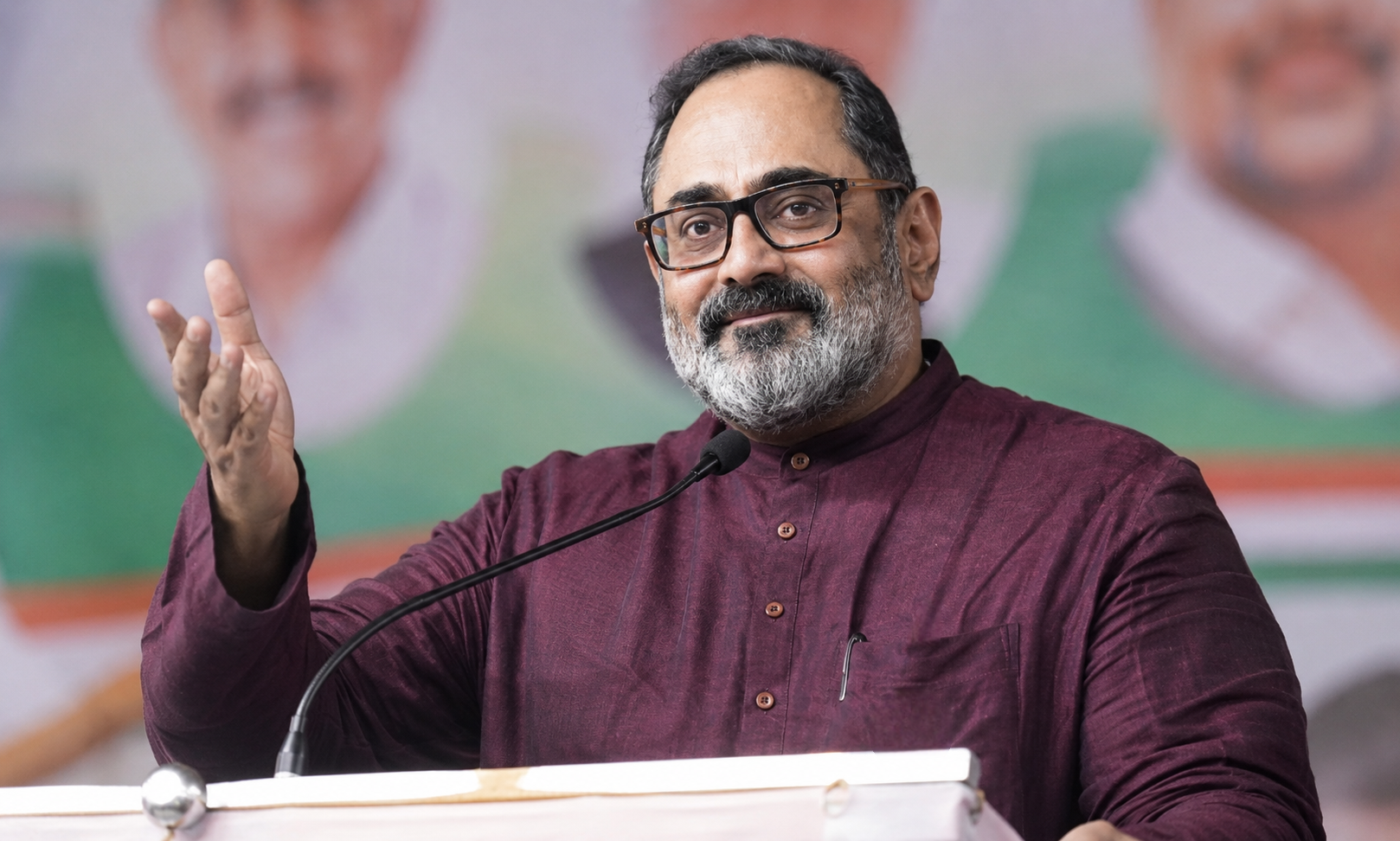
Rajeev Chandrasekhar
Indian Politician, Entrepreneur & Technocrat
Rajeev Chandrasekhar is an Indian politician, entrepreneur, and technocrat. He currently represents Nemom in the Kerala Legislative Assembly since 2026. He is also the state president of BJP Kerala. Rajeev Chandrasekhar was born to a Malayali family in Ahmedabad, Gujarat. His father, M. K. Chandrasekhar, was an Air Commodore in the Indian Air Force and a trainer of Rajesh Pilot, and his mother is Anandavalli Amma. His family hails from Desamangalam in the Thrissur district of Kerala. Rajeev Chandrasekhar studied at St. Paul’s Convent School in Thrissur and completed his schooling at Kendriya Vidyalaya in Bengaluru. He then studied electrical engineering at the Manipal Institute of Technology. He obtained his master’s degree in computer science in 1988 from the Illinois Institute of Technology in Chicago.
Key Facts
Full Name: Rajeev Chandrasekhar
Born: 31 May 1964
Native Place: Desamangalam, Thrissur, Kerala
Profession: Politician, Entrepreneur, Technocrat
Political Party: Bharatiya Janata Party
Current Position: MLA from Nemom, BJP Kerala State President
Former Ministerial Roles: Minister of State for Electronics & IT, Skill Development & Entrepreneurship, Jal Shakti
In the shifting landscape of modern India, where technology, politics, media, and entrepreneurship increasingly intersect, few public figures embody that convergence as completely as Rajeev Chandrasekhar. Long before India began speaking the language of startups, digital sovereignty, artificial intelligence, and data governance in Parliament, Chandrasekhar had already lived through the first generation of India’s technology revolution. He moved from engineering classrooms in the United States to India’s emerging telecom industry in the 1990s, built one of the country’s influential mobile businesses, entered the media ecosystem at a transformative moment, and eventually stepped into national politics with the confidence of a technocrat rather than the instincts of a traditional career politician.
Yet beneath the boardrooms, parliamentary debates, and television studios remains a deeply rooted Malayali identity. Though born in Ahmedabad and politically shaped across Bengaluru and Delhi, Rajeev Chandrasekhar has consistently framed Kerala as an emotional and cultural anchor in his life. Over the years, he evolved from a businessman with national reach into one of the most visible and outstanding Malayali political figures within the Bharatiya Janata Party’s southern strategy, carrying with him the vocabulary of innovation, governance, and economic aspiration.
The Making of a Technocrat
Rajeev Chandrasekhar’s early life reflected the disciplined mobility common to many Indian military families of the post-independence era. Born in 1964 to a Malayali family in Ahmedabad, he grew up under the influence of his father, Air Commodore M. K. Chandrasekhar of the Indian Air Force. The family’s roots traced back to Desamangalam in Kerala’s Thrissur district, but his upbringing unfolded across multiple Indian cities shaped by institutional culture, education, and public service.
Friends and associates who later worked with him often described him as carrying the mindset of an engineer even in politics: methodical, systems-oriented, impatient with inefficiency.
His schooling in Thrissur and Bengaluru exposed him to two very different Indias. Kerala offered political consciousness and intellectual culture. Bengaluru, then quietly transforming into India’s future technology capital, exposed him to modern engineering ambition.
At the Manipal Institute of Technology, he studied electrical engineering during a period when India’s technology ecosystem remained embryonic. But the defining intellectual shift came after he moved to the United States for higher education at the Illinois Institute of Technology, where he earned a master’s degree in computer science in 1988.
America in the late 1980s was witnessing the acceleration of personal computing, telecommunications, and software culture. For many young Indian engineers abroad, it was a glimpse into the future. Chandrasekhar absorbed not just technical education but the logic of innovation-driven capitalism that would later define his business career.
Building BPL Mobile and India’s Telecom Revolution
When Rajeev Chandrasekhar returned to India in the early 1990s, the country stood at the edge of economic liberalisation. Markets were opening. Foreign investment was increasing. Telecommunications, once dominated by state monopolies and waiting lists that stretched for years, was preparing for disruption.
After joining the BPL Group, founded by his father-in-law T. P. G. Nambiar, Chandrasekhar quickly emerged as one of the younger faces of India’s first-generation telecom entrepreneurs.
In 1994, he founded BPL Mobile, entering an industry that was risky, heavily regulated, and capital intensive. Mobile phones were still luxury devices in India. Connectivity itself symbolised aspiration.
BPL Mobile became one of the most recognised telecom brands of its time, particularly in Mumbai, one of India’s most competitive telecom circles. The company’s growth coincided with India’s transformation into a connected economy.
To understand the significance of BPL Mobile, one must remember the period. This was before smartphones, before affordable data, before digital payments and streaming platforms. Telecom entrepreneurs of the 1990s were not merely building businesses; they were laying the infrastructure for modern India’s information economy.
Chandrasekhar developed a reputation as a sharp negotiator and aggressive strategist within the sector. In 2005, he sold his majority stake in BPL Communications to the Essar Group in a deal valued at over a billion dollars, a landmark transaction in India’s telecom history.
The sale transformed him from entrepreneur to investor.
Investor, Media Strategist, and Institution Builder
Following the telecom exit, Chandrasekhar founded Jupiter Capital, positioning it as a diversified investment platform with interests across technology, infrastructure, hospitality, and media.
This phase revealed another dimension of his ambitions: influence through institutions.
His move into media proved especially consequential. Through investments in Asianet Communications and the later formation of Asianet Star Communications alongside News Corp, Chandrasekhar entered one of South India’s most politically influential industries.
Media ownership in Kerala has always carried political implications. Television news channels in the state shape ideological battles, public discourse, and electoral narratives with unusual intensity.
Under his broader business ecosystem emerged Asianet News Network, which expanded into Malayalam and Kannada media spaces. Later, his investment in Republic TV through ARG Outlier Media drew national attention and criticism alike, especially given the increasingly polarised nature of Indian television news.
Supporters viewed him as a strategic media thinker who understood the future of digital communication. Critics argued that his proximity to media networks raised concerns about political influence over news ecosystems.
Either way, his presence in Indian media became impossible to ignore.
Entry into Politics
Rajeev Chandrasekhar’s transition into politics did not follow the conventional Indian route of dynasty, mass agitation, or student activism. He entered Parliament through expertise.
In 2006, he became an Independent member of the Rajya Sabha representing Karnataka, backed by the National Democratic Alliance. Even then, his identity differed from traditional politicians. He positioned himself as a policy-focused parliamentarian interested in technology, economic reform, national security, and governance.
Over time, his ideological alignment with the BJP became clearer. In 2018, he officially joined the party.
Inside Parliament, Chandrasekhar built influence through committee work rather than mass theatrics. He participated in major legislative and policy discussions involving finance, technology regulation, data protection, GST reforms, and real estate legislation.
Unlike many television-centric politicians, he cultivated the image of a technocratic policymaker.
The Policy Mind
Rajeev Chandrasekhar’s ministerial years under Prime Minister Narendra Modi reflected the increasing centrality of technology in governance.
When he was inducted into the Union government in 2021 as Minister of State for Electronics and Information Technology, Skill Development, and Jal Shakti, the appointment appeared ideologically logical. Few ministers in India combined business, technology, investment, and policy experience as directly as he did.
He became closely associated with debates around digital governance, cybersecurity, data protection, online regulation, semiconductor manufacturing, startup ecosystems, and emerging technologies including artificial intelligence.
As a member of the Joint Parliamentary Committee examining the Data Protection Bill, Chandrasekhar emerged as a prominent voice arguing for India’s digital sovereignty and indigenous technology capability.
Supporters praised his understanding of startup culture and digital economics. Critics occasionally questioned aspects of the government’s approach toward internet regulation and platform governance during his tenure. But even critics generally acknowledged his fluency in technology policy, a rarity in Indian politics.
He often framed India’s digital future not merely as economic policy but as geopolitical strategy.
Kerala Politics and the Malayali Connection
For years, Rajeev Chandrasekhar remained politically influential in Delhi and Bengaluru while maintaining a relatively indirect relationship with Kerala’s electoral politics. That changed dramatically in the 2020s.
As the BJP intensified efforts to expand in Kerala, Chandrasekhar emerged as one of the party’s most recognisable Malayali faces. Unlike traditional BJP leaders in the state, he carried a cosmopolitan technocrat image that appealed particularly to urban professionals, entrepreneurs, and sections of aspirational middle-class voters.
His candidature in the 2024 Lok Sabha election from Thiruvananthapuram against Shashi Tharoor transformed into one of Kerala’s most closely watched political contests.
Though he narrowly lost, the campaign significantly elevated his visibility inside Kerala politics.
His later emergence as BJP Kerala state president and subsequent electoral victory from Nemom in the 2026 Assembly election marked a deeper transition: Rajeev Chandrasekhar was no longer merely a Delhi-based technocrat of Malayali origin. He had become a direct participant in Kerala’s ideological and electoral battles.
Leadership Style and Public Image
Rajeev Chandrasekhar’s political persona differs markedly from Kerala’s traditional mass leaders.
He speaks less like a street agitator and more like a boardroom strategist. His communication style emphasises efficiency, systems thinking, innovation, and economic opportunity. In a state where political rhetoric often revolves around ideological confrontation, Chandrasekhar introduced the language of startups, technology ecosystems, investment flows, and digital transformation.
Supporters see him as modern, articulate, globally exposed, and policy-driven. Critics argue that his corporate background sometimes creates distance from Kerala’s grassroots political culture.
His media presence also attracts scrutiny. Given his business interests and media associations, opponents have frequently questioned the overlap between influence, politics, and communication power.
Still, even critics acknowledge that he represents a distinctly new type of Malayali political figure: internationally networked, technologically fluent, and comfortable operating simultaneously across business, governance, and media.
Rajeev Chandrasekhar as an Outstanding Malayali
Kerala has historically produced intellectuals, administrators, entrepreneurs, and political leaders with global visibility. Rajeev Chandrasekhar belongs to a newer generation of Malayali achievers shaped not by migration alone, but by India’s liberalised economy and technological transformation.
His significance lies partly in symbolism. He represents a version of Malayali ambition deeply connected to technology, global markets, and policy innovation rather than only traditional politics or bureaucracy.
For many younger Malayalis, especially those working in engineering, startups, artificial intelligence, finance, and digital industries, Chandrasekhar’s journey carries aspirational resonance. He embodies the possibility that technical expertise can evolve into national influence.
At the same time, his increasing investment in Kerala politics reflects an attempt to reposition the state within broader conversations around economic modernisation and technological growth.
Whether one agrees with his politics or not, his role in bringing technology discourse into mainstream political conversation remains significant.
Legacy and Future
Rajeev Chandrasekhar occupies an unusual space in contemporary India.
He is simultaneously entrepreneur and policymaker, investor and parliamentarian, media strategist and political organiser. Few Indian politicians move so fluidly between the languages of technology, governance, capital, and ideology.
His long-term legacy will likely depend on two parallel questions. The first concerns India’s digital future: how policymakers of his generation shaped technology regulation, innovation ecosystems, and data governance during a transformative period. The second concerns Kerala politics itself, where he represents the BJP’s attempt to cultivate a more technocratic and aspirational political vocabulary.
For now, his story remains unfinished.
From the engineering classrooms of Chicago to Parliament debates in Delhi, from telecom towers in liberalising India to electoral battles in Kerala, Rajeev Chandrasekhar’s journey reflects the evolution of a changing nation itself: ambitious, networked, restless, and technologically driven. In that story, he stands as one of the most outstanding Malayali political and entrepreneurial figures of his generation, a man who built influence not through inheritance alone, but through reinvention across multiple worlds.
Awards and accolades
Honoured by Army’s Western Command GOC-in Commendation for his work for the Armed Forces and Veterans
India Today magazine ranked him #41st in India’s 50 Most Powerful People of 2017 list
2007 – IIT Global Service Award by Illinois Institute of Technology, Chicago
2013 – Honorary Doctor of Science by Visvesvaraya Technological University, Belgaum
2013 – Distinguished Alumnus Award by Manipal Institute of Technology
2016 – GOC-in-C Commendation by Indian Army Western Command