S. Jithesh
Indian performing speed cartoonist
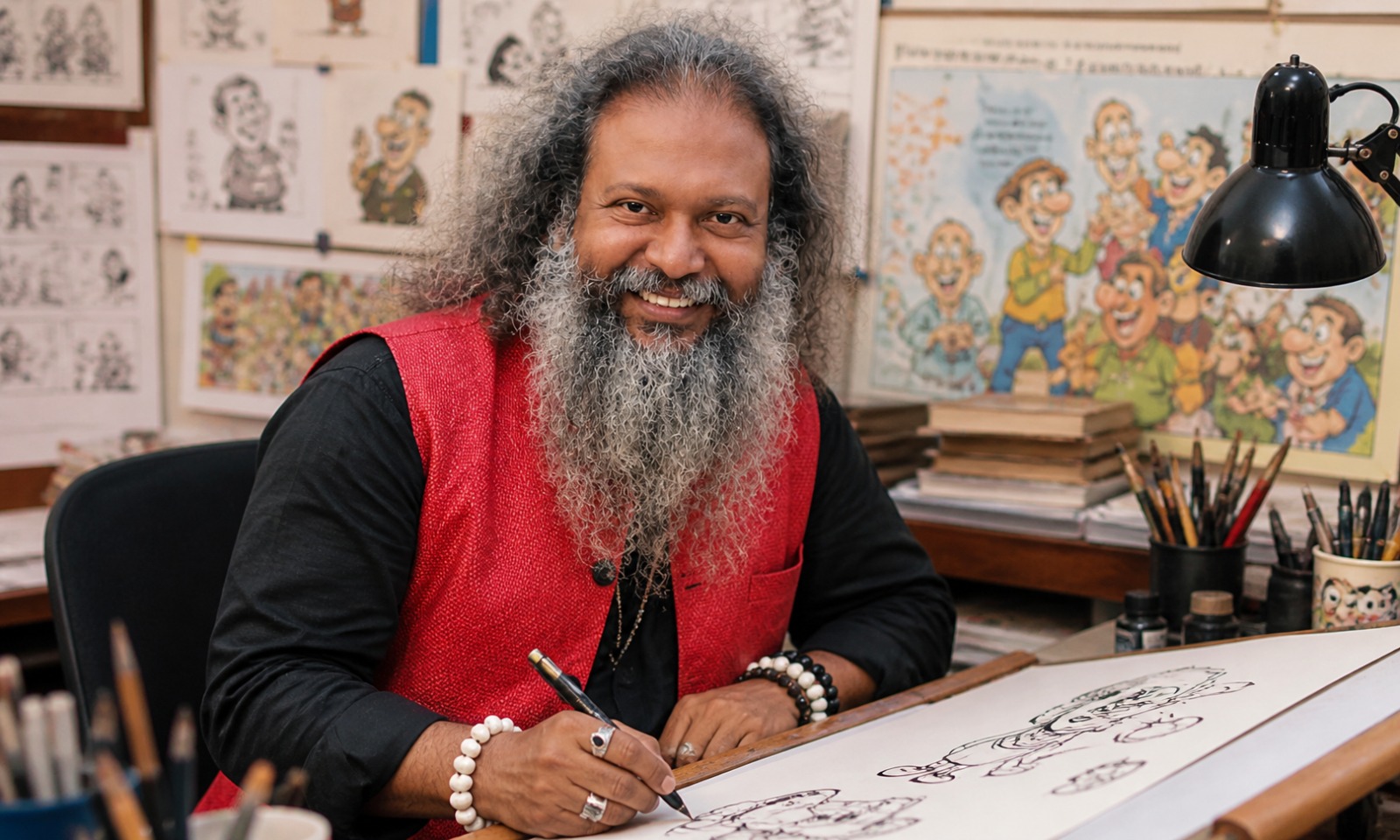
S. Jithesh (Sekhar Jithesh), popularly known as Dr. Jitheshji, is an Indian performing speed cartoonist and a former vice-chairman of the Kerala Cartoon Academy. He is considered the father of Speed Cartooning, having initiated and popularised concepts such as Speed Cartooning, Super-Speedy Cartooning, and Raptoon through his infotainment stage shows titled Varayarangu Raptoon Thriller.
Key Factors
Full Name: Sekhar Jithesh (S. Jithesh)
Date of Birth: 30 December 1974
Place of Birth: Pandalam, Pathanamthitta, Kerala, India
Titles/Recognitions: Performing Speed Cartoonist, “World’s Fastest Performing Cartoonist” (as widely described), Former Vice-Chairman, Kerala Cartoon Academy
Occupation: Cartoonist, Performer, Writer, Editor
Known For: Speed Cartooning, Varayarangu Raptoon Thriller, pictorial oratory, memory feats, global stage performances
The Making of an Unconventional Artist
Pandalam, a town steeped in tradition and ritual memory, is not an obvious birthplace for a new form of performance art. Yet, it is here that Jithesh’s story begins. Born to K. N. Somasekharan Nair and M. Remani Amma, his early life unfolded within a cultural environment where storytelling, oral traditions, and public discourse were integral to everyday life.
Unlike many artists who follow a linear creative path, Jithesh’s academic journey reflects a layered intellectual formation. He pursued law (LL.B), followed by a Master’s degree in English Literature, and later a D.Litt., an unusual trajectory for someone who would eventually redefine cartooning. This dual grounding in language and structure, narrative and logic, becomes crucial in understanding his later work.
Cartooning, for him, was never merely about visual expression. It was about communication, compression, and immediacy. Early influences likely came from Kerala’s strong tradition of political cartoons and satirical commentary, where artists have historically engaged with public life in sharp, visual ways. Jithesh absorbed this tradition but chose not to remain within its conventional boundaries.
Inventing Speed Cartooning: Art Meets Performance
What distinguishes Jithesh from other cartoonists is not just skill but format. He did not simply refine cartooning; he reimagined it.
The emergence of “Speed Cartooning” and later “Super-Speedy Cartooning” marked a shift from studio-based work to live performance. But the real innovation lies in his concept of Varayarangu Raptoon Thriller, a hybrid form that blends drawing with narration, satire, poetry, and cultural commentary.
In these performances, the act of drawing becomes secondary to the experience of witnessing it. Audiences are not just observers but participants in a shared intellectual space. As caricatures of well-known personalities emerge in seconds, they are accompanied by anecdotes, historical references, and socio-political insights.
This transformation of cartooning into a performative medium aligns it more closely with Kerala’s tradition of stage-based storytelling forms like Kathaprasangam or Chakyar Koothu, where narrative, humour, and critique coexist. Jithesh’s work can be seen as a contemporary extension of this lineage, adapted for modern audiences.
Claims about his speed, including the widely cited ability to sketch dozens of caricatures within minutes, have contributed to his public persona. While such feats are often highlighted as records, their real significance lies in how they sustain audience engagement in a live setting.
A Mind Like No Other
If speed defines his hand, memory defines his mind.
Jithesh has often been described as a “super memoriser,” capable of recalling vast amounts of information, from historical timelines to specific dates and events. His reputation as the “History Man of India” stems from his ability to connect each day of the year with historical significance, extending across centuries.
In his performances, memory is not presented as a separate skill but integrated seamlessly into the narrative. A caricature of a historical figure might lead into a brief discourse on a particular event, followed by a contemporary parallel.
This interplay between memory and performance raises an interesting question: is Jithesh primarily a cartoonist, or is he a knowledge performer using art as a medium? The answer likely lies somewhere in between. His work challenges traditional definitions of artistic identity, positioning him within a broader category of intellectual performers.
Global Performer and Cultural Ambassador
Over the course of his career, Jithesh has taken his performances beyond Kerala, conducting shows across India and in more than 20 countries. With over 10,000 stage performances, his reach reflects both consistency and adaptability.
Performing across cultures requires more than technical skill. It demands the ability to translate context, to make humour and satire accessible to diverse audiences. Jithesh achieves this by focusing on universal themes, human behaviour, politics, history, while retaining the distinct flavour of his Malayali sensibility.
In this sense, he functions as a cultural ambassador, not in a formal diplomatic sense, but through the transmission of a uniquely Kerala-born art form to global audiences.
The Digital Age and Mass Reach
Like many traditional performers, Jithesh has had to navigate the transition from physical stages to digital platforms. His presence on social media, particularly the milestone of crossing 20 million views on Instagram for his performances, indicates a successful adaptation.
Digital platforms, however, alter the nature of engagement. The immediacy of live performance is replaced by fragmented viewing, shorter attention spans, and algorithm-driven visibility. Yet, Jithesh’s format, visually dynamic, fast-paced, and layered with commentary, lends itself well to this environment.
His appearance as a speaker at TEDx KIIT University in 2024 further reflects this transition into broader intellectual spaces, where performance intersects with ideas.
Literary and Editorial Contributions
Beyond the stage, Jithesh has maintained a parallel engagement with writing and publishing. As the editor-in-chief of Chiricheppu, a monthly cartoon magazine, he has contributed to sustaining and shaping Kerala’s cartooning culture.
His literary works, spanning Malayalam and English, include poetry and instructional texts. Nakshathrangale Pranayicha Oraal, a poetry collection published in 1999, reflects a more introspective side of his personality. Meanwhile, works like Cartoon–Caricature Varakkaan Padikkan serve as practical guides, bridging the gap between art and pedagogy.
These contributions suggest that his engagement with cartooning is not limited to performance but extends into documentation and education.
The Performer, The Thinker, The Malayali
To understand Jithesh’s significance, one must place him within Kerala’s broader cultural framework. The state has long valued intellectual engagement, public discourse, and artistic experimentation. From political satire to literary movements, Kerala’s cultural history is marked by a willingness to question and reinterpret.
Jithesh’s work fits within this tradition while also pushing its boundaries. By combining satire, education, and performance, he creates a form that is both entertaining and thought-provoking.
Public perception of his work often oscillates between admiration for his speed and curiosity about his memory. Yet, beneath these surface-level attributes lies a deeper contribution: the redefinition of what cartooning can be.
Legacy and Continuing Relevance
Assessing Jithesh’s legacy requires looking beyond individual achievements to the form he has created. Speed cartooning, as he has conceptualised it, exists today as a distinct performance genre, one that future artists may adopt, adapt, or expand.
His influence on younger artists is likely to be less about imitation and more about possibility, the idea that art forms can be reinvented through interdisciplinary thinking.
As performance art continues to evolve in the digital age, blending visual, verbal, and intellectual elements, Jithesh’s work remains relevant. It anticipates a future where boundaries between art forms become increasingly fluid.
In the end, S. Jithesh stands not just as a cartoonist, but as an innovator who transformed a solitary craft into a shared experience. That transformation, grounded in skill, memory, and imagination, secures his place as an outstanding Malayali artist whose work continues to challenge and expand the contours of contemporary performance.