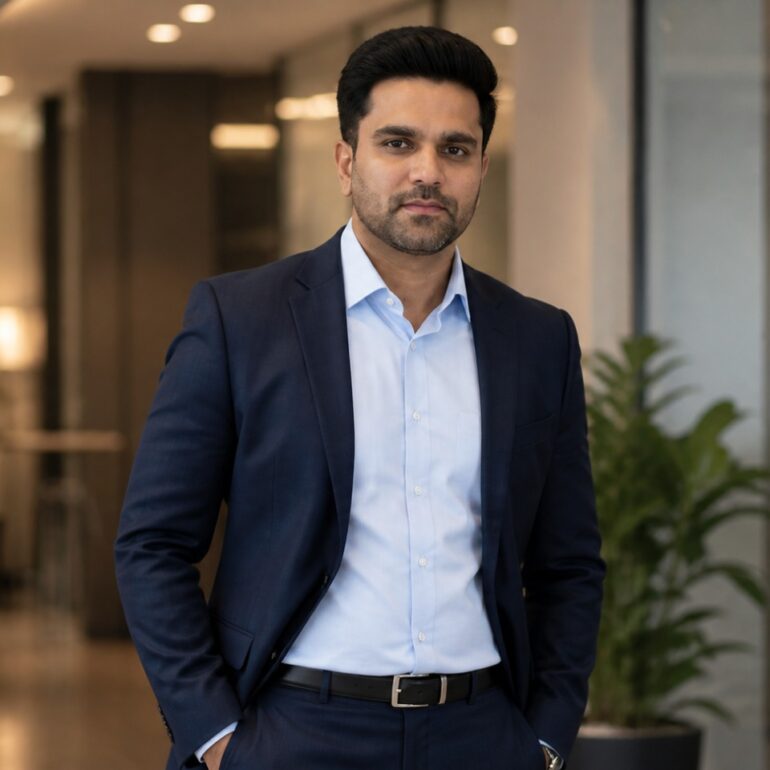

Vishnu RG
CEO & Executive Director, RG Group
Vishnu RG is the CEO and Executive Director of the Kerala-based RG Group, a third-generation business leader who has expanded the family’s traditional gingelly oil and food products business into a global brand. Under his leadership, RG Foods has grown to export to over 30 countries and introduced extensive new product lines. As CEO of the RG Group, founded in 1940 by Sri M. Gopalan, he manages diverse ventures including RG Foods, RG Marines, and Pride India Exports. He has expanded the company’s portfolio to over 80 products, expanding distribution to 26+ countries, and rebranded the company to focus on global markets. He has over 14 years of experience in the food industry, with an MBA in Marketing, and blends traditional manufacturing techniques with modern, state-of-the-art technology. He has appeared in business spotlights for taking traditional Kerala products like Milma to international markets and has overseen ventures into UK and Australian markets.
Key Factors
Full Name: Vishnu RG
Place: Kerala, India
Title: CEO & Executive Director, RG Group
Occupation: Business Leader, FMCG Entrepreneur
Known For: Scaling a traditional Kerala food business into a global export brand
Legacy and Origins
The story of RG Group begins in 1940 in Calicut, a coastal city that has long been a gateway for trade and cultural exchange in Kerala. Founded by Sri M. Gopalan, the company initially operated within the traditional framework of regional food production, focusing on gingelly oil, a staple in South Indian households.
At the time, food businesses in Kerala were largely localized, built on trust, quality, and community relationships rather than scale. RG’s early success followed this pattern. The brand grew steadily within the domestic market, establishing itself as a reliable name in edible oils.
Over the decades, the company evolved through generational leadership, adapting to changing market conditions while retaining its core identity. By the time Vishnu RG entered the business, RG Foods had already built a strong regional presence. What it lacked, however, was a structured push toward global expansion, something that would define its next phase.
Enter Vishnu RG: The Third-Generation Shift
Vishnu RG’s entry into the business marked a turning point rather than a continuation. Armed with an MBA in Marketing and over a decade of experience in the food industry, he approached the company with a perspective shaped by both academic training and industry exposure.
Unlike earlier generations that focused on consolidating regional markets, Vishnu’s vision extended outward. He recognized that Kerala’s food products, rooted in authenticity and cultural identity, had a natural demand among the global Indian diaspora.
His early years in the business appear to have been focused on understanding operational dynamics, supply chains, manufacturing processes, and distribution networks. This foundation allowed him to identify gaps not just in production, but in branding, packaging, and international positioning.
The transition into leadership was not abrupt but strategic, aligning modernization efforts with the company’s legacy strengths.
Scaling Tradition into a Global Brand
Under Vishnu RG’s leadership, RG Foods underwent a significant transformation from a regional player into an export-driven FMCG brand. The company expanded its product portfolio to over 80 items, covering a wide range of categories including oils, rice, breakfast mixes, frozen foods, and traditional Kerala snacks.
Exports grew to over 30 countries, spanning Europe, the GCC region, Australia, and New Zealand. The GCC market, in particular, emerged as a stronghold, with RG Foods reportedly commanding a significant share in the oil segment.
The expansion was not limited to product categories. Vishnu also diversified the group’s operations through ventures such as RG Marines and Pride India Exports, signaling a broader ambition to build a multi-sector business ecosystem.
Distribution became a key pillar of this growth. Domestically, RG Foods established a network of approximately 1.5 lakh retail outlets and over 450 distributors across Kerala. Internationally, partnerships with distributors enabled deeper market penetration.
Product Innovation and Market Strategy
One of the defining aspects of Vishnu RG’s strategy has been product diversification without diluting authenticity. While traditional products like gingelly oil and Palakkadan Vadi Matta rice remain central to the brand, the company has expanded into categories that cater to evolving consumer preferences.
This includes ready-to-cook and ready-to-eat products such as instant payasam mixes, ginger coffee, and frozen foods. These offerings are particularly relevant for global consumers seeking convenience without compromising on cultural familiarity.
Branding has also undergone a shift. Packaging, product positioning, and marketing have been redesigned to appeal to international markets, where consumer expectations differ significantly from domestic ones.
The strategy reflects a balance, maintaining the essence of Kerala’s culinary heritage while adapting to global consumption patterns.
Manufacturing Excellence and Certifications
Scaling a food business internationally requires more than market access; it demands adherence to stringent quality standards. RG Foods has invested in state-of-the-art manufacturing facilities equipped with automation and advanced processing technologies.
Certifications such as HACCP, US FDA, FSSC 22000, ISO 22000, WHO GMP, and AGMARK underscore the company’s commitment to quality and safety. These certifications are not merely compliance requirements but also serve as trust markers in global markets.
Consistency in product quality becomes critical when operating across diverse geographies. Automated systems and standardized processes help ensure that products maintain the same quality regardless of where they are consumed.
Market Dominance and Global Footprint
RG Foods’ strong presence in the GCC region is particularly notable. The Middle East has long been a key market for Indian food exporters, driven by a large expatriate population. However, competition in this segment is intense, with multiple brands vying for market share.
RG’s ability to establish a significant presence in this region reflects both product-market fit and effective distribution strategies. The company’s expansion into markets such as the UK and Australia further indicates its ambition to move beyond diaspora-driven demand into broader consumer segments.
Strategic partnerships with international distributors have played a crucial role in this expansion, enabling the company to navigate regulatory requirements and local market dynamics.
Leadership Style and Business Philosophy
Vishnu RG’s leadership style appears to be grounded in pragmatism and long-term thinking. Rather than pursuing rapid, high-risk expansion, his approach emphasizes steady growth, operational efficiency, and brand consistency.
A key aspect of his philosophy is the integration of traditional manufacturing techniques with modern technology. This balance allows the company to preserve authenticity while achieving scalability.
Risk management also plays a significant role. Entering new markets and product categories involves uncertainties, but Vishnu’s strategy suggests a measured approach, expanding incrementally while ensuring operational stability.
Challenges and Competitive Landscape
The FMCG sector, particularly in the food segment, is highly competitive both domestically and globally. Indian brands face competition not only from local players but also from multinational corporations with significant resources.
For RG Foods, maintaining authenticity while scaling presents a unique challenge. As production volumes increase, ensuring that products retain their traditional characteristics becomes more complex.
Supply chain management is another critical factor. Sourcing raw materials, maintaining quality, and managing logistics across international markets require robust systems and constant oversight.
Regulatory compliance adds another layer of complexity, with different countries imposing varying standards for food safety and labeling.
Vision 2030
Looking ahead, Vishnu RG’s Vision 2030 outlines an ambitious roadmap for global expansion. The goal is to make Kerala’s traditional food products accessible worldwide while strengthening the brand’s position in existing markets.
This involves not just increasing export volumes but also expanding product categories and improving distribution networks. Investments in technology, supply chain infrastructure, and branding are likely to play a key role in achieving these objectives.
The vision also reflects a broader shift in India’s FMCG sector, where regional brands are increasingly seeking global relevance.
Reflection
Vishnu RG’s journey is emblematic of a larger transformation within India’s family-run businesses, where legacy is no longer a constraint but a foundation for global ambition. By reimagining RG Foods as an export-driven brand, he has demonstrated that traditional products can find relevance in modern markets when supported by strategy, quality, and execution.
In an industry where scale often comes at the cost of identity, his approach offers a different blueprint, one that prioritizes authenticity alongside growth. It is an outstanding example of how regional heritage can evolve into a global enterprise without losing its core.