
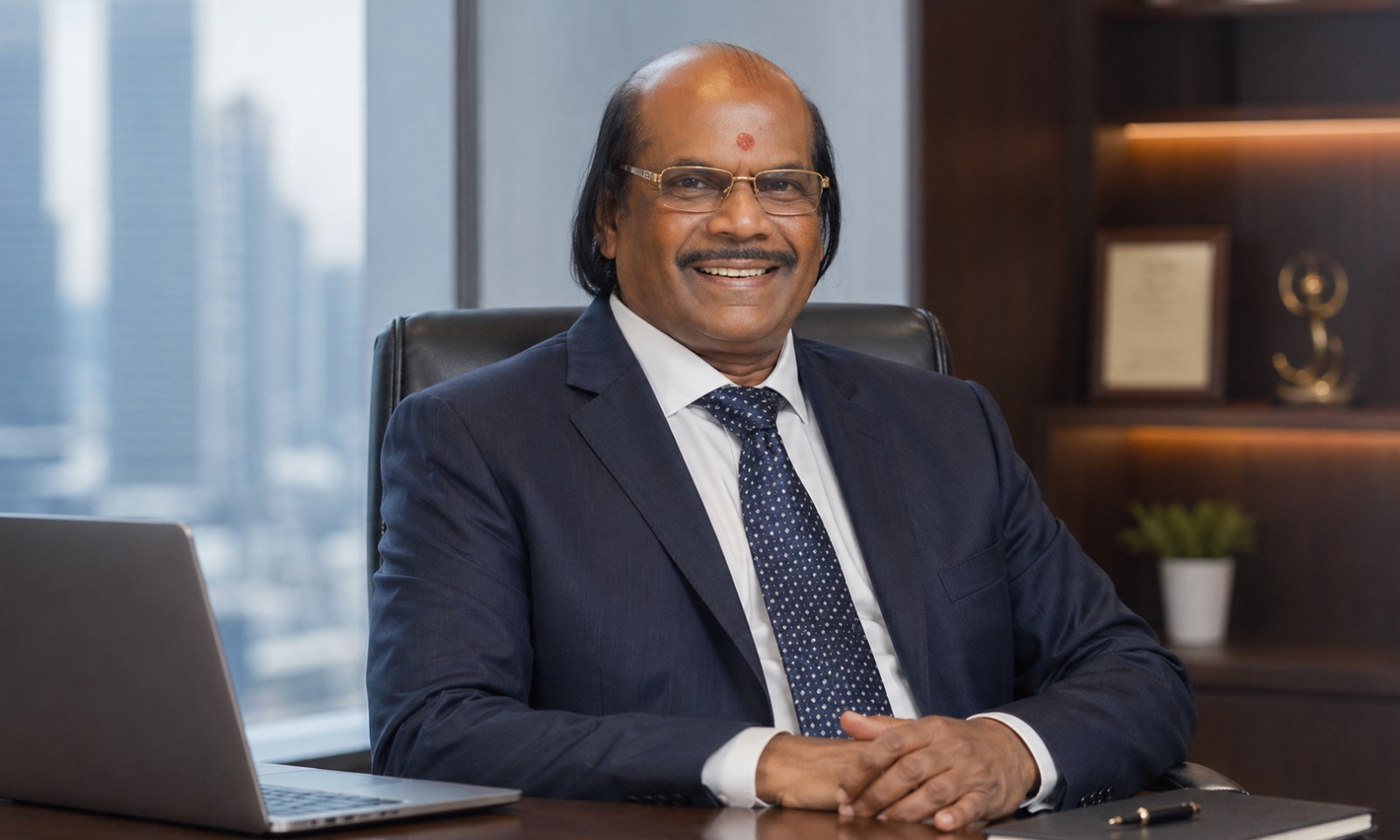
M. P. Ramachandran
Founder and Chairman Emeritus of Jyothy Labs
Moothedath Panjan Ramachandran is an Indian businessman from Thrissur, Kerala. He is the Founder and Chairman Emeritus of Jyothy Labs. He has completed his B.Com degree from St. Thomas College, Thrissur. In India’s crowded fast-moving consumer goods market, where multinational giants dominate shelves and advertising budgets, a handful of homegrown brands have rewritten the rules of scale. M. P. Ramachandran, founder of Jyothy Labs, belongs to that group. Starting with a small, improvised product in the early 1980s, he built a company that challenged established players through distribution discipline and frugal innovation. His journey from Thrissur to national prominence is not just a story of entrepreneurship, but of understanding the Indian consumer at a granular level. It stands as an outstanding example of how insight, persistence, and execution can reshape an industry from the margins.
Key Factors
Full Name: M. P. Ramachandran
Born: 1944 (widely reported)
Place: Thrissur, Kerala, India
Education: B.Com from St. Thomas College Thrissur
Title: Founder & Chairman Emeritus, Jyothy Labs
Occupation: Industrialist, Entrepreneur
Known For: Building a leading FMCG company from a small-scale venture
A Modest Beginning in Kerala
Thrissur in the 1950s and 60s was not a city of industrial ambition. It was a town shaped by trade, education, and a strong middle-class ethos. For M. P. Ramachandran, growing up here meant absorbing values of discipline, thrift, and self-reliance.
His family background did not offer immediate access to capital or industrial networks. What it did provide was a mindset grounded in practicality. Like many from Kerala’s middle class, education was seen as both a necessity and a pathway.
At St. Thomas College Thrissur, where he completed his B.Com, Ramachandran gained formal exposure to commerce. But the more significant lessons were informal, how to think about value, cost, and opportunity in everyday life.
The Spark: A Problem at Home
The origin story of Jyothy Labs is often traced to a simple domestic observation. Ramachandran was dissatisfied with the fabric whiteners available in the market at the time. The products were inconsistent, and their application was often cumbersome.
This dissatisfaction led to experimentation. Using basic materials and guided by the principle of the “blueing” agent, a traditional method of enhancing the whiteness of fabrics, he began developing his own formulation.
These experiments, conducted in a kitchen setting, were not backed by formal R&D infrastructure. They were iterative, trial-and-error processes. The goal was not innovation for its own sake, but solving a practical problem.
This phase highlights a recurring pattern in Indian entrepreneurship, products emerging from lived experience rather than abstract market research.
The Leap into Entrepreneurship
Before committing fully to entrepreneurship, Ramachandran moved to Mumbai, then Bombay, a city that functioned as India’s commercial nerve center. There, he worked as an accountant while simultaneously studying financial management.
This period was critical. It exposed him to structured business environments, financial systems, and the realities of urban markets. It also reinforced a key tension, the stability of employment versus the uncertainty of entrepreneurship.
Leaving a steady job to pursue a small-scale venture required both conviction and a tolerance for risk. For Ramachandran, the decision was not driven by external validation but by belief in the product he had developed.
Birth of Jyothy Labs
In 1983, with a loan of ₹5,000 from his brother, Ramachandran set up a small manufacturing unit. The company was named after his daughter, giving it a personal anchor.
The early operations were modest. Production was small-scale, packaging was basic, and distribution relied on direct engagement with retailers. The product, later branded as Ujala, entered a market dominated by established players.
Margins were thin, and volumes were limited. But the focus was clear, consistent quality and affordability.
This stage of the business underscores a fundamental principle in FMCG, distribution matters as much as the product. Without access to shelves, even a superior product cannot scale.
Building a Brand from Scratch
The rise of Ujala Supreme, the flagship brand of Jyothy Labs, is central to Ramachandran’s story. Unlike traditional fabric whiteners, Ujala offered ease of use and consistent results.
The product’s distinctive blue liquid and small packaging made it both recognizable and affordable. More importantly, it was positioned for mass consumption, particularly in rural and semi-urban markets.
Ramachandran’s approach to distribution was unconventional for its time. Instead of relying solely on large distributors, the company built a network that penetrated deep into smaller markets. This grassroots strategy allowed Ujala to reach consumers often overlooked by larger FMCG companies.
Advertising also played a role, though initially limited by budget constraints. Over time, as revenues grew, the brand invested in broader campaigns, reinforcing its identity.
Expansion and Business Strategy
From a single-product company, Jyothy Labs gradually expanded into a diversified FMCG player. The portfolio grew to include detergents, dishwashing products, insect repellents, and personal care items.
This expansion was not immediate. It followed a phased approach, leveraging the distribution network built through Ujala. Each new product category required adjustments in manufacturing, marketing, and supply chain management.
The company also pursued acquisitions, a strategic shift that marked its transition into a larger corporate entity. Competing with multinational FMCG giants required both scale and brand recognition.
Yet, even as the company expanded, it retained a focus on value-driven products, targeting price-sensitive consumers without compromising on quality.
Leadership Style and Philosophy
Ramachandran’s leadership style is often described as frugal and disciplined. Unlike many entrepreneurs who prioritize rapid expansion, he emphasized sustainable growth.
Decision-making was guided by practicality rather than hype. Investments were measured, and risks were calculated. This approach helped the company navigate periods of uncertainty.
Equally important was his relationship with employees and distributors. In FMCG, these networks form the backbone of operations. Maintaining trust and consistency within these relationships contributed to the company’s stability.
Challenges and Turning Points
Building a national FMCG brand is inherently competitive. Jyothy Labs faced challenges from established multinational companies with deeper pockets and wider reach.
Scaling operations introduced complexities in logistics, quality control, and brand management. Each phase of growth required adjustments in strategy.
One of the critical turning points was the company’s ability to maintain its core identity while expanding into new categories. Balancing diversification with brand coherence is a common challenge in FMCG, and Jyothy Labs navigated it with varying degrees of success.
Legacy and Current Role
As Chairman Emeritus, Ramachandran has stepped back from day-to-day operations, allowing the next generation to lead. This transition reflects a broader trend in Indian family-run businesses, where leadership continuity is managed within the family structure.
His role now is more advisory, providing strategic guidance while the company adapts to evolving market conditions.
Impact and Significance
M. P. Ramachandran’s contribution to India’s FMCG sector lies in demonstrating that scale can be built from simplicity. A product developed in a kitchen evolved into a national brand through disciplined execution.
His journey also highlights the role of regional entrepreneurship in shaping national markets. Companies like Jyothy Labs challenge the dominance of larger players by focusing on underserved segments.
For emerging entrepreneurs, the lessons are clear, understand the consumer, build distribution, and grow sustainably.
A Quiet Architect of Scale
M. P. Ramachandran’s story does not rely on dramatic pivots or sudden breakthroughs. It is a narrative of incremental progress, built on observation, experimentation, and persistence.
In an industry often driven by advertising and brand perception, his approach emphasizes substance, product quality, distribution strength, and operational discipline.
That approach may lack spectacle, but it has delivered enduring results. And in its quiet consistency, his journey remains an outstanding example of how Indian entrepreneurship can scale from the most modest of beginnings.