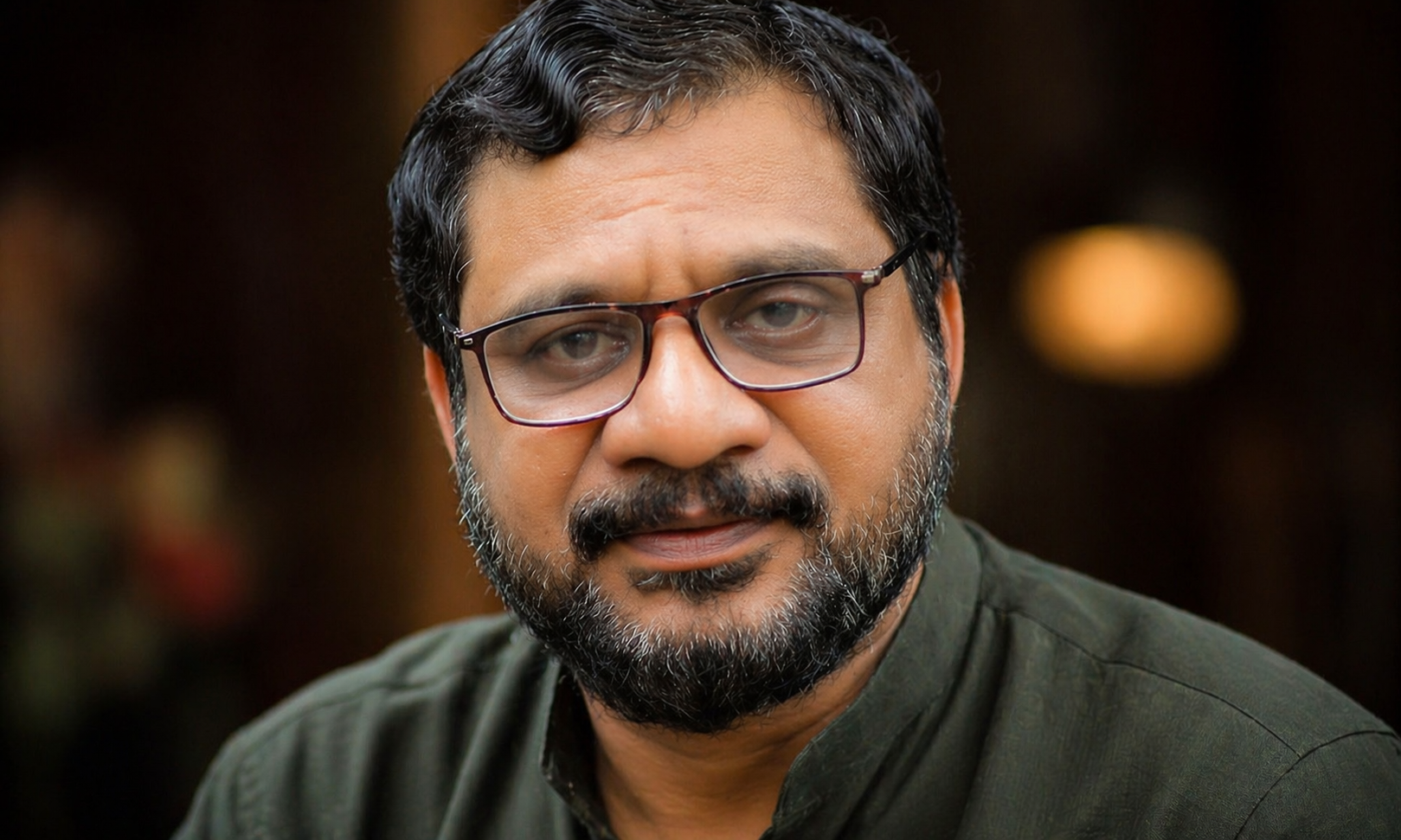
Rafeeq Ahammed
There is a moment in Malayalam cinema when the narrative pauses, not to stop, but to breathe. A character looks out, rain falls, memory intrudes, and then the words arrive, quietly, almost as if they were always there. In songs like “Ente Kannil Ninakkai” or “Lailakame,” Rafeeq Ahammed does not merely describe emotion, he translates its texture. His lines rarely demand attention. They settle into the listener, unfolding gradually, revealing layers over time. This is his outstanding gift, an ability to write lyrics that feel both immediate and enduring, rooted in everyday language yet carrying a poetic resonance that lingers long after the music fades.
Born: 17 December 1961 (age 64)
Place: Thrissur, Kerala, India
Education: Sree Krishna College, Guruvayur
Title: Poet, Lyricist, Novelist
Years active: 1997–present
A Language Formed in Quiet Spaces
Rafeeq Ahammed was born in Kerala, in an environment where language and culture are deeply intertwined. His upbringing was shaped not by spectacle, but by an intimate familiarity with everyday life, landscapes, conversations, and silences.
Kerala’s literary tradition, rich with poets, storytellers, and essayists, formed an implicit backdrop to his formative years. But Rafeeq’s sensibility appears less influenced by grand literary gestures and more by observation.
His early engagement with poetry emerged from this attentiveness.
He wrote before he became known, exploring themes that would later define his work, memory, longing, the passage of time, and the subtle emotional shifts within ordinary experiences. The influence of Malayalam poetic traditions is evident, but his voice developed through a process of refinement rather than imitation.
There is a restraint in his writing that suggests an early understanding, that language is most powerful when it does not try too hard.
Entry into Malayalam Cinema: Finding a Voice Within Structure
Rafeeq Ahammed’s transition into Malayalam cinema was not immediate or inevitable.
Film lyricism demands a different discipline from poetry. It requires alignment with narrative, character, rhythm, and melody. Words must serve not only meaning but also music.
His breakthrough came through collaborations with composers and filmmakers who recognized his ability to balance poetic depth with accessibility. Early songs established him as a lyricist capable of writing within cinematic constraints without losing his literary identity.
This transition is crucial. Many poets struggle to adapt to film, either diluting their voice or resisting the medium’s demands. Rafeeq managed to negotiate this space with precision, retaining his sensitivity while embracing the collaborative nature of cinema.
Over time, he became a recurring presence in Malayalam film music, not as a dominant stylistic force, but as a consistent one.
Signature Style and Poetic Language: Simplicity as Craft
What defines Rafeeq Ahammed’s writing is not complexity, but clarity.
His language is deceptively simple. It avoids ornamentation, yet carries emotional weight. This simplicity is not a limitation. It is a deliberate aesthetic choice.
His recurring themes include:
- Love, not as spectacle, but as quiet intimacy
- Longing, often tied to memory and absence
- Nature, not as backdrop, but as emotional extension
- Spiritual undertones, subtle and unforced
He frequently uses imagery drawn from everyday life, rain, wind, light, familiar landscapes. These elements function as emotional anchors, grounding abstract feelings in tangible experience.
Rhythm plays a crucial role. His lyrics are closely attuned to melody, allowing words to flow naturally within musical structures. This creates a sense of ease, where the listener does not feel the effort behind the writing.
Yet, beneath this ease lies precision. Each word is placed with care, creating layers of meaning that reveal themselves over repeated listening.
Landmark Songs and Collaborations: Lyrics as Narrative Extension
Rafeeq Ahammed’s body of work includes numerous songs that have become integral to Malayalam cinema’s emotional landscape.
In films like Mayaanadhi, songs such as “Mizhiyil Ninnum” capture the fragility of relationships, using minimal language to convey complex emotional states. The lyrics do not explain the characters. They echo them.
In Charlie, “Akale” reflects a sense of wandering, both physical and emotional, aligning seamlessly with the film’s narrative tone.
His collaboration with composers like Gopi Sundar has produced songs that balance contemporary sound with lyrical depth. With M. Jayachandran, his work often leans toward classical and melodic richness.
What distinguishes these songs is their integration into storytelling. They do not interrupt the narrative. They extend it.
The lyrics become a parallel voice, articulating what remains unsaid within the film’s dialogue.
Poetry Beyond Cinema: A Quieter, More Interior Voice
Beyond cinema, Rafeeq Ahammed continues to write poetry, a space where his voice shifts subtly.
Freed from the constraints of melody and narrative, his poems often become more introspective, more elliptical. The themes remain consistent, memory, time, and emotional transience, but the expression becomes less direct.
There is a greater willingness to embrace ambiguity. His poetry does not seek immediate accessibility. It invites reflection, sometimes requiring the reader to engage more actively with the text.
This dual identity, lyricist and poet, creates an interesting dynamic. In cinema, he simplifies without losing depth. In poetry, he allows complexity to unfold without compromise.
Shaping the Sound of Contemporary Malayalam Cinema
Rafeeq Ahammed belongs to a generation of lyricists who have shaped the sound of contemporary Malayalam cinema.
Following the legacy of figures like O. N. V. Kurup and Vayalar Ramavarma, he represents a shift toward more understated, introspective lyricism.
His work aligns with broader changes in Malayalam cinema, where narratives have become more character-driven and emotionally nuanced.
Younger lyricists often reflect similar tendencies, a preference for simplicity, emotional subtlety, and conversational tone.
In this sense, Rafeeq’s influence is both direct and atmospheric.
The Risk of Repetition
No body of work is without limitation.
In Rafeeq Ahammed’s case, the very qualities that define his strength, simplicity, restraint, emotional consistency, can also lead to repetition.
Certain images recur.
Rain, distance, silence, longing.
While these motifs are central to his aesthetic, their frequent use can create a sense of familiarity that borders on predictability.
There is also the tension between commercial demands and literary ambition.
Film lyricism requires adaptability, and not every song allows for depth. In such cases, his work occasionally leans toward functional writing rather than distinctive expression.
These critiques do not diminish his contribution. They contextualize it.
The Art of Staying Quietly Present
Rafeeq Ahammed’s enduring relevance lies in his ability to remain consistent without becoming static.
He adapts, subtly, responding to shifts in music, cinema, and audience sensibilities, while retaining a core identity.
His lyrics continue to resonate because they do not overwhelm. They accompany.
They create space for the listener to inhabit emotion rather than simply receive it.
In a cultural moment increasingly defined by excess, his restraint feels deliberate, almost necessary.
His legacy is not one of dramatic transformation, but of sustained presence, a body of work that accumulates meaning over time, quietly shaping how Malayalam cinema sounds and feels.
It is an outstanding contribution, not because it dominates attention, but because it understands how to linger, gently, persistently, in the spaces where language meets music and becomes memory.
Awards
Literary awards
2014 – Odakkuzhal Award for Rafeeq Ahammedinte Kavithakal
2006 – Kerala Sahitya Akademi Award for Alamara
2000 – Olappamanna Memorial Award for Paarayil Pathiinjathu
Edappally Award
Kunchupilla Award
Kanakasree Award
Vailoppilli Award
2017 – P. Kunjiraman Nair Award
Ulloor Award
2019 – Swathi-Ayyappa Panicker Literary Award
2024 – Padmaprabha Literary Award
Film awards
2007 – Kerala State Film Award for Best Lyricist (Pranayakalam)
2009 – Kerala State Film Award for Best Lyricist (Sufi Paranja Katha)
2010 – Kerala State Film Award for Best Lyricist (Sadgamaya)
2010 – Filmfare Award for Best Lyricist – Malayalam (Anwar)
2010 – Vanitha Film Awards for Best Lyrics
2012 – Kerala State Film Award for Best Lyricist (Spirit)
2012 – Amrita Film Award for Best Lyrics
2012 – Filmfare Award for Best Lyricist – Malayalam
2012 – Asianet Film Award for Best Lyrics (Ustad Hotel)
2012 – Vanitha Film Awards for Best Lyrics (Spirit, Diamond Necklace)
2013 – Amrita Film Award for Best Lyrics (Oru Indian Pranayakatha)
2014 – Asianet Film Award for Best Lyrics (How old are you?)
2015 – Kerala State Film Award for Best Lyricist (Ennu Ninte Moideen)
2015 – Asianet Film Award for Best Lyrics
2015 – Filmfare Award for Best Lyricist – Malayalam
2015 – Vanitha Film Awards for Best Lyrics
2017 Asianet Film Award for Best Lyrics (Thondimuthalum Driksakshiyum, Munthirivallikal Thalirkkumbol)
2018 – Vanitha Film Awards for Best Lyrics (Odiyan)
2019 – Kerala Film Critics Association Awards for Best Lyrics (Syamaragam)
2022 – Kerala State Film Award for Best Lyricist (Viddikalude Mash)