
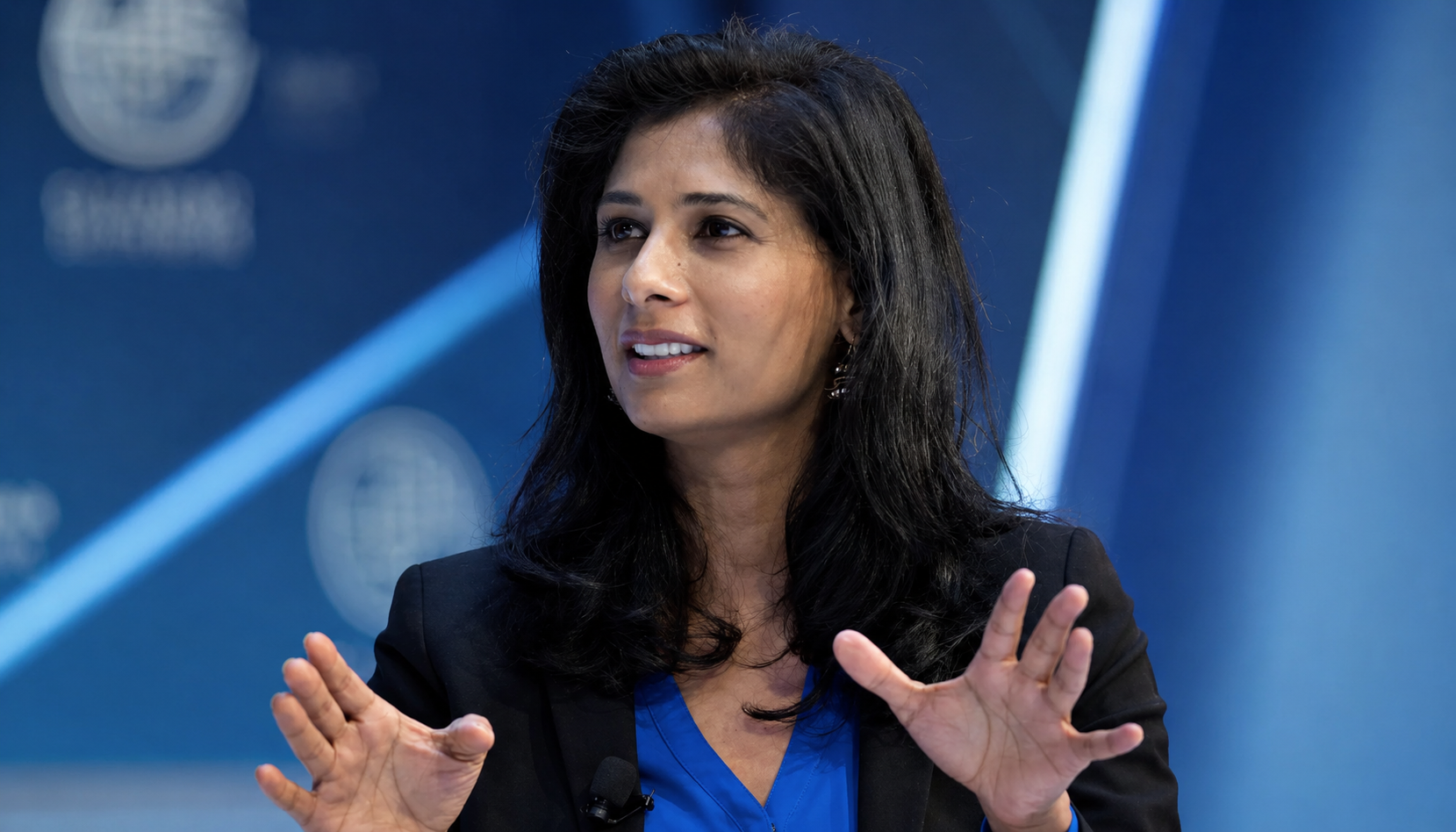
Gita Gopinath
Born: 8 December 1971 (age 54)
Place: Kolkata, West Bengal, India
Citizenship: United States

The Moment Policy Became Urgent
In early 2020, the numbers stopped behaving like numbers. Growth projections collapsed in weeks, unemployment surged across continents, and the global economy entered a synchronized contraction not seen in decades. Inside the International Monetary Fund, forecasts were being rewritten almost in real time. At the center of this recalibration was Gita Gopinath, then Chief Economist, tasked with translating unprecedented uncertainty into policy guidance. Her message was clear and unusually forceful for an institution often associated with caution, spend more, act faster, and do not withdraw support too early. It was an outstanding moment in modern economic policymaking, where orthodoxy gave way to urgency, and the cost of inaction became the central risk.
From Kerala to Global Economics
Gita Gopinath’s intellectual trajectory begins in India, with roots in Kerala and formative years shaped by a middle-class environment that valued education as both discipline and opportunity.
She studied at Lady Shri Ram College, part of Delhi University, where economics was not just a subject but an entry point into understanding systems, markets, and global interdependence.
Her academic path then moved to the United States, first to the University of Washington and later to Princeton University, where she completed her PhD under leading economists in international macroeconomics.
This progression matters. Her training combined rigorous theoretical grounding with exposure to global economic debates. She entered the field at a time when questions of globalization, capital mobility, and exchange rate dynamics were central to policy discussions.
Her early influences included economists working on open economy macroeconomics, shaping her focus on how countries interact within a global financial system.
Rise in Academia: Establishing Intellectual Authority
Before entering policymaking, Gopinath built her reputation in academia.
At Harvard University, she served as a professor of economics, specializing in international finance and macroeconomics. Her research focused on exchange rates, capital flows, sovereign debt, and the dynamics of global financial integration.
One of her key contributions lies in understanding how exchange rate movements affect trade and pricing, challenging simplified assumptions about currency depreciation automatically boosting exports.
Her work also engaged with the concept of dominant currency pricing, particularly the role of the US dollar in global trade. This insight has significant implications, suggesting that exchange rate adjustments may have less immediate impact on trade balances than traditional models predict.
Within academic circles, she was regarded as a rigorous and influential economist, someone capable of bridging theory and policy relevance.
Historic Role at the IMF: Breaking and Entering Power Structures
In 2019, Gita Gopinath was appointed Chief Economist of the IMF, the first woman to hold the position in the institution’s history.
The significance of this appointment was both symbolic and structural.
Symbolically, it marked a shift in representation within a field historically dominated by male economists from Western institutions.
Structurally, it placed her at the center of global economic policymaking, responsible for shaping the IMF’s analytical framework and flagship publications, including the World Economic Outlook.
In 2022, she transitioned to the role of First Deputy Managing Director, effectively becoming the second-in-command at the IMF. This expanded her influence beyond analysis into broader institutional strategy and operations.
Her rise reflects both individual merit and gradual institutional change within global financial governance.
Economic Thought and Policy Influence: Between Theory and Action
Gopinath’s policy influence is grounded in her academic work but adapted to real-world constraints. Her approach emphasizes:
- The importance of fiscal policy in stabilizing economies
- The limits of monetary policy alone in crisis situations
- The interconnectedness of global markets
She has been a strong advocate for coordinated policy responses, particularly during periods of systemic stress. Her work at the IMF has shaped discussions on:
- Global debt sustainability
- Inflation dynamics in post-crisis recovery
- The future of globalization amid geopolitical tensions
Through reports like the World Economic Outlook, her influence extends beyond the IMF to governments, central banks, and financial institutions worldwide.
The COVID-19 Moment: Redefining Policy Boundaries
The COVID-19 pandemic represented a defining moment in Gopinath’s career.
Her policy stance was clear and consistent, governments should deploy aggressive fiscal stimulus to prevent economic collapse.
This marked a departure from earlier IMF positions, which had often emphasized fiscal discipline, particularly in developing economies. Her argument rested on several points:
- The shock was exogenous and global
- Private sector demand had collapsed
- Premature austerity would deepen the recession
She also emphasized the need for targeted support, particularly for vulnerable populations and small businesses. However, this approach was not without risk.
Large-scale fiscal expansion raised concerns about rising public debt and future inflation, issues that would later become central to global economic debates.
Style of Leadership and Communication: Translating Complexity
One of Gopinath’s distinguishing strengths is her ability to communicate complex economic ideas clearly.
Her public speeches and interviews avoid excessive jargon while retaining analytical depth. This balance is critical in policymaking, where communication influences expectations, markets, and public perception.
She operates at the intersection of academia and policy, translating theoretical insights into actionable frameworks. Her leadership style reflects this duality.
It is analytical, data-driven, but also responsive to real-time developments.
The Limits of Multilateralism
Working within the IMF involves navigating inherent tensions.
The institution itself has been criticized for its role in enforcing austerity measures in developing countries, particularly during debt crises.
While Gopinath’s tenure has seen a shift toward more flexible fiscal approaches, the IMF remains constrained by its structure, member state interests, and political realities. Critics argue that:
- Global financial governance still reflects power imbalances
- Policy recommendations may not fully account for local conditions
- Debt sustainability frameworks can impose long-term constraints on growth
Gopinath’s role, therefore, involves balancing intellectual conviction with institutional limitations.
Representation and Legacy: Beyond Symbolism
As an Indian woman in one of the most influential positions in global finance, Gopinath represents a shift in visibility.
However, her significance extends beyond representation.
Her career demonstrates that expertise, rather than identity alone, shapes influence. She occupies a space where analytical rigor and policy relevance intersect.
For aspiring economists, particularly from emerging economies, her trajectory expands the perceived boundaries of possibility.
Navigating an Unstable Global Economy
The challenges facing the global economy are increasingly complex.
Inflationary pressures, rising debt levels, and geopolitical fragmentation are reshaping the landscape in which institutions like the IMF operate. Gopinath’s role will involve addressing:
- The balance between inflation control and growth
- Debt restructuring for vulnerable economies
- The future of globalization in a fragmented world
These issues do not have straightforward solutions. They require navigating trade-offs, between stability and growth, national priorities and global coordination.
Economics in Motion
Gita Gopinath’s career reflects a broader transformation in global economic thinking.
She operates within systems that are both influential and constrained, shaping policy while responding to forces beyond any single institution’s control.
Her contribution lies not in definitive answers, but in reframing questions, how to respond to crisis, how to balance fiscal responsibility with social need, how to adapt economic models to changing realities.
It is an outstanding example of economics in motion, where theory meets urgency, and decisions made in moments of uncertainty shape outcomes that extend far beyond them.
Honours
2014 – Named one of the top 25 economists under 45 by the International Monetary Fund
2011 – Young Global Leader by the World Economic Forum
2016 – The 2017 Distinguished Alumna at the University of Washington
2018 – Elected a fellow of the American Academy of Arts and Sciences at Harvard University
2018 – Elected a fellow of the Econometric Society in November
2019 – Named one of the Top Global Thinkers in Foreign Policy
2019 – Pravasi Bharatiya Samman by the President of India Ram Nath Kovind
2021 – “25 most influential women of the year” named by Financial Times
The Schumpeter-Haberler Distinguished Fellow by The International Economic Association
John Kenneth Galbraith Award by The Agricultural & Applied Economics Association
Carnegie Corporation named her among “Great (American) Immigrants”
The Bloomberg named her “50 people who defined 2019”
“Women who Broke Major Barriers to Become Firsts” by Time magazine
2021 – selected by the Carnegie Corporation as a “Great Immigrant, Great American”