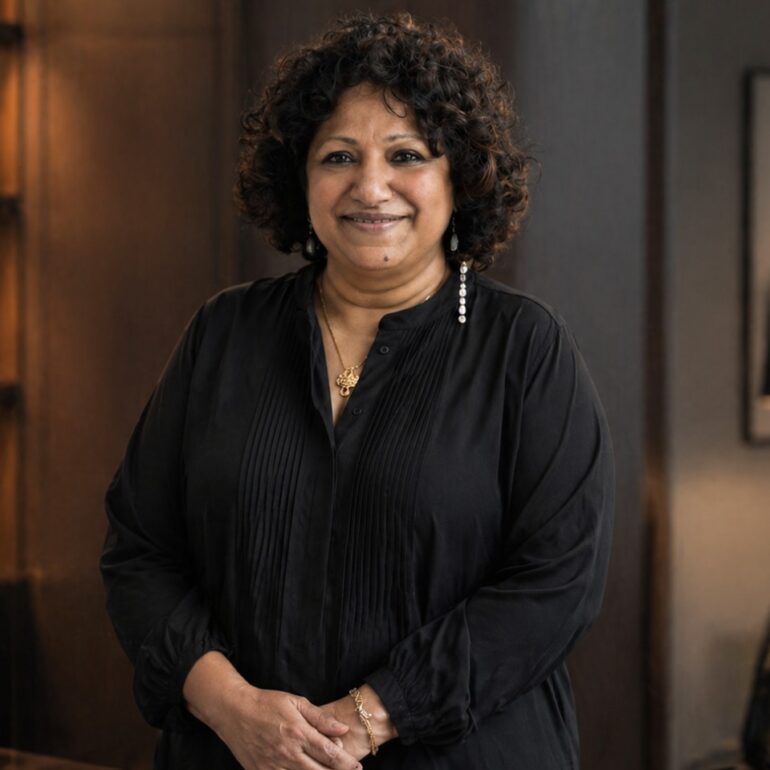

Methil Devika
Indian classical dancer, research supervisor and actress
Born: 1976 (age 49–50)
Place: Dubai, United Arab Emirates
Education: Rabindra Bharati University, Kolkata (Master of Arts), University of Madras (Master of Business Administration), Bharathidasan University, Tiruchirappalli (Doctor of Philosophy)
Title: Performing artist, Researcher
Known for: Indian classical dance, Mohiniyattam
A Movement That Refuses Ornament
The movement begins almost invisibly, a shift of weight, a curve of the torso that gathers intention before it becomes visible. Methil Devika does not rush the gesture. In Mohiniyattam, time stretches, and in her interpretation, it stretches further, allowing each transition to register fully before the next emerges. The eyes do not merely follow the hand; they anticipate, resist, and then align. What appears delicate is, in fact, rigorously controlled. It is an outstanding recalibration of a form often mistaken for softness alone. Devika’s dance does not decorate the space. It interrogates it, asking what the body remembers, what it carries, and what it chooses to reveal.
An Intellectual Grounding of the Body
Methil Devika’s journey into dance did not follow a singular, uninterrupted path.
Born in Kerala, she grew up in an environment where education and cultural exposure coexisted, but not necessarily in ways that immediately aligned with a full-time artistic career. Her academic trajectory is notable, she studied commerce, pursued management, and later engaged deeply with performing arts.
This multi-disciplinary background is not incidental. It shaped the way she approaches dance, not just as performance but as inquiry.
Her formal training in Mohiniyattam came under established gurus, grounding her in the traditional grammar of the form. Yet, even in these early stages, her engagement was not purely imitative. There was a visible tendency to question, to understand the logic behind movement rather than replicate it.
This intellectual orientation would later define her as both a practitioner and a thinker.
Mohiniyattam and Its Reinvention: Between Grammar and Inquiry
Mohiniyattam, historically associated with the temple traditions of Kerala, is often described through its defining qualities, lasya (grace), circular movements, and restrained expressiveness.
However, the form itself has undergone multiple reconstructions, particularly in the 20th century, when it was codified and institutionalized.
Devika enters this history at a moment where the form is both stabilized and open to reinterpretation.
Her approach is not to disrupt Mohiniyattam’s grammar, but to expand its possibilities.
She questions:
- What constitutes femininity within the form?
- How does the body carry narrative beyond codified gestures?
- Can stillness be as expressive as movement?
In her work, the circularity of Mohiniyattam becomes less ornamental and more conceptual. The body does not merely trace patterns; it explores internal states.
This shifts the focus from external beauty to internal experience.
The Scholar-Performer: Theory as Practice
Methil Devika’s academic work is central to understanding her artistic practice.
She holds a doctoral degree in dance, with research that engages deeply with the history, structure, and philosophy of Mohiniyattam. Her scholarship does not exist separately from her performance. It informs it.
This dual role, as scholar and performer, places her within a lineage of artists who treat dance as both embodied knowledge and intellectual pursuit.
Her research interrogates:
- The historical narratives that shaped Mohiniyattam
- The politics of codification and institutionalization
- The ways in which gender is constructed within classical forms
In performance, these inquiries translate into choices, how a gesture is held, how a narrative is framed, how silence is used.
The result is work that feels considered rather than instinctive, even when it appears fluid.
Innovation and Interdisciplinary Work: Expanding the Frame
Devika’s work extends beyond conventional stage performance.
Projects like Sarpatatwam explore the body through metaphor, in this case, the serpent, not as symbol alone but as movement logic. The spine becomes central, the flow continuous, the boundaries between human and non-human blurred.
Her engagement with dance films introduces another dimension. The camera allows for intimacy, framing details that stage performance cannot isolate.
One of her notable explorations involves integrating Indian Sign Language with classical mudras. This is not a superficial fusion. It raises questions about communication, accessibility, and the limits of codified gesture systems.
Such interdisciplinary work positions her within contemporary performance discourse, where boundaries between forms are increasingly fluid.
Performance Career and Global Presence: Carrying the Form Outward
Methil Devika has performed across major festivals in India and internationally, representing Mohiniyattam on global stages.
Her performances are often received with a combination of curiosity and recognition. For audiences unfamiliar with the form, her work offers an entry point that is both accessible and intellectually layered.
For those within the tradition, it presents a reinterpretation that invites debate.
Her role as a cultural ambassador is not limited to performance. It involves contextualizing the form, explaining its history, and situating it within broader artistic conversations.
In this sense, she carries not just choreography but discourse.
Art, Identity, and the Contemporary Woman: Reframing Femininity
Mohiniyattam has often been framed as a “feminine” dance form, emphasizing grace, softness, and restraint.
Devika complicates this framing.
Her work suggests that femininity within dance is not a fixed category but a constructed one. By altering emphasis, slowing transitions, or intensifying gaze, she introduces elements of strength, tension, and ambiguity.
Her performances often resist the expectation that the female body in classical dance must be pleasing.
Instead, they present the body as:
- A site of memory
- A carrier of cultural codes
- A space of negotiation
This aligns her work with broader feminist discourses in performance, though she rarely positions it in explicitly political terms.
Critical Perspective: Between Admiration and Debate
Methil Devika’s work has been widely appreciated for its depth and innovation, but it has also invited critique.
Some practitioners argue that her reinterpretations risk moving too far from traditional aesthetics, potentially alienating audiences rooted in classical expectations.
Others see her work as essential to keeping the form alive, preventing it from becoming static.
This tension is not unique to her. It reflects a broader debate within Indian classical arts, how to balance preservation with evolution.
What distinguishes Devika is her willingness to engage with this tension directly, rather than resolve it.
A Form in Motion
Methil Devika’s contribution to Mohiniyattam lies not in redefining it entirely, but in opening it.
She has expanded the range of what the form can express, both physically and conceptually. Her role as a mentor and educator ensures that these ideas extend beyond her individual practice.
For younger dancers, her work offers a model that integrates discipline with inquiry, suggesting that tradition is not a boundary but a framework.
As classical dance continues to navigate contemporary contexts, questions of relevance, audience, and interpretation remain central.
Devika’s trajectory suggests that these questions do not weaken the form. They sustain it.
Her legacy is still unfolding, but it is already clear that she has contributed to a shift in how Mohiniyattam is understood, not just as a visual tradition, but as a thinking body of knowledge.
It is an outstanding and necessary evolution, one that ensures the form remains alive, responsive, and capable of speaking to the present without losing its connection to the past.
Awards and honours
National awards
2007 – Ustad Bismillah Yuva Puraskar for Mohiniyattam
2010 – Devadasi Award from the Minister of Orissa
State honours
2011 – Kerala Sangeetha Nataka Akademi Award
2020 – Kshetrakala Akademy Award
2010 – Empanelled into SPIC‐MACAY (Society for the Promotion of Indian Classical Music and Culture Amongst Youth)
2016 – Best Dancer Award of the Mid‐Year Fest from Madras Music Akademy
2022 – Dakshinamurthy Puraskar along with Pandit Hariprasad Chaurasia and Sivamani
2023 – The Avanavan Kadamba award by Kavalam Samskriti
Devika’s archival film was voted into the Academy Awards Contention List 2018.
She is empanelled artiste for Mohiniyattam at the Indian Council for Cultural Relations.