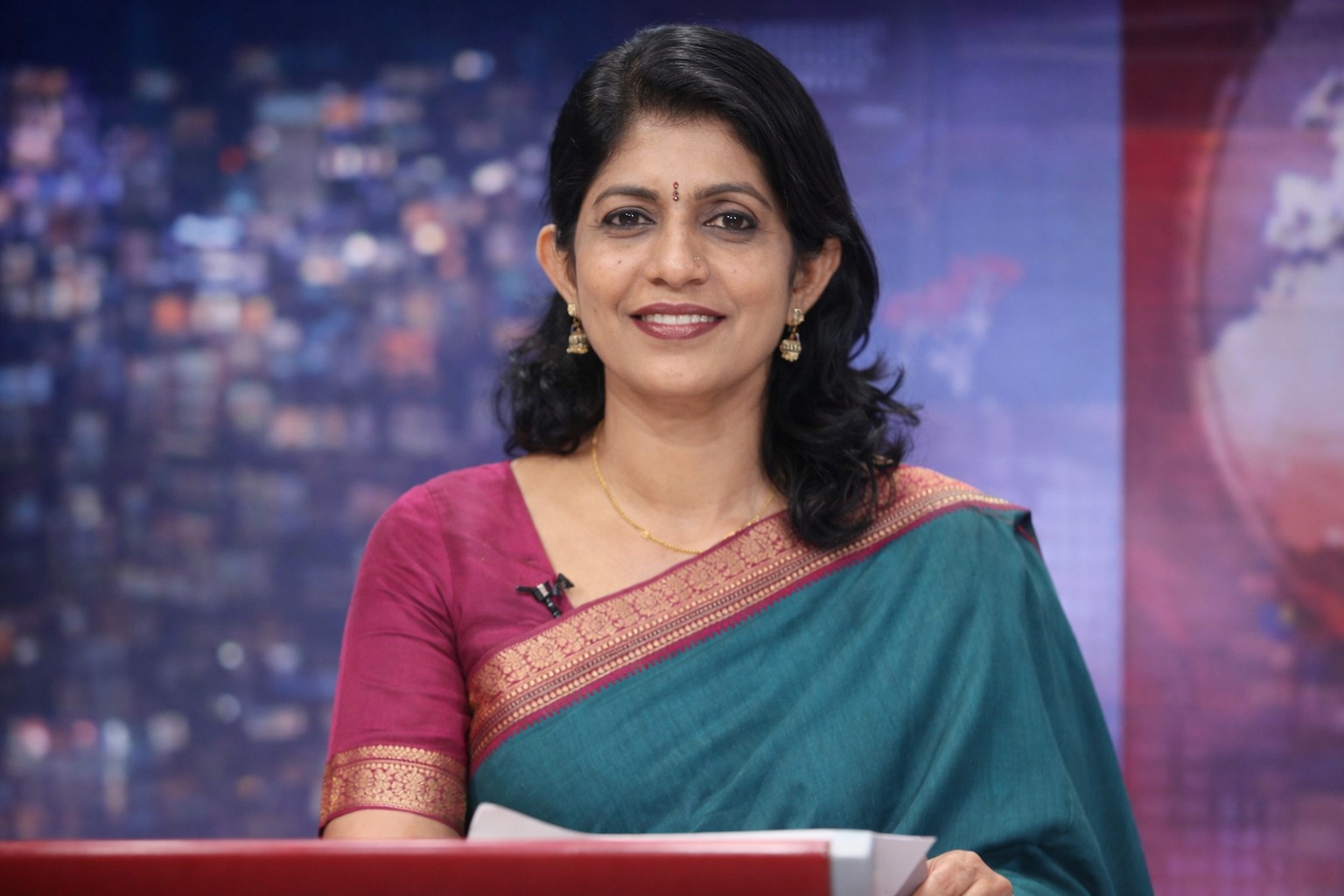
Alakananda
senior journalist, news anchor, and television presenter
Place: Kerala, India
Profession: Television Journalist, News Anchor
Known For: Anchoring and presenting analytical news programs on Asianet News
Title: Senior Malayalam Television Journalist
Notable Program: Lokajalakam
The Discipline of Live Television
The red light comes on without warning.
In a live newsroom, there is no rehearsal that can fully prepare you for the moment when the script changes mid-sentence, when breaking news cuts through a carefully structured bulletin. The anchor does not pause. The voice steadies, the eyes remain fixed, and the shift happens seamlessly, from prepared text to controlled improvisation. In that moment, the anchor becomes the system. Alakananda has built her career in precisely this space, where authority is measured not by volume but by composure. It is an outstanding form of presence, quiet, consistent, and calibrated for trust in a medium where credibility is fragile and attention is fleeting.
A Profession with Few Public Traces
Unlike public figures in entertainment or politics, many news anchors operate with limited biographical visibility. Alakananda belongs to this category.
Details about her early life and education are not widely documented in public sources, which is not unusual in Malayalam television journalism. The profession often prioritizes institutional identity over individual narrative, with anchors becoming familiar faces without fully disclosed personal histories.
What can be inferred is her entry into television journalism through a process that typically involves a combination of language proficiency, training in media communication, and on-screen testing. Malayalam news channels, particularly established networks, maintain rigorous standards for diction, clarity, and neutrality.
Her transition into newsreading suggests a foundation in these skills. The early phase of such careers is often defined by adaptation, learning to manage live broadcasts, teleprompter pacing, and editorial coordination under time pressure.
In this sense, her entry is less about a singular breakthrough and more about sustained integration into a demanding system.
Rise in Asianet News: Becoming a Recognizable Voice
Asianet News is one of Kerala’s most influential television news networks, known for its wide reach and competitive newsroom culture.
Within such an environment, visibility is earned through consistency.
Alakananda’s association with Asianet News positioned her within a high-pressure, high-visibility ecosystem. Over time, she became a familiar presence to viewers, particularly through programs such as Lokajalakam, where presentation extends beyond straightforward bulletin reading into more engaged storytelling.
Her rise is not marked by dramatic shifts but by accumulation. Regular appearances, steady delivery, and the ability to maintain composure across varying news cycles contributed to audience recognition.
In Malayalam television, where viewers often develop long-term relationships with anchors, familiarity translates into trust.
Signature Style and On-Screen Presence: Control as Credibility
What distinguishes Alakananda’s on-screen presence is restraint.
Her delivery is measured, avoiding both excessive dramatization and mechanical flatness. This balance is critical in news broadcasting, where tone must align with content without overwhelming it.
- Voice and Modulation
Her voice maintains a steady cadence, with clear articulation and controlled emphasis. Key information is highlighted without exaggeration, allowing viewers to process content without distraction.
- Visual Composure
Eye contact with the camera, posture, and minimal gestures contribute to a sense of stability. In live television, these elements are not incidental. They are part of the anchor’s credibility.
- Engagement Without Intrusion
Programs like Lokajalakam require a degree of engagement beyond traditional newsreading. Here, Alakananda adapts by introducing subtle conversational elements while maintaining professional distance.
Audience perception of her style often centers on clarity and reliability. She does not seek to dominate the broadcast. She facilitates it.
Beyond Newsreading: Expanding the Role
The role of a modern news anchor extends beyond reading scripts.
While detailed public documentation of Alakananda’s off-screen responsibilities is limited, industry practices suggest involvement in aspects such as:
- Script review and editorial coordination
- Understanding visual cues and broadcast flow
- Maintaining presentation standards
There are also indications of her engagement with cultural activities, including classical dance. This aligns with a broader pattern in Kerala’s media landscape, where anchors often have artistic backgrounds that inform their sense of rhythm, expression, and stage presence.
Such intersections between art and journalism are not always visible on screen, but they influence performance.
The Evolution of Malayalam News Anchoring: From Reading to Presence
Malayalam news anchoring has undergone significant transformation over the past three decades.
Earlier formats emphasized formal reading, anchors delivering news with minimal variation in tone or expression. The focus was on neutrality and linguistic precision.
With the expansion of private news channels and 24-hour broadcasting, the role evolved.
Anchors became:
- Interpreters of breaking news
- Moderators of discussions
- Participants in live debates
Presentation styles adapted accordingly. Visual design, graphics, and pacing became more dynamic.
In this context, anchors like Alakananda represent a transitional model. She retains the clarity and discipline of traditional newsreading while adapting to the demands of contemporary broadcasting.
Her work reflects a balance between continuity and change.
Visibility and Scrutiny
Television journalism operates under constant scrutiny.
For female anchors, this scrutiny often extends beyond professional performance to appearance, demeanor, and public perception.
Maintaining credibility requires navigating multiple pressures:
- The demand for accuracy in fast-moving news cycles
- Audience expectations for clarity and engagement
- Public commentary, increasingly amplified by social media
In Kerala’s media environment, where viewers are highly engaged and critical, anchors must sustain both linguistic precision and editorial integrity.
The challenge lies in balancing visibility with credibility. Excessive personalization can undermine authority, while excessive detachment can reduce engagement.
Alakananda’s approach leans toward controlled visibility, maintaining a clear boundary between professional presence and personal exposure.
Familiarity as Trust
In television journalism, legacy is often informal.
It is measured less by awards and more by recall, how quickly a viewer recognizes a face, how instinctively they associate it with credibility.
Alakananda’s presence on Asianet News has contributed to this form of recognition. She is part of a group of anchors who have shaped the visual and vocal identity of Malayalam news over time.
For aspiring journalists, such figures represent both aspiration and standard. The profession demands not just knowledge but performance, the ability to translate information into accessible, reliable communication.
Her career demonstrates that longevity in this field depends on consistency rather than visibility alone.
The Quiet Authority of Continuity
In an era where media is increasingly fragmented, where attention shifts rapidly between platforms and formats, the role of a television news anchor remains both fragile and essential.
Alakananda’s career does not rely on dramatic reinvention. It is built on repetition, refinement, and the steady accumulation of trust.
Her work reflects a particular kind of authority, one that does not assert itself loudly but remains present, day after day, bulletin after bulletin.
It is an outstanding form of continuity, a reminder that in journalism, credibility is not created in singular moments but sustained over time, through discipline, clarity, and the quiet ability to hold the viewer’s attention without demanding it.