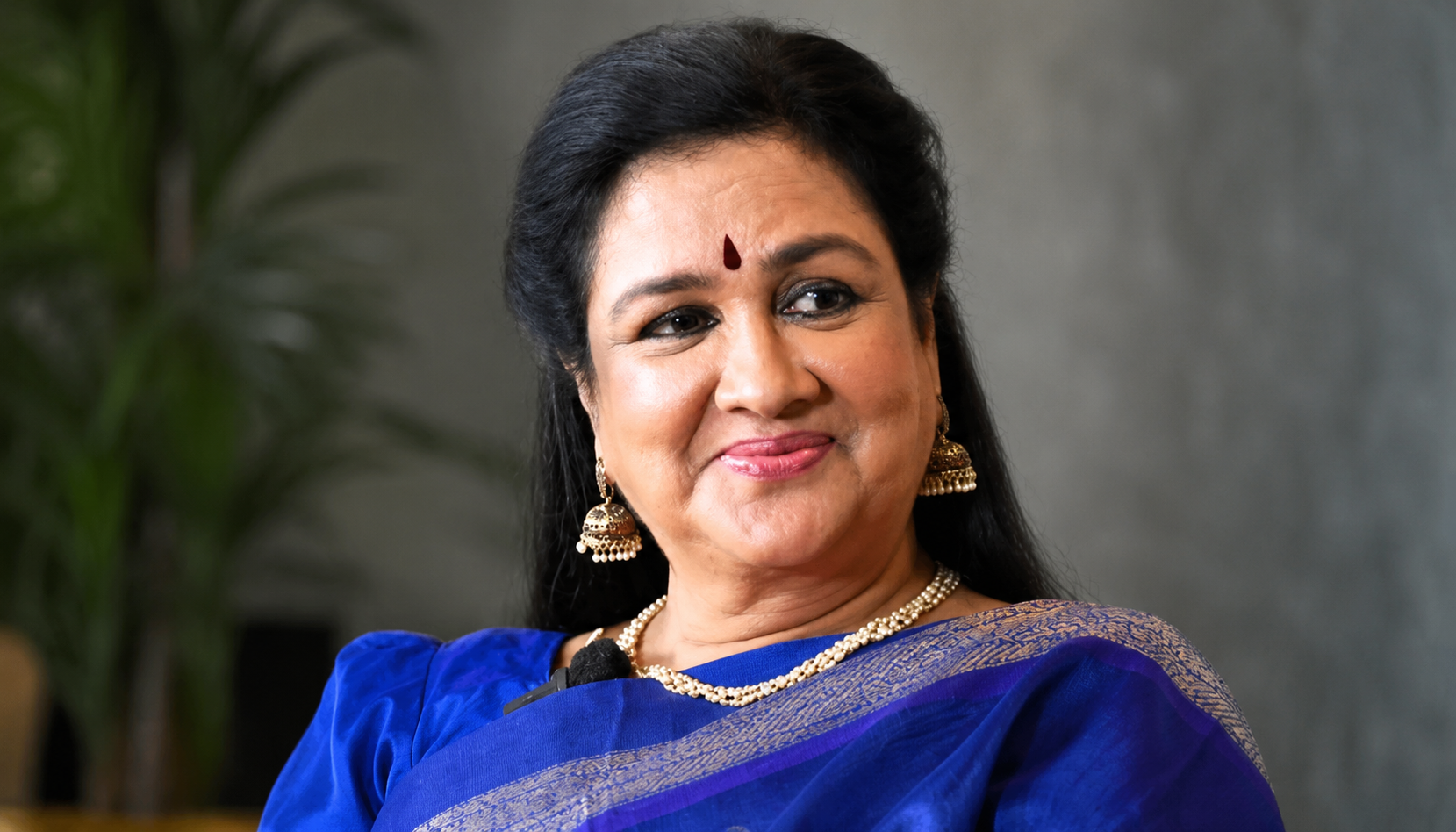
Urvashi
The South Indian Actress
Real Name: Kavitha Ranjini
Born: 6 September 1969 (age 56)
Place: Kollam, Kerala, India
Title: Actress
A Moment That Feels Too Real to Be Acting
There is a moment in Achuvinte Amma where a mother breaks, not in a dramatic outburst, but in a quiet collapse of certainty. Her voice trembles, her eyes search for something to hold on to, and for a few seconds, the performance disappears into something uncomfortably real. That is where Urvashi operates, in the space where acting stops announcing itself. It is an outstanding ability, to make performance feel like memory rather than construction. Across decades, languages, and genres, Urvashi has built a career not on spectacle, but on precision, the ability to inhabit the emotional rhythms of ordinary lives with extraordinary clarity.
Growing Inside the Industry
Urvashi was born as Kavitha Ranjini in 1969 into a family already connected to cinema. Her sisters, Kalaranjini and Kalpana, were also actors, and the household was shaped by performance, rehearsal, and the practical realities of the film industry.
Her entry into cinema came early, first as a child artist and then, gradually, into more substantial roles. This transition is often difficult, many child actors struggle to redefine themselves, but Urvashi navigated it with unusual ease.
The timing of her emergence is important. Malayalam cinema in the late 1970s and early 1980s was undergoing a shift toward more grounded storytelling, with directors focusing on realism, character depth, and social context. This environment allowed actors like Urvashi to develop performances that were not restricted to glamour or archetype.
She did not arrive as a fully formed star. She grew into one, within a system that valued performance.
Rise to Stardom: The 1980s–1990s Arc
The 1980s marked Urvashi’s transition into a leading actress, and by the early 1990s, she had become one of the most recognizable faces in Malayalam cinema.
Her collaborations with actors like Mohanlal and Mammootty placed her at the center of the industry’s most important narratives. But unlike many leading actresses of the time, her presence was not defined by conventional romantic roles alone.
Films such as Thanthram (1988), Mazha Peyyunnu Maddalam Kottunnu (1986), and Kadinjool Kalyanam (1991) showcased her ability to balance humor with emotional weight.
She became particularly associated with comedy, but this categorization is misleading. Her performances in comedic roles were rooted in character rather than exaggeration. She did not “perform comedy” in a separate register. She allowed humor to emerge from the situation and the character’s logic.
This distinction is crucial. It is what prevented her work from becoming dated.
The Mechanics of Naturalism
Urvashi’s acting is often described as “natural,” but this term requires unpacking.
- Dialogue and Rhythm
Her dialogue delivery is conversational, often slightly off-beat, mimicking the irregular rhythms of real speech. She does not emphasize lines for effect unless the moment demands it.
- Physicality
Her body language is unforced. Small gestures, a shift in posture, a glance held a second longer than expected, carry meaning.
- Comic Timing
Her comic timing is precise, but it is never mechanical. She reacts rather than performs, allowing humor to arise organically.
- Emotional Range
What distinguishes her is the ability to move between registers without visible transition. A scene can shift from humor to vulnerability within seconds, and she navigates this shift without signaling it.
In Achuvinte Amma, for example, she constructs a character through accumulation, small moments that build toward emotional intensity rather than relying on singular dramatic peaks.
Her performances often feel incomplete in the best sense, as if the character continues beyond the frame.
Language as Medium, Not Barrier
Urvashi’s work extends beyond Malayalam cinema into Tamil, Telugu, and Kannada industries.
In Tamil cinema, she took on roles that required a different tonal balance, often adapting to more stylized narratives while retaining her core naturalism. Her performances in films like Michaela and later character roles demonstrated her ability to recalibrate without losing identity.
In Telugu and Kannada cinema, she often appeared in supporting roles, but even within limited screen time, her presence was distinct.
Language, for Urvashi, is a technical adjustment, not a barrier. She adapts diction, intonation, and cultural cues without altering the internal logic of her performance.
Compared to contemporaries like Revathi or Shobana, who often balanced performance with strong star personas, Urvashi leaned more consistently toward character immersion.
Interruption and Return
Urvashi’s career has not been linear.
Personal challenges, including a highly publicized marriage and subsequent separation, affected both her public image and professional trajectory. There were periods where her visibility in cinema reduced.
However, her return to the screen was marked not by an attempt to reclaim earlier stardom, but by reinvention.
She transitioned into character roles, often portraying mothers, older women, and complex supporting characters. In films like Soorarai Pottru, her performance as a grounded, emotionally resilient mother stands out for its restraint.
This phase of her career demonstrates a shift in strategy. Rather than competing within a younger star system, she repositioned herself within narratives that required depth and experience.
Awards, Recognition, and Critical Acclaim: Sustained Respect
Urvashi has received multiple recognitions, including the National Film Award for Best Supporting Actress for Achuvinte Amma (2005) and Ullozhukku (2023).
She has also won several Kerala State Film Awards, reflecting consistent critical appreciation over decades.
What is notable is not just the number of awards, but their distribution across her career. Recognition has come in different phases, early stardom, mature performances, and later character roles.
This suggests a sustained engagement with craft rather than a single peak.
Within the industry, she is regarded as an actor’s actor, someone whose performances are studied for their precision and adaptability.
Redefining the Everyday Woman
Urvashi’s cultural impact lies in how she redefined the representation of women in South Indian cinema.
She often played characters who were Middle-class, Flawed, Emotionally complex and Grounded in everyday reality.
These were not idealized figures. They argued, made mistakes, expressed frustration, and occupied space without apology.
In doing so, she expanded the possibilities for female characters, moving beyond stereotypes of sacrifice or glamour.
Her influence is visible in younger actors who approach roles with similar attention to detail and realism.
Continuity Without Nostalgia
Today, Urvashi remains active across industries, taking on roles that align with her evolving identity as an actor.
She does not rely on nostalgia. Her performances continue to adapt to contemporary storytelling styles, including more subdued, realism-driven narratives.
Her presence in recent films suggests that she is not merely a legacy figure, but an active participant in shaping current cinema.
For aspiring actors, her career offers a model that prioritizes craft over image, adaptability over consistency, and longevity over immediate visibility.
The Art of Staying Real
Urvashi’s career is a study in endurance, not through repetition, but through evolution.
She has moved across phases, from leading roles to character parts, from comedy to deeply emotional performances, without losing the core of her craft.
What defines her is not versatility alone, but the discipline behind it, the ability to adjust without compromising authenticity.
In an industry that often rewards exaggeration, she has built a body of work rooted in observation and restraint.
It is an outstanding legacy, not because it seeks to dominate, but because it continues to resonate, quietly, consistently, and with a clarity that refuses to fade.
Awards and recognitions
National Film Awards
2005 – Best Supporting Actress (Achuvinte Amma)
2023 – Best Supporting Actress (Ullozhukku)
Kerala State Film Awards
1989 – Best Actress (Mazhavil Kavadi, Varthamanakalam)
1990 – Best Actress (Thalayanamanthram)
1991 – Best Actress (Bharatham, Mukha Chithram, Kakkathollayiram, Kadinjool Kalyanam)
1995 – Best Actress (Kazhakam)
2006 – Best Actress (Madhuchandralekha)
2023 – Best Actress (Ullozhukku)
Tamil Nadu State Film Awards
1994 – Tamil Nadu State Film Award Special Prize (Magalir Mattum)
1995 – Tamil Nadu State Film Honorary Kalaivanar Award (Contributions to Various Tamil films)
2017 – Tamil Nadu State Film Award for Best Comedy Actress (Magalir Mattum)
Filmfare Awards South
1983 – Filmfare Award for New Face – Tamil (Mundhanai Mudichu)
1983 – Filmfare Award for Best Actress – Tamil (Mundhanai Mudichu – Nominated)
1990 – Filmfare Award for Best Actress – Tamil (Michael Madana Kama Rajan – Nominated)
1994 – Filmfare Award for Best Actress – Tamil (Magalir Mattum – Nominated)
1996 – Filmfare Award for Best Actress – Tamil (Irattai Roja – Nominated)
2010 – Filmfare Award for Best Supporting Actress – Malayalam (Mummy & Me)
2018 – Filmfare Award for Best Supporting Actress – Tamil (Magalir Mattum – Nominated)
2021 – Filmfare Award for Best Supporting Actress – Tamil (Soorarai Pottru)
2022 – Filmfare Award for Best Supporting Actress – Tamil (Veetla Vishesham)
2024 – Filmfare Award for Best Actress – Tamil (J Baby – Nominated)
2024 – Filmfare Award for Best Actress – Malayalam (Ullozhukku)
Kerala Film Critics Association Awards
1990 – Best Actress (Thalayanamanthram,Thoovalsparsham)
1991 – Best Actress (Kakkathollayiram, Mukha Chithram)
2022 – Chalachithra Prathibha Puraskaram (Contribution to Malayalam Film Industry)
Vanitha Film Awards
2019 – Best Actress-Special Performance (Aravindante Athidhikal, Ente Ummante Peru)
Asianet Film Awards
2019 – Best Actress-Special Jury Award (Aravindante Athidhikal, Ente Ummante Peru)
South Indian International Movie Awards
2019 – Best Actress in a Supporting Role – Malayalam (Aravindante Athidhikal – Nominated)
2020 – Best Actress in a Supporting Role – Malayalam (Varane Avashyamund – Nominated)
2020 – Best Actress in a Supporting Role – Tamil (Soorarai Pottru – Nominated)
2020 – Best Actress in a Comedy – Tamil (Mookuthi Amman – Nominated)
2024 Best Actress – Malayalam (Ullozhukku)
2024 – Best Actress – Tamil (J Baby – Nominated)
Ananda Vikatan Cinema Awards
2007 – Best Actress in a Comedy (Tamil) Malaikottai
2017 – Best Actress in a Comedy (Tamil) Magalir Mattum
2020 – Best Actress in a Comedy (Tamil) Dhilluku Dhuddu 2
2020 – Aval Awards for Evergreen Heroine-2021 (Soorarai Pottru, Mookuthi Amman, Putham Pudhu Kaalai)
2020-21 – Best Supporting Actress (Soorarai Pottru)
Amrita Film Awards
2005 – Best Supporting Actress (Achuvinte Amma)
Other Film Awards
1983: Best New face Madras Telugu Film Academy Award – Mundhanai Mudichu (Tamil)
1984: Savithry Award for Best Actress – Mundhanai Mudichu
1993: Woman of the Year Award By Film Fans Association for various films
2005: Best Actress Award by Film Fans Association – Achuvinte Amma
2009: Edison Awards (India) for Best Character (Female) – Siva Manasula Sakthi
2010: Jaihind TV Special Award for Best Actress – Mummy & Me
2010: Jayan Smaraka Award for Best Actress – Mummy & Me & Sakudumbam Shyamala
2019: Creative Film Awards – Best supporting actress -Ente Ummante Peru
2021: Women Achievers Awards
2023: 7th Malayalam Film Awards- Best Actress -Jaladhara Pumpset Since 1962
2024: Mazhavil Entertainment Awards- Master Entertainer (Actor) [14]