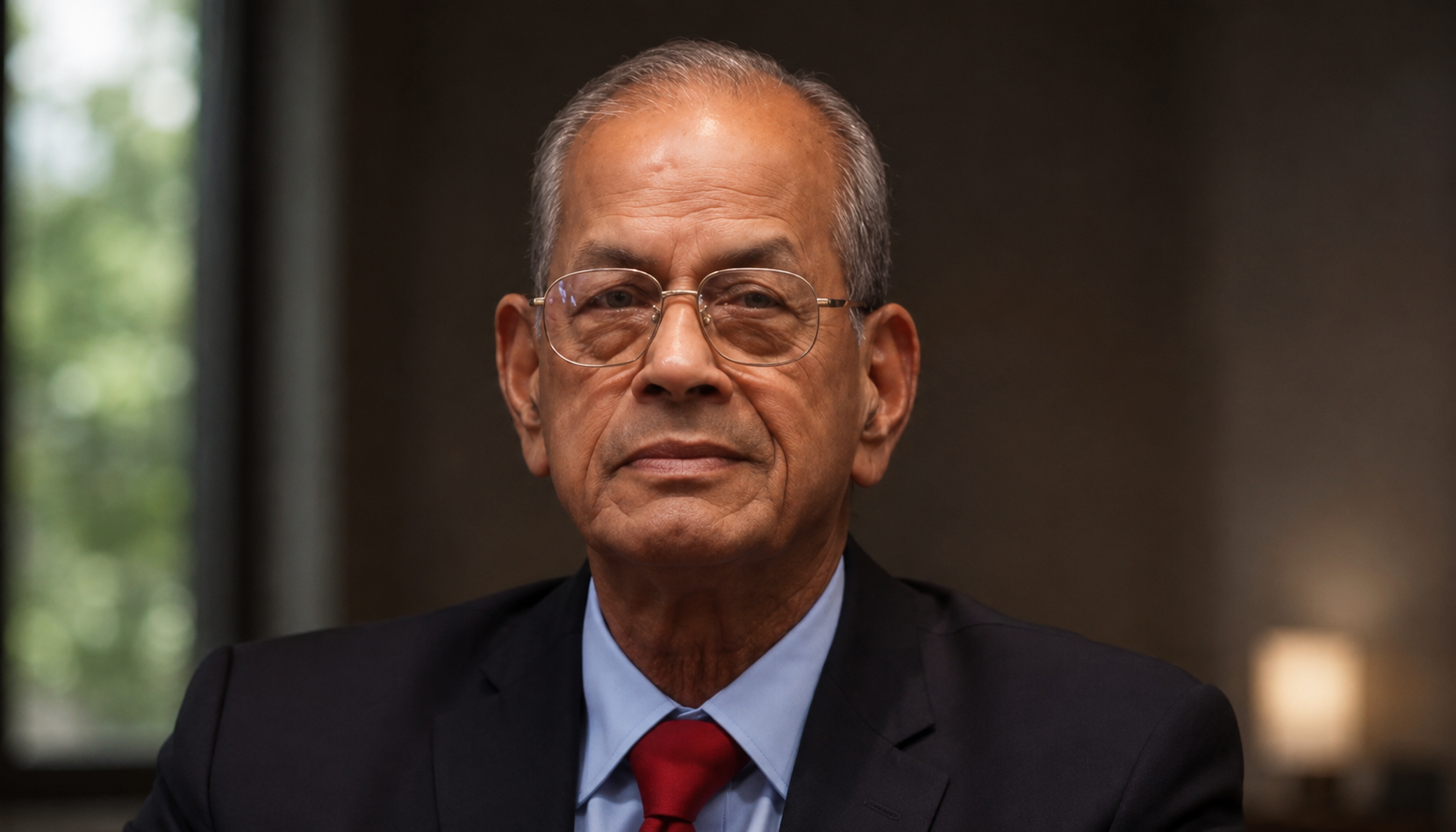
E. Sreedharan
Indian civil engineer and infrastructure expert, known as the “Metro Man of India”
Indian civil engineer best known for building and leading major infrastructure projects in India, especially the Delhi Metro. Through his work, he helped change how millions of people travel in Indian cities every day. Even after retirement, he continues to be admired as a symbol of efficiency and public service.
Born: 12 June 1932 (age 93)
Place: Pattambi Taluk, Palakkad district, Kerala, India
Other names: Metro Man
Education: Government Victoria College, Palakkad, University College of Engineering, Kakinada, Andhra Pradesh (JNTUK)
Title: Civil engineer (retired), Politician
Known for: Konkan Railway, Delhi Metro, Kochi Metro and other rail related developments
A Train Arrives on Time
On a winter morning in December 2002, as the first stretch of the Delhi Metro opened to the public, the platform at Shahdara was crowded not just with commuters but with expectation. The train arrived exactly on schedule. Doors opened. People stepped in, some cautiously, others with quiet relief. In a city accustomed to delay, congestion, and improvisation, this felt unfamiliar, almost disruptive. Standing slightly apart from the ceremony was E. Sreedharan, composed, watchful, as if the moment belonged less to celebration than to verification. It was an outstanding shift, not just in transport, but in administrative possibility, a demonstration that large public projects in India could be executed with precision, integrity, and speed.
Early Life and Formation: Engineering as Discipline
E. Sreedharan was born on June 12, 1932, in Karukaputhur, a village in Kerala’s Palakkad district. His upbringing was shaped by a mix of traditional values and an emerging post-independence aspiration toward education and professional mobility. Kerala, with its early investments in literacy and schooling, provided a fertile environment for intellectual development, even if economic opportunities were still limited.
He studied civil engineering at Government Engineering College, Kakinada, in present-day Andhra Pradesh, graduating in the early 1950s. This was a period when India’s infrastructure ambitions were expanding rapidly under a state-led development model. Railways, dams, and public works were not just engineering challenges; they were instruments of nation-building.
Sreedharan joined the Indian Railways Engineering Service in 1954. His early assignments exposed him to the operational realities of a vast and often overstretched system. What distinguished him early on was not flamboyance but method. He developed a reputation for procedural clarity, adherence to timelines, and an insistence on accountability, traits that would later define his leadership.
The Pamban Bridge Turning Point: Precision Under Pressure
In December 1964, a devastating cyclone struck the southern coast of India, severely damaging the Pamban Bridge, a critical rail link connecting the mainland to Rameswaram island in Tamil Nadu. The destruction disrupted not just transport but also the economic and social lifelines of the region.
At just 31, Sreedharan was tasked with overseeing the restoration.
The challenge was formidable. The bridge spanned a volatile marine environment, with strong currents and unpredictable weather. Resources were limited, and the urgency was high. The original estimate suggested a six-month timeline for restoration.
Sreedharan completed it in 46 days.
The achievement was not merely about speed. It involved logistical coordination, rapid mobilization of materials, and precise execution under difficult conditions. The restored bridge reopened well ahead of schedule, restoring connectivity and establishing Sreedharan’s reputation within Indian Railways as a problem-solver capable of delivering under pressure.
This episode became a defining moment, less for its scale than for what it revealed about his approach: engineering as disciplined execution, not theoretical ambition.
Konkan Railway: Engineering Against the Impossible
If the Pamban Bridge established Sreedharan’s capability, the Konkan Railway defined his legacy as a builder.
Stretching approximately 760 kilometers along India’s western coast, from Roha in Maharashtra to Thokur near Mangaluru, the Konkan Railway cut through some of the most challenging terrain in the country. The route required:
- Over 90 tunnels, including several exceeding 3 kilometers
- Nearly 2,000 bridges, ranging from small culverts to major viaducts
- Continuous management of landslides, monsoon flooding, and unstable soil conditions
The project had been discussed for decades but remained unrealized due to financial and engineering constraints.
Appointed as the Managing Director of the Konkan Railway Corporation in 1990, Sreedharan introduced institutional innovations that were unusual for Indian public sector projects. The corporation operated with a degree of autonomy, raised funds through a mix of government support and market borrowing, and adopted a project management approach that emphasized accountability at every level.
Construction began in 1990 and was completed by 1998.
The Konkan Railway was not flawless. It faced cost overruns and safety challenges, particularly related to landslides. Yet, its completion marked a breakthrough in India’s ability to execute large-scale infrastructure in difficult environments.
More importantly, it demonstrated a model of semi-autonomous, professionally managed public infrastructure development, a template that would later be refined in urban metro projects.
Delhi Metro: Redefining Urban India
When Sreedharan took charge as the Managing Director of the Delhi Metro Rail Corporation (DMRC) in 1997, urban transport in India’s capital was at a breaking point. Traffic congestion, pollution, and unreliable public transport had created a system under strain.
The Delhi Metro project aimed to change that, but skepticism was widespread. Previous large infrastructure projects in India had been plagued by delays, cost overruns, and corruption.
Sreedharan approached the project differently.
Phase I of the Delhi Metro, covering about 65 kilometers, was completed between 1998 and 2006, largely within budget and ahead of schedule in several segments. Subsequent phases expanded the network rapidly, making it one of the largest metro systems in the world.
Several aspects distinguished the project:
- Strict adherence to timelines, often enforced through daily monitoring
- Transparent procurement processes, minimizing corruption
- Integration of international best practices, including collaboration with Japanese agencies such as JICA
The Delhi Metro became more than a transport system. It set new benchmarks for public project execution in India. Stations were clean, trains were punctual, and the system operated with a level of efficiency that contrasted sharply with existing public services.
Its impact extended beyond mobility. It reshaped urban planning, influenced real estate development, and demonstrated that infrastructure could be both functional and citizen-centric.
Leadership Philosophy and Work Ethic: Discipline as Strategy
Sreedharan’s leadership style has often been described in terms that echo engineering itself: structured, precise, and uncompromising.
He maintained strict personal discipline, reportedly adhering to fixed working hours, avoiding extensions or informal deviations. Meetings began on time. Decisions were documented. Accountability was clearly assigned.
His ethical framework was equally central. He cultivated an institutional culture at DMRC that emphasized integrity. Contractors and officials operated under clear rules, reducing discretionary ambiguity, a common source of corruption in public projects.
At the same time, his style was hierarchical. Decision-making was centralized, with limited tolerance for dissent once a course of action had been established. This contributed to efficiency but also raised questions about scalability in more complex or politically fragmented environments.
Beyond Delhi: Kochi Metro and Advisory Roles
After retiring from DMRC in 2011, Sreedharan continued to play an active role in infrastructure development.
His involvement in the Kochi Metro project in Kerala was both influential and controversial. Initially brought in as a principal advisor, he advocated for DMRC’s execution model. The project eventually adopted a hybrid approach, combining local institutional frameworks with technical inputs from experienced agencies.
The Kochi Metro, inaugurated in 2017, reflected some of his principles, particularly in execution discipline and integration with urban mobility planning. However, it also revealed the complexities of replicating the Delhi model in different political and administrative contexts.
Sreedharan also engaged in public debates on infrastructure policy in Kerala, often advocating for faster decision-making and reduced bureaucratic delays. His positions occasionally brought him into conflict with state authorities, highlighting the tension between technocratic efficiency and democratic process.
Criticism, Debate, and Limitations
Sreedharan’s career, while widely celebrated, is not without critique.
One key criticism concerns the centralization of authority. His model relied heavily on strong, singular leadership. While effective in specific contexts, it raises questions about institutional sustainability once such leadership exits.
There are also debates about whether the “Sreedharan model” can be scaled across diverse projects with varying political, financial, and geographic conditions. Not all infrastructure projects benefit from the same degree of autonomy or clarity of mandate that DMRC enjoyed.
His brief foray into electoral politics in Kerala, where he contested assembly elections in 2021, further complicated his public image. It introduced him into partisan narratives, potentially diluting the technocratic neutrality that had defined his career.
Legacy and National Impact: Engineering a Standard
E. Sreedharan’s influence on Indian infrastructure extends beyond individual projects.
He redefined expectations.
Before the Delhi Metro, delays and cost overruns were often accepted as inevitable. After it, they became less defensible. His work demonstrated that:
- Public sector projects could be delivered on time
- Transparency could coexist with scale
- Technical rigor could shape governance outcomes
His impact is visible in subsequent metro projects across cities like Bengaluru, Chennai, and Hyderabad, many of which adopted elements of the DMRC model.
Globally, comparisons are sometimes drawn with infrastructure leaders who combined engineering expertise with administrative authority, figures who operated at the intersection of design and governance. Sreedharan occupies a similar space in the Indian context.
Yet, his legacy is not just about systems or structures. It is about a shift in mindset, a belief that infrastructure is not merely built, but managed, disciplined, and held accountable.
In the end, the title “Metro Man” captures only part of his contribution. What he represents is a standard, an outstanding insistence that public works, in a country of immense complexity, can still aspire to precision.
Awards and accolades
2001 – Padma Shri by the Government of India
2002 – Man of the Year by The Times of India
2002 – Om Prakash Bhasin Award for professional excellence in engineering
Dr.Y.Nayudamma Memorial Award[45]
2005 – Chevalier de la Légion d’Honneur (Knight of the Legion of Honour) by the government of France
2008 – CNN-IBN Indian of the Year 2007: Public Service
2008 – Padma Vibhushan by the Government of India
2009 – D.Litt by Rajasthan Technical University, Kota, Rajasthan
2009 – Degree of Doctor of Philosophy (Honoris causa) from IIT Roorkee
2010 – Honorary doctorate by Cochin University of Science and Technology
2012 – Sree Chithira Thirunal National Award
2013 – Degree of Doctor of Science (Honoris Causa) by Mahamaya Technical University on its first convocation
2013 – Order of the Rising Sun, Gold and Silver star by Government of Japan
2017 – KPP Nambiar Award by IEEE Kerala Section