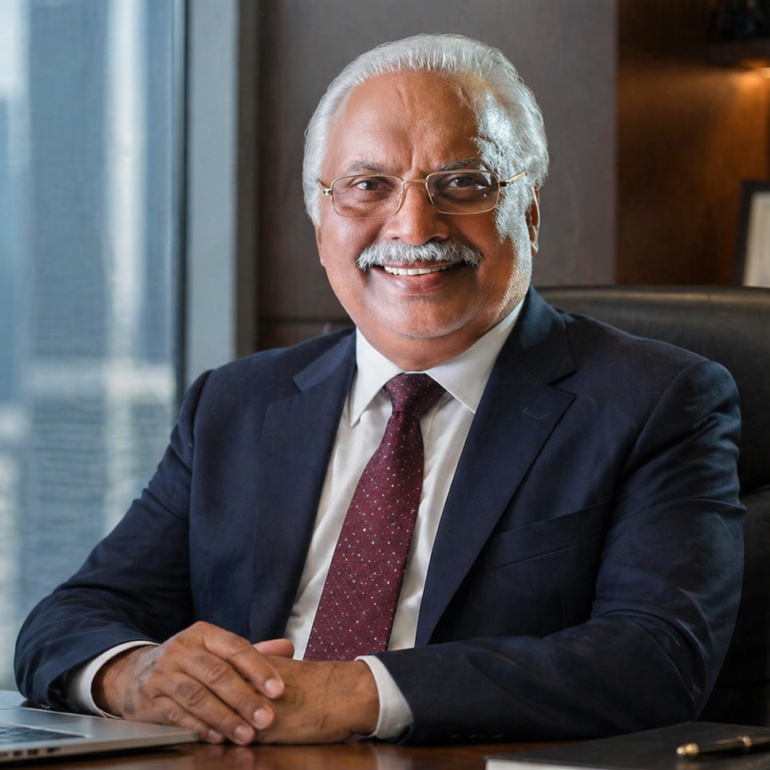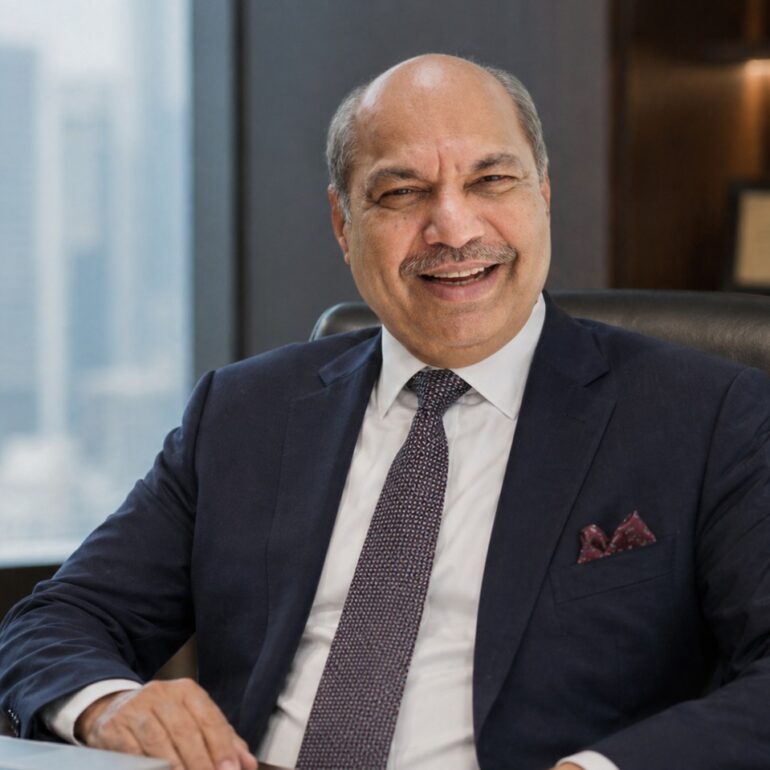

V. P. Nandakumar
Chairman & MD of Manappuram Finance
V. P. Nandakumar is an Indian businessman hailing from Valapad in Thrissur District of Kerala. He is the Chairman and Managing Director of Manappuram Finance Limited. He is also the chairman of Asirvad Microfinance, the 4th largest microfinance institution (MFI) in India with over Rs. 5,000 crore AUM (Assets Under Management). V.P.Nandakumar is also the International Director of the Lion’s Club International.
Key Facts
Born: 1954 (age 71–72)
Place: Valapad, Thrissur, Kerala, India
Title: Chairman and Managing Director of Manappuram Finance
The Custodian of Trust
In a small office in Valapad, Kerala, long before balance sheets grew into billions, there was a desk, a ledger, and a steady procession of people carrying their most personal collateral, gold. Not wealth, not luxury, but security. Bangles wrapped in cloth, chains tucked into old envelopes, heirlooms carrying stories heavier than their weight.
V. P. Nandakumar learned early that finance, at its core, is not about money. It is about trust under pressure.
He watched closely, how a loan could rescue a failing harvest, fund a daughter’s education, bridge a family through crisis. And in those quiet transactions, he began to see a larger system waiting to be built.
What emerged over decades was not just Manappuram Finance, but a reimagining of how India lends to those the formal system often overlooks.
Roots in Valapad
Born into a family that ran a modest money-lending business, Nandakumar inherited more than a trade. He inherited proximity to uncertainty.
Valapad was not a place of excess capital. It was a place where liquidity was episodic, tied to agriculture, migration, and seasonal income.
After completing his education in science and later pursuing law, Nandakumar stepped into the family business in the late 1980s. It was still informal, localized, and deeply dependent on personal relationships.
What he recognized early was the gap between need and access. Formal banking was expanding, but slowly, and often without the agility required for small borrowers.
From Pawnshop to Powerhouse
The transformation began with structure.
Nandakumar formalized the family enterprise, bringing systems, compliance, and scale into what had traditionally been a fragmented sector. In 1992, Manappuram Finance was incorporated, marking a shift from informal lending to an institutional model.
The core idea remained simple, gold loans. But the execution was anything but.
Gold, in India, is both asset and emotion. By building a system that respected both, Nandakumar positioned Manappuram as a trusted intermediary.
Over time, the company expanded aggressively, opening branches across the country, standardizing valuation, ensuring transparency, and introducing faster loan disbursement cycles.
What was once a neighborhood business became a national network.
The Gold Loan Revolution
Nandakumar did not invent gold loans. He scaled them.
He understood something fundamental, India’s vast reserves of household gold were underutilized as financial assets.
By converting idle gold into working capital, Manappuram tapped into a latent economy. Farmers, small traders, and micro-entrepreneurs suddenly had access to quick liquidity without the bureaucratic hurdles of traditional banks.
This model proved resilient, especially during times of economic stress.
While other financial institutions struggled with defaults and credit risk, gold-backed lending offered security. It was a business built not on speculation, but on tangible collateral.
Crisis and Reinvention
The journey, however, was not without turbulence.
The early 2010s brought regulatory tightening around non-banking financial companies (NBFCs), particularly those dealing in gold loans. The sector faced scrutiny over lending practices and valuation norms.
For Manappuram, this was a moment of reckoning.
Nandakumar responded not with retreat, but recalibration. The company diversified into microfinance, vehicle finance, housing loans, and SME lending.
This strategic pivot transformed Manappuram from a mono-product company into a diversified financial services group.
It was a shift that required both risk appetite and discipline, balancing growth with regulatory compliance.
Leadership Without Noise
In an era where business leaders often cultivate visibility, Nandakumar has remained understated.
His leadership style is deliberate, data-driven, and quietly assertive. He is less interested in spectacle, more in systems.
Colleagues describe him as someone who listens more than he speaks, but when he decides, execution follows with precision.
This restraint has shaped Manappuram’s culture, one that prioritizes operational efficiency over narrative building.
Expanding the Definition of Credit
Today, Manappuram Finance operates thousands of branches across India, serving millions of customers.
But its real impact lies beyond numbers.
By legitimizing and scaling gold-backed lending, Nandakumar helped bridge a critical gap in India’s financial ecosystem. He brought informal credit practices into a regulated, institutional framework.
In doing so, he expanded the definition of who deserves access to capital.
For millions outside the formal banking grid, Manappuram became not just a lender, but a first point of financial inclusion.
Reflection
There is a quiet dignity in the way V. P. Nandakumar built his empire.
No dramatic disruption, no flamboyant reinvention, just a steady, disciplined expansion of something deeply rooted in Indian life.
Gold, in Indian households, has always been more than ornament. It is memory, security, inheritance.
What Nandakumar did was recognize its second life, as capital.
In doing so, he did not just grow a company. He unlocked a system that had always existed, waiting to be organized.
And somewhere, in a small town, when someone walks into a Manappuram branch with a piece of gold wrapped in cloth, that original transaction continues. Quiet, urgent, and full of possibility.