
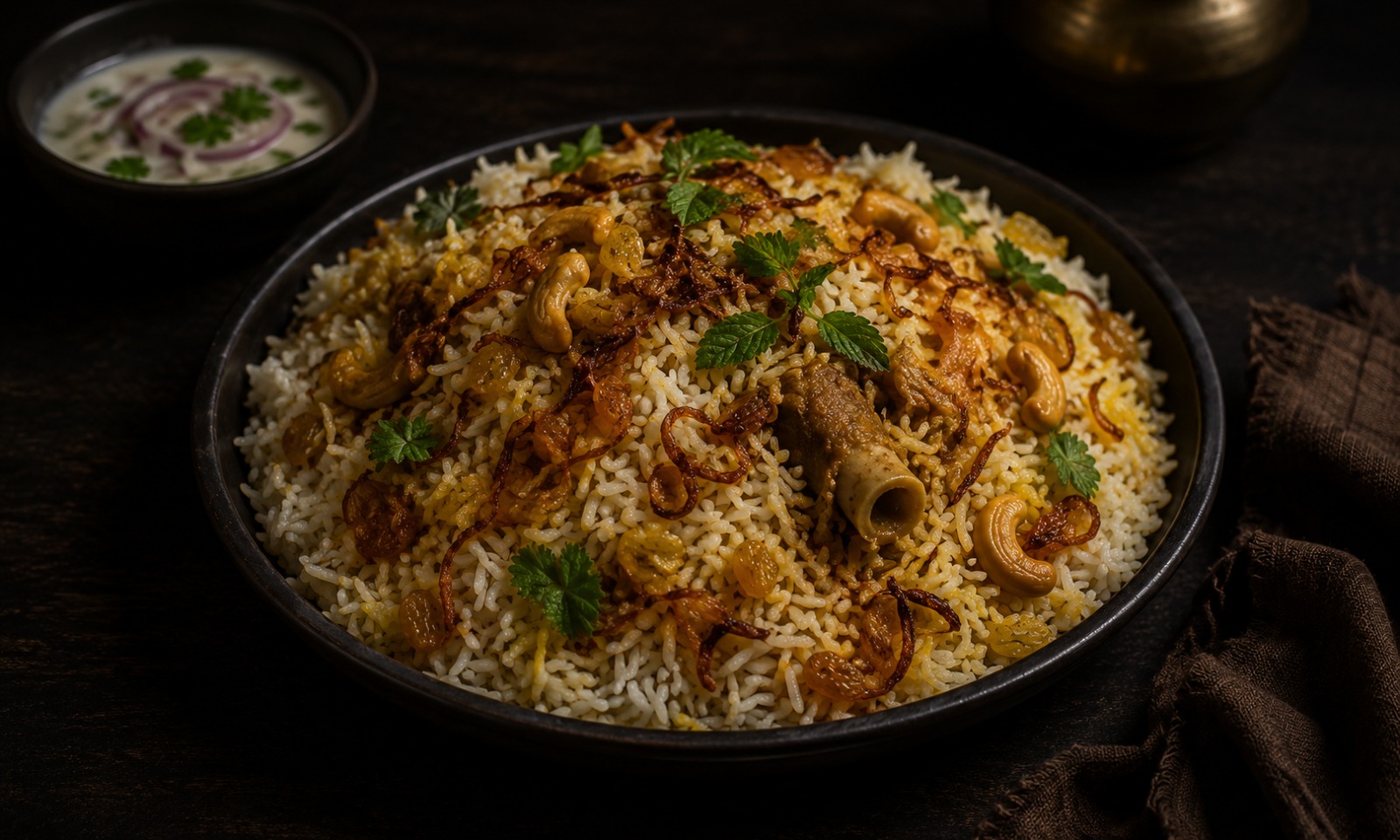
Thalassery Biryani is one of Kerala’s most famous rice dishes, known for its fragrant Kaima rice, tender meat, fried onions, ghee, and gently balanced spices. Deeply connected to the food traditions of Malabar, it reflects the region’s long history of trade and cultural exchange. Served at weddings, Eid celebrations, Ramadan gatherings, and family occasions, Thalassery Biryani remains a much-loved part of Kerala’s culinary identity.
The Flavours of Malabar
In Malabar homes, biryani is never merely food. It is celebration, hospitality, memory, and identity carried through steam and spice. Unlike heavier northern biryanis built around intensity, Thalassery Biryani seduces gently. Its aroma arrives first, warm ghee, fried onions, cardamom, and soft mint, followed by the delicate fragrance of Kaima rice. Every spoonful feels layered yet restrained, rich yet unexpectedly light.
The soul of Thalassery Biryani lies in its ingredients. At its center is Kaima rice, also known as Jeerakasala rice, a short-grain variety deeply associated with Malabar cuisine. Unlike long-grained basmati used in Hyderabadi or Lucknow biryanis, Kaima rice absorbs flavor without losing softness. It carries aroma beautifully while giving the biryani a compact, moist texture unique to northern Kerala.
Tender chicken or meat is marinated with curd, lemon juice, turmeric, and mild spices before slow cooking. Fried onions contribute sweetness and depth, while mint leaves brighten the richness. Cashews and raisins often appear as finishing touches, adding subtle contrast rather than extravagance.
What distinguishes the dish most, however, is balance. Thalassery Biryani is not aggressively spicy. The flavors unfold gradually through cinnamon, cloves, cardamom, black pepper, and fennel, creating warmth without overwhelming heat.
The Origins of Thalassery Biryani
To understand Thalassery Biryani is to understand the history of the Malabar coast itself.
For centuries, Thalassery stood as one of Kerala’s most important port towns, connected through maritime trade to Arabia, Persia, and beyond. Arab merchants arriving along the Malabar coast brought not only commerce but culinary traditions that slowly merged with local ingredients and Kerala’s spice-rich landscape.
These exchanges shaped Moplah cuisine, the distinctive culinary tradition of Kerala’s Muslim communities. Over generations, foreign cooking methods adapted themselves to local tastes, coconut oil replaced animal fats in some kitchens, native rice varieties entered biryani preparation, and spice profiles softened into something uniquely Malabar.
The result was not an imitation of Persian or Mughlai biryani, but an entirely regional expression shaped by trade, migration, and Kerala’s agricultural identity.
Unlike Hyderabadi biryani, where raw marinated meat and rice are cooked together, Thalassery Biryani typically involves separate preparation of rice and masala before layering. This creates a lighter texture where each grain remains distinct while still carrying flavor deeply.
The dum process remains central. Once layered, the pot is sealed to trap steam, allowing rice, meat, ghee, and spices to merge slowly into a unified aroma.
Compared to Hyderabadi biryani’s bold spice intensity or Kolkata biryani’s subtle sweetness and potato-rich composition, Thalassery Biryani feels more aromatic than fiery. Ambur biryani carries stronger chilli heat, while Kozhikode biryani often leans slightly richer and heavier.
Thalassery’s version stands apart through elegance and restraint.
Even visually, it differs. The rice appears softer and more compact due to Kaima rice, creating a texture that feels deeply comforting rather than dramatic.
A Dish Deeply Connected to Malabar Life
In northern Kerala, biryani accompanies life’s most important gatherings. Weddings are unimaginable without giant vessels of biryani prepared overnight. During Ramadan, the aroma of biryani drifts through homes and mosques before evening prayers. Eid mornings often begin with relatives arriving early for elaborate meals centered around steaming biryani platters.
The emotional attachment runs deep because the dish often arrives tied to memory. Many Malayalis remember waiting near kitchens while elders guarded sealed biryani pots, or waking to the smell of fried onions before family celebrations.
Even roadside restaurants and modest Malabar cafés carry their own biryani identities. Small eateries near bus stands or market roads often preserve recipes passed quietly across generations.
Over time, biryani itself became part of Malabar’s cultural identity, particularly in Kannur and Kozhikode regions where food traditions remain deeply communal.
The Legendary Biryani Houses of Malabar
Across Thalassery and Kozhikode, certain biryani houses have achieved near-legendary status through decades of consistency and inherited culinary skill. Many remain family-run establishments where spice mixes are closely guarded and rice ratios adjusted instinctively rather than measured scientifically.
Food travelers from across India increasingly visit Malabar specifically to taste these biryanis in their original setting. Yet what often surprises visitors is not extravagance, but intimacy. The best biryanis are frequently found in modest dining halls where recipes survive through repetition rather than reinvention.
These kitchens preserve not just flavor, but memory.
The Aroma of History: Arab and Malabar Cultural Fusion
Few dishes express Kerala’s maritime history as clearly as Thalassery Biryani.
The spice routes connecting Malabar to Arabia and Persia transformed the region’s cuisine permanently. Moplah cooking absorbed influences gradually, adapting foreign culinary ideas through local ingredients like coconut oil, curry leaves, Kaima rice, and Kerala spices.
Even today, traces of Arab culinary traditions remain visible in layered rice dishes, dried fruit garnishes, and slow-cooked meat preparations across Malabar Muslim cuisine.
Yet Thalassery Biryani feels unmistakably Kerala because the region transformed those influences into something rooted deeply in local soil and memory.
Today, Thalassery Biryani exists simultaneously as heritage food and modern culinary icon. Social media, food tourism, and Malayalam cinema have expanded its reputation far beyond Kerala. Younger chefs continue preserving dum cooking methods while introducing the dish to new audiences globally.
For Malayalis living abroad, especially in Gulf countries, Thalassery Biryani often becomes an emotional bridge back home. Its aroma alone can evoke weddings, Ramadan nights, and crowded family gatherings.
Perhaps that is why the dish continues to endure so powerfully.
Because Thalassery Biryani is not simply rice and meat layered inside a pot. It is centuries of spice trade history, Moplah culinary tradition, coastal memory, and family celebration carried through aroma and steam. In every spoonful lives the spirit of Malabar itself, warm, layered, generous, and outstandingly unforgettable.