Thalappil Pradeep
Indian chemist
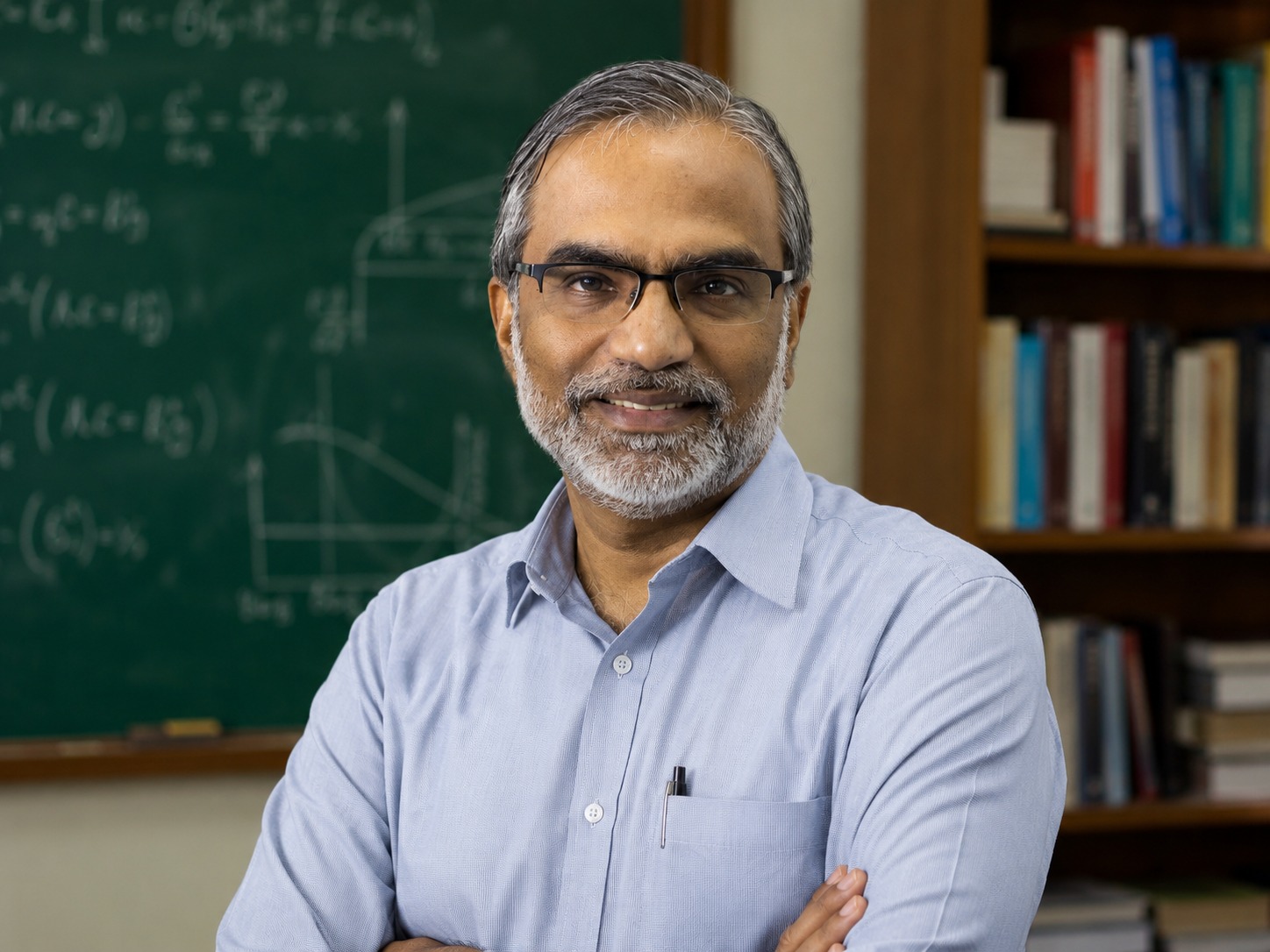
Thalappil Pradeep is an Indian chemist and Institute Professor at the Indian Institute of Technology Madras (IIT Madras), where he holds the Deepak Parekh Institute Chair Professorship. Pradeep is known for developing scalable, sustainable materials-based solutions for drinking-water purification that enable access to safe water. His work has enabled community-scale access to safe drinking water in affected regions. Pradeep was born in Panthavoor, Kerala, India.
Key Factors
Full Name: Thalappil Pradeep
Date of Birth: 8 July 1963
Birthplace: Panthavoor, Kerala, India
Occupation: Chemist, Nanoscientist, Professor (IIIT Madras)
Known For: Nanotechnology-based water purification
Major Awards: Padma Shri, Nikkei Asia Prize, ENI Award, VinFuture Prize, Rashtriya Vigyan Puraskar
Thalappil Pradeep is one of India’s most influential scientists, a chemist whose work moved beyond laboratories and academic journals to directly transform human lives. As an Institute Professor at Indian Institute of Technology Madras, he built a globally respected research career in nanoscience, molecular materials, and surface chemistry. Yet what distinguishes Pradeep from many celebrated scientists is the social direction of his science. His work on affordable water purification technologies has enabled safe drinking water access in some of India’s most contaminated regions, turning advanced nanotechnology into a tool of public health and social justice.
For decades, scientists around the world studied nanoparticles for their theoretical possibilities. Pradeep insisted they must also solve human problems. That insistence changed not only Indian scientific research, but also the way universities began imagining innovation itself.
From the dusty roads of rural Kerala to global laboratories of nanoscience, Thalappil Pradeep built a scientific career where chemistry became a form of humanitarian action.
A Village Waiting for Water
In many parts of rural India, the tragedy of contaminated water is invisible.
The water often looks clean. It flows quietly through hand pumps and village taps. But hidden inside are arsenic, uranium, pesticides, fluoride, and heavy metals, chemicals that slowly poison generations. Children grow up drinking danger without knowing its name.
In one such village, when a community water purification unit developed from the research of Thalappil Pradeep began operating, the transformation was almost immediate. Women no longer walked miles searching for safer wells. Families stopped boiling contaminated groundwater repeatedly. Schoolchildren carried cleaner water bottles. Science had arrived not as abstraction, but as relief.
That image, perhaps more than any international award citation, captures the meaning of Pradeep’s work.
For him, chemistry was never merely about molecules. It was about dignity.
Kerala Roots and an Intellectual Childhood
Thalappil Pradeep was born on 8 July 1963 in Panthavoor, a village in Kerala shaped by monsoon landscapes, agricultural rhythms, and the state’s deep educational culture.
His parents were both school teachers. His father, Narayanan Nair, was also a Malayalam writer who published under the pen name N. N. Thalappil and authored fourteen books. The house was filled not just with textbooks, but with ideas, language, debate, and intellectual seriousness.
That atmosphere mattered profoundly.
Unlike many scientists whose stories begin with expensive laboratories or elite schools, Pradeep’s education emerged entirely from government institutions. He studied at Government High School, Mookkuthala, where both his parents taught. Like many rural children of that generation, he walked nearly four kilometres to school most days.
Those walks became part of his education too.
Kerala in the 1960s and 1970s was experiencing a unique intellectual transition. Literacy movements, public education, left-leaning political thought, and scientific awareness campaigns were reshaping rural society. Pradeep grew up in an environment where education was treated not merely as personal advancement, but as collective empowerment.
The idea that knowledge should serve society would remain central to his scientific philosophy for the rest of his life.
The Making of a Scientist
Pradeep’s academic journey moved through institutions across Kerala before entering the elite world of Indian science.
After pre-degree studies at MES College, Ponnani, he pursued a BSc at St. Thomas College, Thrissur, and later completed his MSc at Farook College under Calicut University.
But the defining transition came at the Indian Institute of Science in Bengaluru.
There, between 1986 and 1991, he pursued doctoral research in chemical physics under legendary scientist C. N. R. Rao and M. S. Hegde. Rao’s influence was particularly significant. Indian science at the time was pushing aggressively into advanced materials research, and Pradeep entered that world during a period of intense global excitement around nanoscale science.
After research positions at the University of California, Berkeley, and Purdue University, he joined IIT Madras in 1993.
What followed was not merely an academic career, but the construction of an entirely new research ecosystem.
Nanotechnology With Human Consequences
Nanotechnology is often described in futuristic language, tiny particles, invisible systems, molecular engineering. But Pradeep’s genius lay in making it tangible.
His research focused heavily on nanomaterials capable of removing toxic contaminants from drinking water. Arsenic contamination alone affects millions across South Asia. Traditional purification systems are frequently expensive, electricity-dependent, or difficult to maintain in rural environments.
Pradeep approached the problem differently.
His laboratory developed advanced sand-like composite materials capable of filtering contaminants affordably and sustainably. These systems could function through gravity-fed mechanisms without electricity, making them practical for underserved communities.
This was critical.
Many scientific innovations fail because they are designed for ideal laboratory conditions rather than real human environments. Pradeep insisted on scalability, affordability, and deployment.
By 2016, approximately 1.5 million filters based on his technologies had entered the market. IIT Madras earned substantial royalties from these patents, a rare example in Indian academia where fundamental research successfully translated into public-impact technology.
But the deeper achievement was philosophical.
He helped redefine the role of scientific research in India.
The Strange Beauty of Nanoclusters
If water technologies gave Pradeep social relevance, his work on atomically precise nanoclusters gave him international scientific distinction.
Nanoclusters are collections of atoms so small that they behave differently from ordinary materials. At this scale, matter begins to blur the line between chemistry and physics. Gold, for example, stops behaving like bulk gold and begins exhibiting entirely new optical and catalytic properties.
Pradeep’s research demonstrated that nanoparticles could undergo reactions similar to conventional molecules. In simple terms, he showed that nanoscale particles could behave according to predictable chemical equations.
This altered scientific understanding of how nanomaterials interact.
For non-scientists, the significance may sound abstract. But in research communities, such discoveries reshape entire fields. These nanoclusters have applications ranging from sensing and catalysis to advanced photonics and environmental monitoring.
His work helped bring order and language to a rapidly expanding scientific frontier.
Ice, Space, and Molecular Mysteries
Some of Pradeep’s most fascinating work exists far away from drinking-water systems and public technology.
At IIT Madras, his group built one of the world’s earliest ultra-low energy ion scattering spectrometers operating under cryogenic conditions. The device allowed scientists to study molecular interactions on surfaces at incredibly sensitive scales, almost like watching chemistry unfold atom by atom.
His research explored how molecules behave on ice surfaces under space-like conditions. One notable discovery involved clathrate hydrates forming in environments similar to outer space.
There is something poetic about this range.
The same scientist building rural water filters was also studying chemistry resembling interstellar environments.
Microdroplets and the Unpredictability of Water
Another remarkable area of his research involved microdroplets, tiny charged droplets of water acting as microscopic chemical reactors.
Pradeep’s group demonstrated that these droplets could break down even hard minerals like quartz and ruby into nanoparticles. The discovery challenged assumptions about how chemistry behaves in confined environments.
Such work reflects Pradeep’s scientific personality: curious, unconventional, unwilling to remain confined within predictable academic boundaries.
Science as Social Justice
Many elite scientists spend their careers publishing influential papers. Pradeep certainly did that.
But what distinguishes him historically is his insistence that science must leave the laboratory.
His technologies were deployed in contaminated regions through partnerships involving governments, industry, and nonprofit organizations. He founded the International Centre for Clean Water at IIT Madras Research Park to expand collaborative solutions globally.
This approach placed him within a rare category of scientists who combine frontier research with public infrastructure building.
He incubated multiple companies working on water purification, atmospheric water generation, sensing technologies, and sustainability systems.
In India, where academic research often struggles to translate into usable technology, that achievement carries enormous institutional significance.
The Public Intellectual
Beyond laboratories, Pradeep also emerged as an important science communicator.
His textbook Nano: The Essentials became widely used across universities and helped introduce generations of students to nanoscience. He also wrote extensively in Malayalam, making advanced scientific ideas accessible to ordinary readers.
That bilingual intellectual life reflects something deeply Kerala-like: the refusal to separate elite knowledge from public culture.
Recognition Beyond Borders
The awards eventually followed.
Padma Shri in 2020. Nikkei Asia Prize. VinFuture Prize. ENI Award. Election to the US National Academy of Engineering. Rashtriya Vigyan Puraskar in 2025.
But the meaning of these honors lies less in prestige than in what they recognize: a model of science rooted simultaneously in global excellence and local necessity.
Conclusion
The story of Thalappil Pradeep is ultimately about scale.
A boy walking four kilometres to a government school in rural Kerala grows into a scientist whose work influences laboratories, industries, and villages across the world. Yet despite the complexity of nanoclusters, cryogenic spectroscopy, or microdroplet chemistry, the emotional core of his work remains startlingly simple: people deserve clean water, accessible science, and technologies that improve ordinary life.
That conviction gives his research unusual moral clarity.
In an era when scientific achievement is often measured through citations, patents, and global rankings, Pradeep represents a different possibility, science that remains intellectually ambitious while staying deeply accountable to society. His career reminds us that the greatest discoveries are not always those that merely explain the universe, but those that quietly change human lives. And in that sense, Thalappil Pradeep’s journey remains one of the most outstanding stories in modern Indian science.