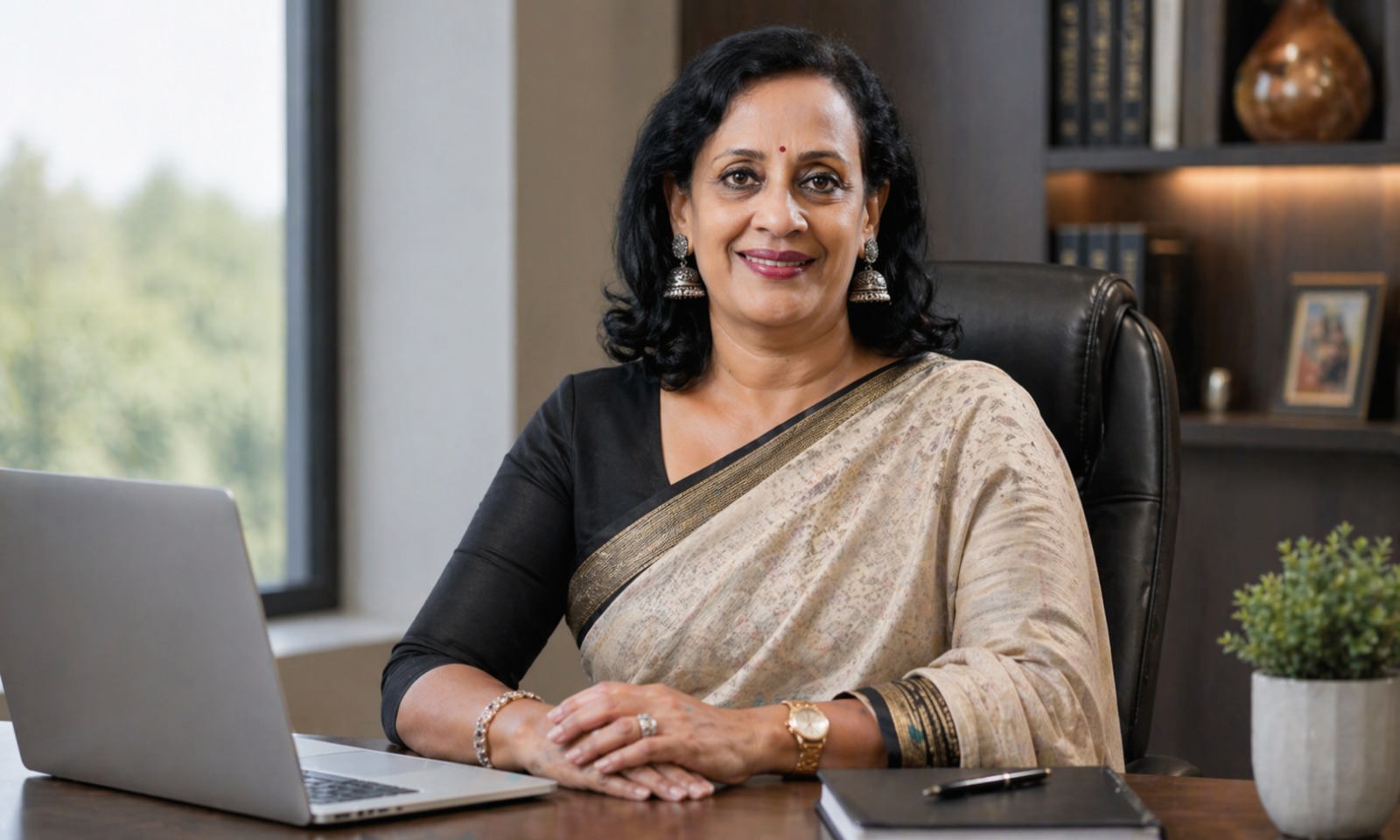
Sheela Kochouseph
V-Star Creations was founded in 1995 by Sheela Kochouseph, who is the wife of Kochouseph Chittilappilly, the founder of V-Guard Industries. The company specializes in innerwear and has grown into a significant player in the fashion industry, providing employment to women from underprivileged families. Sheela Kochouseph started the business with borrowed funds and has since made it a prominent name in the innerwear market, employing over 1000 people and operating more than 30 manufacturing units across India.
Key Facts
Full Name: Sheela Kochouseph
Born: Not consistently documented in widely available public sources
Place of Origin: Kerala, India
Title: Founder, V-Star Creations
Occupation: Entrepreneur, Industrialist
Known For: Building V-Star Creations, women-centric manufacturing model, leadership in India’s innerwear segment
A Business Built on Precision and Purpose
Inside a garment unit, the rhythm is mechanical but human at its core. Rows of sewing machines hum in synchrony, guided by hands that have learned precision through repetition. Fabric moves from cut to stitch to finish, eventually becoming a product that will be worn daily, rarely noticed, but essential. This is the world Sheela Kochouseph stepped into in the mid-1990s, not as an extension of an existing empire, but as a separate enterprise with its own risks and logic. What began as a small-scale operation has since grown into V-Star Creations, an outstanding example of how manufacturing, when aligned with social intent, can scale without spectacle.
Early Life and Influences
Publicly documented details about Sheela Kochouseph’s early life remain limited, a common pattern among first-generation women entrepreneurs in family-led business ecosystems, where institutional narratives often overshadow personal histories.
What is more visible is her proximity to enterprise. As the spouse of Kochouseph Chittilappilly, founder of V-Guard Industries, she was part of a business environment that emphasized manufacturing, distribution, and disciplined growth. However, V-Star was not positioned as a subsidiary extension at its inception. It emerged as an independent entrepreneurial effort.
This distinction matters. Rather than inheriting an operational role within an existing company, she initiated a business in a completely different category, apparel manufacturing, with its own supply chains, labor dynamics, and market challenges.
The Birth of V-Star Creations
V-Star Creations was founded in 1995, at a time when India’s innerwear market was largely unorganized, dominated by regional manufacturers and limited branding.
The choice of category was both practical and strategic. Innerwear is a high-volume, repeat-purchase segment with relatively stable demand. However, it is also highly price-sensitive and operationally demanding. Margins depend on efficiency, scale, and supply chain discipline rather than brand premiums alone.
Early accounts suggest that the business began with borrowed capital, reflecting a cautious but committed entry. Unlike capital-intensive industries, garment manufacturing allows for incremental scaling, but it also requires tight control over costs and quality from the outset.
The initial years would have involved building vendor relationships, setting up production units, and establishing distribution channels, all without the advantage of an established brand identity.
Building the Brand
The evolution of V-Star from a manufacturing unit into a recognized brand reflects a gradual, layered approach. Instead of rapid expansion, the company appears to have prioritized consistency in production and steady market penetration.
Brand development followed later. In 2002, the company introduced women’s innerwear under the “Vanessa” label, followed by men’s products under “Valero” in 2004. These sub-brands allowed V-Star to segment its offerings while maintaining a unified manufacturing backbone.
Further diversification came in 2012 with the introduction of youth-focused lines such as “Little Vanessa” and “Little Valero.” This progression indicates a strategy of expanding within adjacent categories rather than moving into unrelated segments.
Distribution has largely been rooted in traditional retail networks, particularly in South India, before expanding into broader markets. Unlike direct-to-consumer startups that rely heavily on digital channels, V-Star’s growth reflects the older model of building dealer networks and retail presence.
Women-Centric Workforce Model
One of the defining aspects of V-Star Creations is its workforce structure. The company has consistently emphasized the employment of women, particularly from economically disadvantaged backgrounds.
This is not incidental. Garment manufacturing globally relies heavily on female labor, but V-Star’s model extends beyond standard employment practices. The company has worked with units run by charitable institutions, supplying materials and enabling decentralized production.
Such models serve dual purposes. They expand manufacturing capacity while also creating income opportunities for women who may not otherwise have access to formal employment. In Kerala, where female literacy is high but workforce participation has historically lagged, this approach carries particular relevance.
Publicly available data suggests that the company employs over a thousand workers, though exact current figures vary and should be interpreted cautiously without recent disclosures.
Leadership Style and Business Philosophy
Sheela Kochouseph’s leadership style is notably understated. There is limited public-facing commentary, few high-profile interviews, and minimal personal branding. This aligns with a broader pattern among industrial entrepreneurs who prioritize operational focus over visibility.
Her approach appears to emphasize discipline over risk-taking. The company’s growth trajectory, steady rather than aggressive, suggests a preference for controlled expansion.
There is also a clear alignment with manufacturing fundamentals. In apparel, success depends on consistency, quality control, and efficient production cycles. These are areas that require sustained attention rather than episodic innovation.
Her relationship with the broader business ecosystem, including the V-Guard group, provides contextual support but does not define V-Star’s operational identity. The company functions within its own domain, with distinct challenges and dynamics.
Challenges and Competition
The Indian innerwear market has become increasingly competitive over the past two decades. Established brands, new entrants, and international players have intensified pricing pressure and raised expectations around design and quality.
For a company like V-Star, the challenge lies in maintaining its positioning within this evolving landscape. Competing purely on price risks margin erosion, while moving upmarket requires investment in branding and product development.
Scaling manufacturing also introduces complexity. Quality control becomes more difficult as production expands, and supply chain disruptions can have immediate impacts on output.
The company’s reliance on decentralized production units adds another layer of operational challenge. Ensuring uniform standards across multiple locations requires robust systems and oversight.
V-Star Today
Today, V-Star Creations operates as a significant player in India’s innerwear segment, with a presence across multiple states and a network of manufacturing units reportedly exceeding 30.
The product portfolio spans women’s, men’s, and children’s innerwear, along with related apparel categories. While the company does not dominate national market share in the way some larger brands do, it has established a strong foothold, particularly in South India.
Its operational model, combining centralized oversight with distributed manufacturing, allows for scalability while retaining cost efficiency. However, as the market continues to evolve, the company will need to navigate shifts toward organized retail and e-commerce.
Legacy and Impact
Sheela Kochouseph’s contribution to Indian entrepreneurship lies less in visibility and more in structure. By building V-Star Creations from the ground up, she demonstrated that manufacturing-led businesses, particularly those led by women, can scale within traditional sectors.
Her emphasis on women’s employment adds a social dimension to this achievement. In a sector often characterized by informal labor practices, creating structured opportunities for women represents a meaningful intervention.
Within Kerala’s industrial landscape, V-Star stands as an example of diversification beyond traditional sectors. It reflects a broader shift toward manufacturing and value-added production, complementing the state’s service-oriented economy.
Her journey does not conform to the archetype of high-growth, venture-backed entrepreneurship. Instead, it represents a slower, more grounded model, one that prioritizes sustainability over speed.
In a business environment that often rewards visibility and rapid expansion, this approach may seem understated. But its impact, measured in employment, production capacity, and market presence, is tangible. That quiet, sustained influence is what makes her story not just relevant, but in its own way, outstanding.