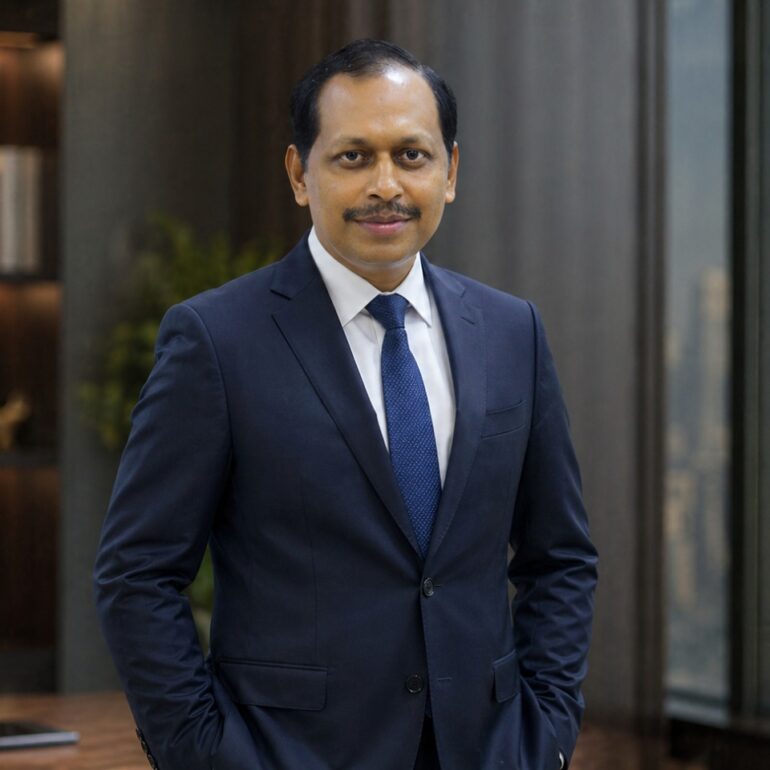
Narasimha Satheeshkumar
In Kerala’s retail landscape, where legacy brands often outlast the individuals behind them, Narasimha Satheeshkumar occupies a role that is both central and understated. As Director and Whole-Time Director of Jayalakshmi Silks and a director at Jayalakshmi Realtors, he represents a generation of business leaders focused less on visibility and more on continuity. His career reflects the steady stewardship of a legacy enterprise navigating changing consumer behavior, urban expansion, and diversification, all without departing from its core identity.
Key Factors
Full Name: Narasimha Satheeshkumar
Born: Not Publicly Documented
Place: Ernakulam, Kerala, India (based on corporate association)
Title: Director, Whole-Time Director
Occupation: Business Executive, Corporate Director
Known As: Key figure in Jayalakshmi Silks and Jayalakshmi Realtors
Quiet Evolution of Jayalakshmi
On a typical evening along MG Road in Kochi, the flow of people into large textile showrooms is constant. Families move through floors stacked with silk sarees, wedding collections, and festive wear, often returning to the same store across generations. Among these institutions, Jayalakshmi Silks stands as a familiar landmark, less a store and more a ritual space for major life purchases. The scale, the predictability, and the trust built over decades do not happen by accident. Behind this outstanding continuity is a layer of management that rarely surfaces publicly, figures like Narasimha Satheeshkumar, whose role is not to redefine the brand, but to ensure it endures.
Legacy Context: Jayalakshmi Silks
The story of Jayalakshmi Silks begins in 1947, when it was founded by Narasimha Kamath. Like many textile businesses of its time, it started as a modest trading operation and gradually expanded into a large-format retail presence.
Over the decades, the brand grew alongside Kerala’s own economic transformation. Rising incomes, migration-driven remittances, and a strong cultural emphasis on textiles, particularly for weddings and festivals, created sustained demand. Jayalakshmi positioned itself within this ecosystem as a reliable, large-scale retailer capable of catering to diverse customer segments.
Unlike newer entrants that rely heavily on branding and marketing campaigns, legacy textile houses often build their identity through consistency. Product range, pricing discipline, and customer familiarity become the pillars of growth. Jayalakshmi’s expansion into a multi-floor retail destination reflects this model, where scale reinforces trust rather than replacing it.
Role of Narasimha Satheeshkumar
Corporate records indicate that Narasimha Satheeshkumar has been associated with Jayalakshmi Silks since the mid-1990s, with directorship roles dating back to around 1994. Over time, he assumed the position of Whole-Time Director, a role that typically involves active involvement in day-to-day operations and strategic decision-making.
This timeline is significant. The period from the 1990s onward marked a shift in India’s retail environment. Liberalization, increased competition, and evolving consumer expectations required traditional businesses to adapt without losing their core strengths.
While detailed public accounts of his specific decisions are limited, the sustained relevance of Jayalakshmi Silks suggests a leadership approach focused on operational stability and gradual adaptation. Unlike high-profile retail entrepreneurs who foreground personal branding, Satheeshkumar’s role appears embedded within the institution itself.
This kind of leadership is often less visible but critical in family-run enterprises. It involves managing supply chains, vendor relationships, inventory cycles, and customer experience at scale, functions that rarely attract attention but define long-term success.
Diversification into Real Estate
In 2021, the incorporation of Jayalakshmi Realtors marked a formal expansion beyond textiles. Narasimha Satheeshkumar’s directorship in this entity reflects a broader trend among established retail families in Kerala, diversification into real estate.
This move is not incidental. Retail and real estate are closely linked, particularly in urban centers like Kochi. Large-format showrooms require significant property investments, and control over real estate can provide both operational flexibility and long-term asset appreciation.
The timing also aligns with Kerala’s urban growth trajectory. Cities like Kochi have seen increasing demand for commercial and mixed-use developments, driven by infrastructure expansion and changing consumption patterns.
However, diversification carries its own risks. Real estate operates on different cycles compared to retail, with longer gestation periods and exposure to regulatory and market fluctuations. For a legacy brand, the challenge lies in leveraging existing strengths without overextending into unfamiliar territory.
Corporate Profile and Governance
From a corporate governance perspective, Narasimha Satheeshkumar’s career reflects long-term involvement in family-linked business structures. His directorship across multiple entities indicates a role that extends beyond a single operational unit into broader group-level oversight.
Such structures are common in Indian family businesses, where different entities handle distinct aspects of operations, retail, real estate, logistics, and investments. Directors often operate across these entities to maintain strategic alignment.
Publicly available data suggests over three decades of association with the Jayalakshmi group. Longevity in such roles often correlates with institutional memory, an understanding of how the business has evolved, what has worked, and what risks to avoid.
Unlike professionally managed corporations with frequent leadership changes, family-run enterprises rely heavily on this continuity. It allows for long-term planning, but also requires balancing tradition with necessary adaptation.
Business Philosophy and Quiet Leadership
One of the more notable aspects of Narasimha Satheeshkumar’s profile is the relative absence of public-facing narratives. There are no widely documented interviews, public speeches, or strong personal branding efforts associated with his name.
This absence is not unusual in Kerala’s traditional retail sector. Many business leaders operate with a deliberate low profile, allowing the brand to remain the primary point of engagement with customers.
This approach contrasts with newer retail models where founders and executives often become the face of the business. In legacy enterprises, visibility is often seen as secondary to stability.
The emphasis, therefore, shifts to continuity. Maintaining consistent product quality, managing customer expectations, and ensuring operational efficiency become the core priorities. Leadership, in this context, is less about articulation and more about execution.
Challenges and Industry Context
The textile retail industry in Kerala has undergone significant changes over the past two decades. Organized retail chains, online platforms, and changing consumer preferences have introduced new competitive pressures.
Customers today are more price-aware, more design-conscious, and increasingly influenced by digital trends. Traditional retailers must adapt to these shifts while preserving the trust built over decades.
For Jayalakshmi Silks, this means balancing scale with personalization, and tradition with innovation. Large showrooms offer variety, but they must also deliver a curated experience that meets evolving expectations.
The move into real estate adds another layer of complexity. Market cycles, regulatory changes, and capital allocation decisions become critical. Diversification can strengthen a business, but it can also dilute focus if not managed carefully.
In this environment, leadership requires a calibrated approach. Rapid transformation carries risks, but so does stagnation. The ability to adjust incrementally, without destabilizing the core business, becomes a key differentiator.
The Invisible Architect
Narasimha Satheeshkumar’s career does not fit the conventional narrative of modern business leadership. There are no dramatic pivots, no high-profile announcements, and little public visibility. Instead, his role is defined by continuity, by the ability to sustain and gradually evolve a legacy institution.
In many ways, this is a less visible but equally demanding form of leadership. It requires resisting the impulse for constant reinvention while ensuring the business remains relevant. It involves managing complexity without drawing attention to it.
As Kerala’s retail and real estate landscapes continue to evolve, figures like Satheeshkumar remain central to the stability of legacy enterprises. They operate behind the scenes, shaping outcomes through decisions that are rarely visible but widely felt.
In a business environment that often celebrates disruption, his journey offers a different perspective, one where endurance, discipline, and institutional focus define success. That quiet, sustained influence is what makes his role not just significant, but in its own way, outstanding.