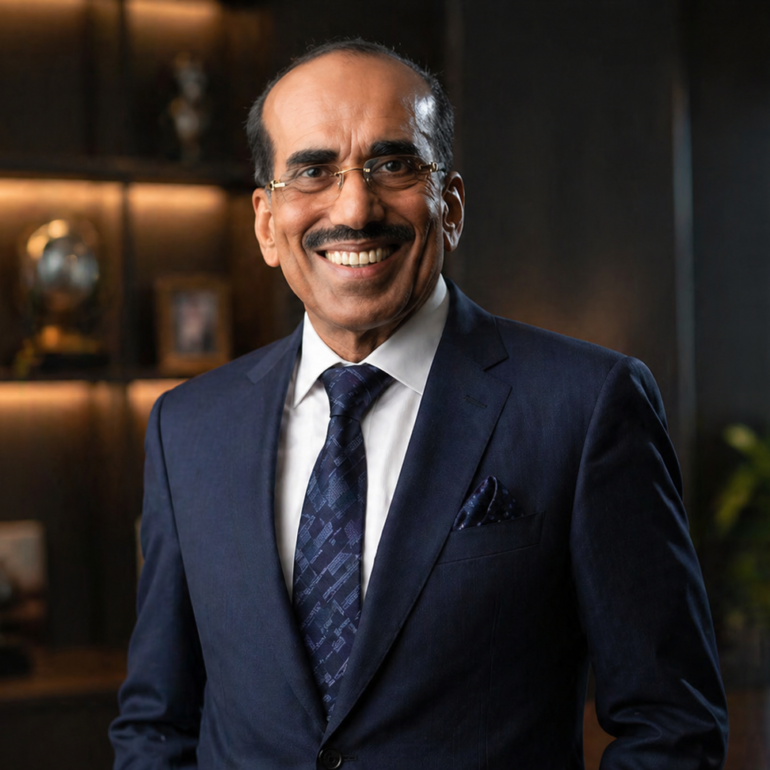
K.V. Abdul Azeez
Founder, Chairman and Managing Director (CMD) of Skyline Builders
K.V. Abdul Azeez is the Founder, Chairman and Managing Director (CMD) of Skyline Builders, a leading real estate developer in Kerala, India, established in 1989. Under his leadership, the company has completed over 150 projects and established itself as a major, trusted builder in the region. Abdul Azeez has also been a prominent figure in the real estate industry, acting as the Chairman of CREDAI-Kerala (2009-2013).
Key Facts
Full Name: K.V. Abdul Azeez
Place: Kerala, India
Title: Founder, Chairman & Managing Director, Skyline Builders
Occupation: Real Estate Developer, Entrepreneur
Known For: Building Skyline Builders into a trusted real estate brand; leadership in CREDAI Kerala; contributions to Kerala’s urban housing ecosystem
In Kerala, real estate has never been merely about land and buildings. It is deeply tied to migration, remittances, and a persistent aspiration for upward mobility. Over the past four decades, as Gulf money reshaped housing demand and cities expanded into vertical communities, a handful of developers emerged as consistent players. Among them, K.V. Abdul Azeez occupies a distinctive position, not for flamboyance or aggressive expansion, but for a methodical, almost understated approach to building.
His entry into real estate dates back to a time when Kerala’s property market was still largely unorganized. The late 1980s were a transitional phase. Urbanization was picking up pace, but institutional frameworks such as RERA were decades away. Trust was informal, transactions were opaque, and developers operated in fragmented ecosystems.
It was in this context that Skyline Builders was founded in 1989.
The early years were defined less by scale and more by survival. Financing was limited, regulatory processes were complex, and customer expectations were evolving. Unlike today’s buyers, who are accustomed to brand-driven decision-making, early customers relied heavily on personal assurance. For a new entrant, credibility had to be earned project by project.
Azeez approached this challenge with a builder’s mindset rather than that of a speculative entrepreneur. His focus was on execution, timely delivery, and consistency. Instead of pursuing rapid expansion, Skyline’s early growth was incremental, anchored in repeat customers and word-of-mouth reputation.
This strategy, while slower, proved resilient.
As Kerala’s housing demand expanded through the 1990s and early 2000s, driven largely by Non-Resident Indian investments, Skyline was well-positioned. The company began to scale, moving from standalone developments to more structured residential projects that emphasized community living. Apartments became the preferred format in cities like Kochi, Thiruvananthapuram, and Kozhikode, and developers who could combine design, functionality, and trust gained a competitive edge.
Skyline’s growth trajectory reflects this shift. Over time, the company crossed the milestone of 150 completed projects, a significant achievement in a market where many players struggled to sustain operations over decades.
Yet, what distinguishes Skyline is not just the number of projects, but the consistency of delivery across them.
Azeez’s leadership style is often described as deeply hands-on. Unlike many second-generation or corporate-led real estate firms, Skyline retains a founder-driven operational culture. Decisions are closely monitored, execution is tightly controlled, and deviations are minimized. This approach has its limitations in terms of rapid scaling, but it has reinforced a key brand attribute: reliability.
In Kerala’s real estate sector, where project delays and quality inconsistencies have historically eroded consumer confidence, this reliability has been a critical differentiator.
Beyond his role within Skyline, Azeez has also been an active participant in shaping the industry itself. His tenure as Chairman of CREDAI Kerala from 2009 to 2013 came at a time when the sector was grappling with regulatory uncertainty and increasing scrutiny. CREDAI, as a collective body of developers, played a role in bridging the gap between policymakers and industry stakeholders.
Azeez’s involvement in this platform reflects a broader understanding of real estate as not just a business, but an ecosystem requiring coordination between developers, government agencies, and financial institutions. His leadership during this period contributed to strengthening industry dialogue and promoting more structured practices.
As the company matured, Skyline also explored opportunities beyond Kerala. The expansion into markets like Dubai is indicative of both ambition and strategic positioning. For many Kerala-based developers, the Gulf represents a natural extension, given the strong diaspora connections. However, operating in international markets requires a different level of regulatory compliance, financial discipline, and project management.
Skyline’s presence in Dubai, though selective, signals a willingness to operate beyond regional boundaries while maintaining core principles.
At the heart of Skyline’s operations lies a consistent emphasis on quality, safety, and innovation. While the term “innovation” in real estate often leans toward architectural aesthetics or amenities, in Skyline’s case, it has been more about process discipline and construction standards. Ensuring structural integrity, adhering to safety norms, and maintaining material quality have been central to its project philosophy.
This approach may not always generate headline-grabbing projects, but it builds long-term trust.
Kerala’s real estate market itself has undergone significant transformation over the past three decades. From low-rise independent houses to high-density apartment complexes, the shift reflects broader socio-economic changes. Land scarcity, urban migration, and lifestyle evolution have driven demand for organized housing.
Developers like Skyline have played a role in normalizing apartment living in a state that traditionally valued independent homes. By focusing on community-oriented designs and practical layouts, the company contributed to changing perceptions around urban housing.
At the same time, the market has become increasingly competitive. National developers, improved regulatory frameworks, and more informed consumers have raised the bar. In this environment, maintaining a legacy brand requires continuous adaptation.
Azeez’s strategy appears to balance continuity with measured evolution. Rather than chasing aggressive diversification or speculative projects, Skyline has largely stayed within its core domain, refining its strengths.
Recognition, including honors like the Kerala Realty Icon Award, reflects industry acknowledgment of this sustained performance. However, Azeez’s public persona remains relatively understated. Unlike some contemporaries who actively cultivate visibility, he has maintained a low-profile approach, focusing more on operations than optics.
This grounded personality is consistent with the company’s positioning. Skyline is not marketed as a luxury disruptor or a hyper-growth player. Instead, it is positioned as a dependable builder, a distinction that resonates strongly in Kerala’s cautious real estate market.
Looking ahead, the challenges for developers like Skyline are multifaceted. Regulatory compliance has increased, margins are under pressure, and customer expectations are higher than ever. Sustainability, digital integration, and smart infrastructure are no longer optional considerations.
The question, then, is how legacy builders adapt without losing their core identity.
For Azeez, the answer seems to lie in disciplined evolution. Maintaining construction quality, adopting new technologies where necessary, and aligning with changing consumer preferences without compromising on fundamentals.
His legacy, therefore, is not defined by a single landmark project or a dramatic expansion story. It is built on consistency, trust, and a long-term commitment to the craft of building.
In an industry often characterized by cycles of boom and bust, such steadiness is rare.
And perhaps that is what makes K.V. Abdul Azeez’s journey not just successful, but quietly outstanding.