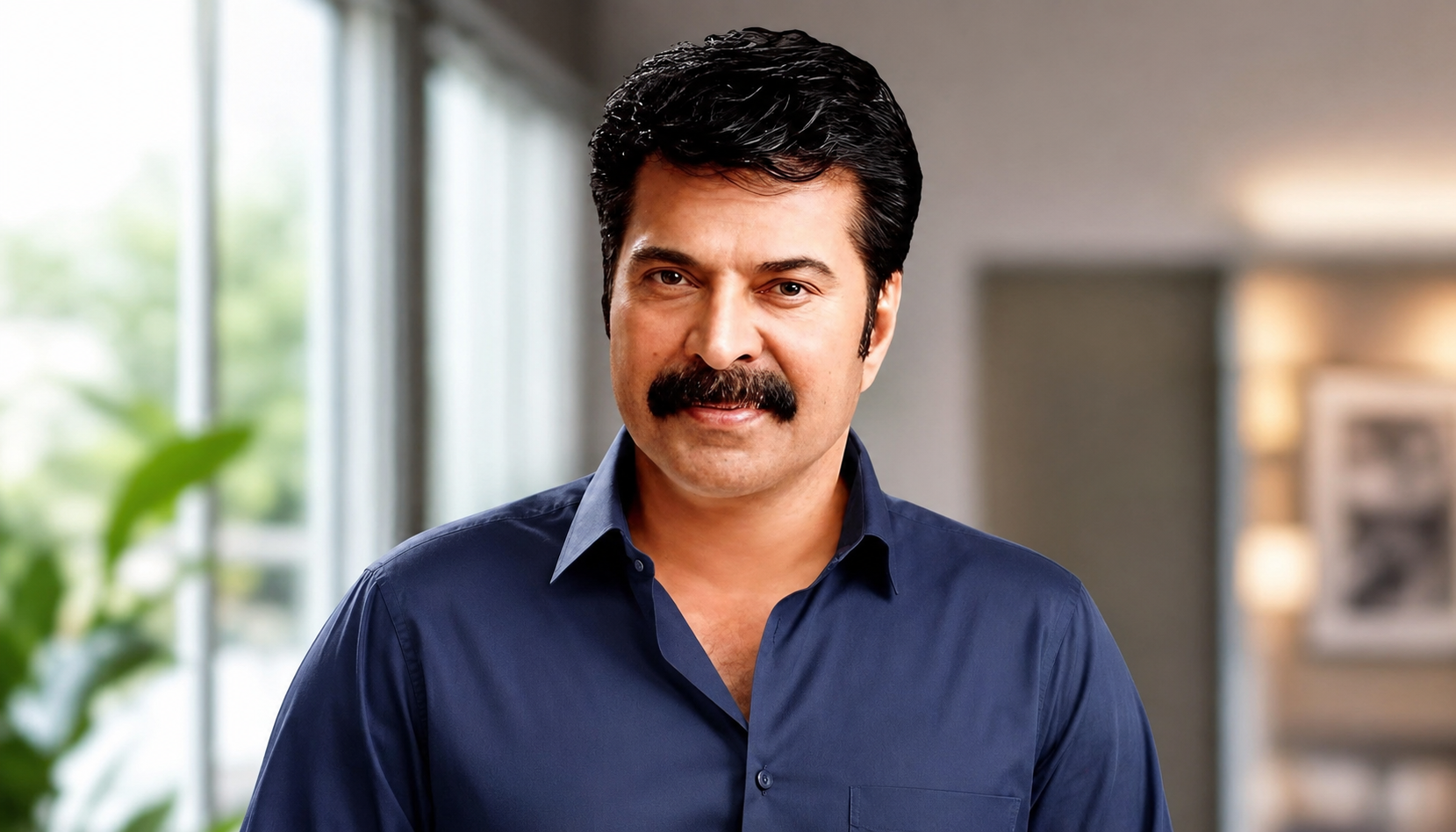
Mammootty
A living legend of Indian films, known for depth, style, and unforgettable characters
Mammootty is one of the most iconic actors in Indian cinema, known for his powerful screen presence and natural acting style. From intense dramas to subtle character performances, he brings depth and realism to every role he plays.
Full Name: Muhammad Kutty Panaparambil Ismail
Born: 7 September 1951 (age 74)
Place: Chandiroor, Travancore–Cochin (present day Alappuzha, Kerala), India
Education: Alma mater Sacred Heart College, Maharaja’s College (BA), Govt. Law College, Mahatma Gandhi University (LLB), University of Kerala, University of Calicut (D.Litt)
Title: Actor, Film producer
Years active: 1971–present
Organization: Mammootty Kampany
Website: mammootty.com
Mammootty: The Master of Craft
There is a certain stillness that precedes a Mammootty performance. A pause that carries weight. And then, with a single line, a glance, or the controlled rise of his voice, the screen rearranges itself around him. Mammootty does not merely enter a frame, he commands it.
Across decades, he has cultivated an aura that is both regal and restrained. His performances are built on precision, on language sharpened to its finest edge, on a physicality that is measured rather than impulsive. If Mohanlal feels like instinct, Mammootty feels like intention.
To Kerala, he is more than a star. He is a standard. A figure who carries within him the evolution of Malayalam cinema itself, from the textured realism of the 1980s to the sleek, global storytelling of today. His journey is not simply a Mammootty biography, it is the story of discipline meeting ambition, of reinvention meeting legacy.
And at every stage, he has remained unmistakably himself, controlled, composed, and commanding.
The Making of Mammootty
Born as Muhammad Kutty Panaparambil Ismail on September 7, 1951, in Chandiroor and raised in Ernakulam, Mammootty’s early life was far removed from cinematic glamour. He grew up in a middle-class Muslim household where discipline, education, and structure were deeply valued.
That sense of structure would go on to define him.
Unlike many actors who arrive in cinema through sheer passion or accident, Mammootty came with a foundation that was intellectual as much as emotional. He studied law at Government Law College and briefly practiced as a lawyer. The courtroom, with its emphasis on articulation, control, and persuasion, quietly shaped the performer he would become.
His entry into cinema, however, was neither immediate nor easy. Early roles in the 1970s were minor, often fleeting. Films like Anubhavangal Paalichakal featured him in uncredited or small appearances. For years, he remained on the margins, watching, learning, absorbing.
There was no overnight breakthrough. No sudden leap to stardom.
Instead, there was patience.
What distinguished Mammootty even in those early years was his attention to detail. He observed how actors spoke, how they held silence, how they occupied space. He refined himself slowly, deliberately.
By the late 1970s, he was no longer just another aspiring actor. He was a performer preparing for something bigger.
Rise to Stardom: Building the Identity
The 1980s marked a decisive shift in the Mammootty career. Malayalam cinema itself was undergoing a transformation, embracing realism, layered storytelling, and morally complex characters. Mammootty emerged as one of the defining faces of this movement.
Films like Yavanika and Thaniyavarthanam showcased his ability to internalize conflict. He brought a seriousness to his roles that felt grounded in lived experience.
The breakthrough, however, came with a string of performances that established him as a leading man. New Delhi positioned him as a powerful, revenge-driven protagonist, a departure from the vulnerability often seen in earlier Malayalam heroes. Here was a man who was assertive, commanding, and unapologetically intense.
Then came Oru Vadakkan Veeragatha, widely regarded as one of his finest performances. As Chandu Chekavar, Mammootty reinterpreted a legendary character with nuance and emotional complexity, earning critical acclaim and a National Award.
By the end of the 1980s, Mammootty was not just a star, he was a force. His screen identity was clear, authoritative, articulate, and deeply masculine, yet capable of vulnerability when required.
The 1990s only expanded this dominance. He balanced commercial successes with critically acclaimed roles, proving that stardom and substance need not be mutually exclusive.
The Actor: Craft, Precision & Range
If Mohanlal’s acting is often described as instinctive, Mammootty’s is architectural.
He builds performances.
Every gesture, every pause, every inflection feels considered. His dialogue delivery, in particular, is legendary. He treats language not just as communication, but as power. His voice carries authority, rhythm, and clarity, making even the simplest lines resonate.
What sets Mammootty apart is control. He rarely allows emotion to spill uncontrollably. Instead, he contains it, letting it simmer beneath the surface. This restraint creates tension, making his performances feel intense without being excessive.
His range is vast. He has portrayed kings, politicians, lawyers, journalists, gangsters, and ordinary men with equal conviction. In films like Mathilukal, he delivered a deeply introspective performance based on Vaikom Muhammad Basheer’s work, proving his mastery over minimalism.
At the same time, he excelled in commercial cinema. His ability to switch between parallel cinema and mass entertainers made him one of the most versatile actors in Indian cinema.
Collaborations with directors like Adoor Gopalakrishnan and Joshiy further expanded his repertoire. Each filmmaker brought out a different facet of him, yet his core remained intact.
Mammootty does not disappear into characters in the conventional sense. Instead, he elevates them, giving them stature, dignity, and presence.
The Superstar Era: Dominance & Devotion
By the 1990s and early 2000s, Mammootty had entered his undisputed superstar phase. His films opened to massive audiences, his characters became cultural references, and his dialogues echoed beyond theatres.
He cultivated a fan base that was both loyal and deeply invested. In Kerala, his releases were events. Celebrations unfolded outside theatres, with cutouts, banners, and first-day-first-show rituals that mirrored a festival.
What made his stardom unique was its duality. He was a mass hero, capable of delivering powerful, larger-than-life performances. Yet, he never abandoned his commitment to meaningful cinema.
Films like The King and Commissioner reinforced his image as a commanding presence, a man of authority who could dominate any space.
At the same time, he continued to take risks, choosing scripts that challenged him. This balance ensured that his stardom was not static. It evolved.
Reinvention & New-Gen Relevance
The most fascinating chapter of the Mammootty career is perhaps his reinvention in the 2010s and 2020s.
At a stage when many actors rely on nostalgia, Mammootty chose risk.
Films like Pathemari explored migration and identity with emotional depth. Peranbu showcased one of his most vulnerable performances, earning widespread critical acclaim.
In Bheeshma Parvam, he reinvented his mass image with a stylized, contemporary edge. Puzhu revealed a darker, more unsettling side of his acting.
Recent projects like Kannur Squad further cemented his relevance among younger audiences. His willingness to collaborate with new directors and experiment with unconventional narratives has kept him at the forefront of Malayalam cinema.
In an era defined by OTT platforms and shifting audience expectations, Mammootty has not just adapted. He has thrived.
Beyond Cinema: The Man Behind the Persona
Off-screen, Mammootty is known for his discipline. He is meticulous about time, appearance, and preparation. His lifestyle reflects a commitment to consistency, whether in fitness, reading, or personal conduct.
He is also a successful entrepreneur, with ventures spanning production and business. Yet, he maintains a degree of privacy that adds to his mystique.
Those who know him often speak of his sharp intellect, his wit, and his ability to observe the world with clarity. He is as much a thinker as he is a performer.
Legacy & Cultural Impact
Mammootty’s legacy is woven into the fabric of Malayalam cinema.
He represents a bridge between eras, between the grounded realism of the past and the global aspirations of the present. His influence can be seen in the performances of younger actors, in the writing of complex characters, and in the industry’s willingness to experiment.
He has shown that stardom is not just about popularity. It is about responsibility, to craft, to audience, and to cinema itself.
The Enduring Authority
Mammootty is not just an actor who has lasted. He is an actor who has evolved, resisted stagnation, and embraced change without losing his core identity.
His journey is not defined by a single era or a handful of iconic roles. It is defined by continuity, by a relentless pursuit of excellence.
In a world that constantly shifts, Mammootty remains a constant, not because he stays the same, but because he knows when to change.
And that is what makes him timeless.
Awards & Recognition
| 1998 | Padma Shri (Fourth highest civilian award in India)
| 2010 | Honorary D.Litt. (University of Kerala)
| 2010 | Honorary D.Litt. (University of Calicut)
| 2022 | Kerala Prabha (Second highest honor by Govt. of Kerala)
| 2024 | Special Recognition for Excellence in World Cinema
National Film Awards (Best Actor)
* 1989: Mathilukal and Oru Vadakkan Veeragatha
* 1993: Vidheyan and Ponthan Mada
* 1998: Dr. Babasaheb Ambedkar
Kerala State Film Awards
* 1981: Best Supporting Actor (Ahimsa)
* 1984: Best Actor (Adiyozhukkukal)
* 1989: Best Actor (Oru Vadakkan Veeragatha, Mrigaya, Mahayanam)
* 1993: Best Actor (Vidheyan, Ponthan Mada, Vatsalyam)
* 2004: Best Actor (Kaazhcha)
* 2009: Best Actor (Paleri Manikyam)
* 2023: Best Actor (Nanpakal Nerathu Mayakkam)
* 2024: Best Actor (Kaathal – The Core)