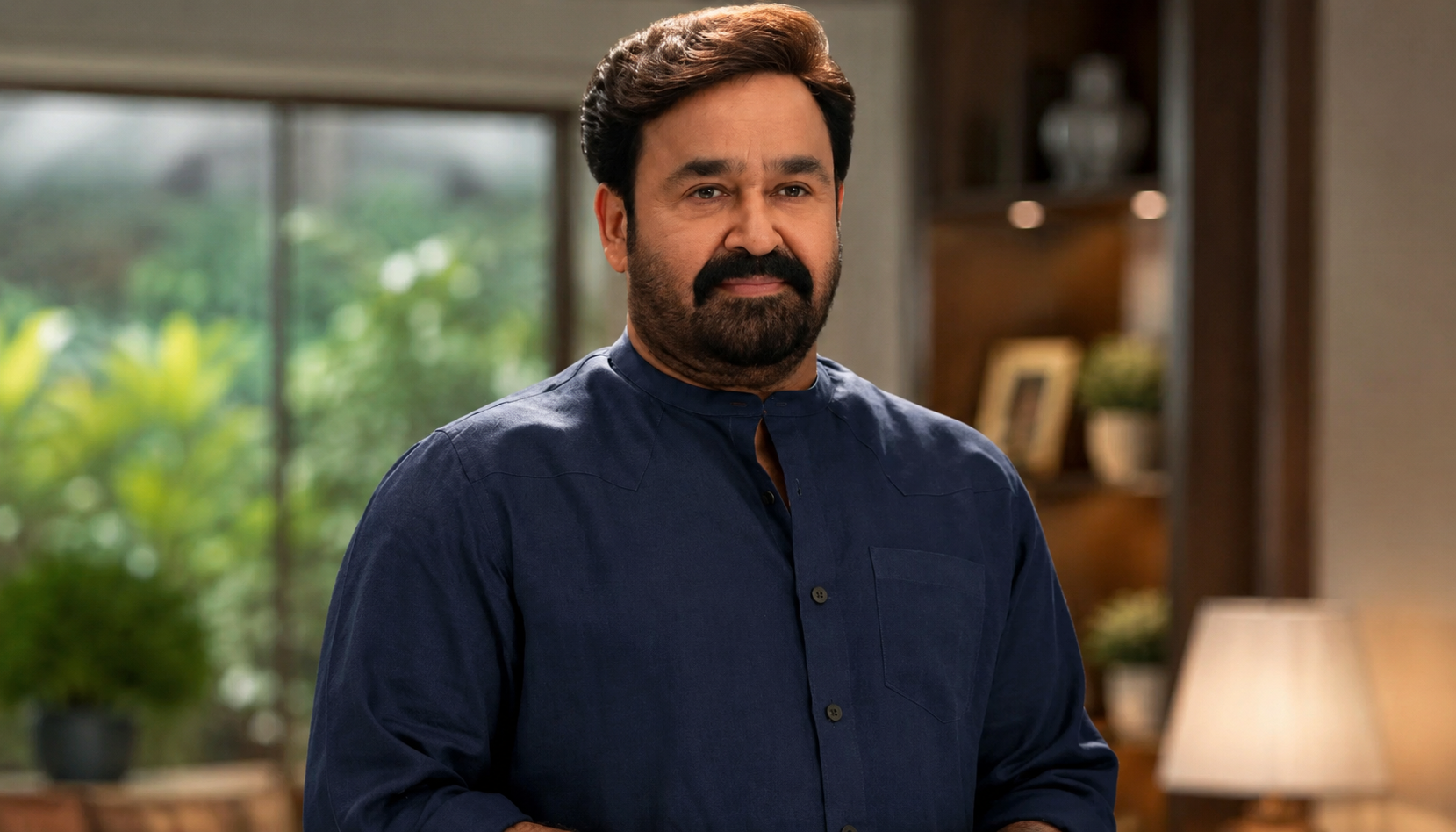
Mohanlal
Indian film actor, producer, and one of the most acclaimed figures in Malayalam cinema
Mohanlal is one of the most celebrated actors in Indian cinema, known for his effortless natural acting and incredible versatility. Born in Kerala, he has spent over four decades bringing unforgettable characters to life in Malayalam films and beyond.
Full Name: Mohanlal Viswanathan
Born: 21 May 1960 (age 65)
Place: Elanthoor, Kollam, Kerala (present-day Pathanamthitta, Kerala, India)
Education: Mahatma Gandhi College (BCom)
Title: Actor, Director, Producer, Distributor, Playback singer
Years active: 1978–present
Website: thecompleteactor.com
Lalettan, The Man Who Became Cinema
There is a moment in Malayalam cinema, one of many, where Mohanlal does almost nothing. He simply listens. His eyes flicker, his breathing shifts, and somewhere between silence and stillness, an entire life unfolds. No grand gesture. No theatrical flourish. Just truth, distilled.
That is Mohanlal’s magic.
For over four decades, he has existed not as a performer trying to impress, but as a presence that absorbs, reacts, and transforms. Audiences do not watch him act, they experience him. His characters feel lived-in, flawed, intimate, and startlingly real.
To Kerala, he is “Lalettan,” a term that carries affection, reverence, and familiarity all at once. To Indian cinema, he is a benchmark. To actors, he is a mystery, a craftsman who makes the most difficult thing look effortless.
This Mohanlal biography is not just the story of a star. It is the evolution of an instinct, a phenomenon that redefined what it means to be an actor in Malayalam cinema, and beyond.
Early Life & Origins: A Quiet Beginning
Born on May 21, 1960, in Pathanamthitta and raised in Thiruvananthapuram, Mohanlal Viswanathan grew up far removed from the arc lights of cinema. His father, Viswanathan Nair, worked in government service, while his mother, Santhakumari, created a home defined by discipline and emotional grounding.
There was nothing overtly cinematic about his childhood. He was not groomed for stardom, nor did he carry the early ambition of becoming an actor. Instead, he lived a life that was distinctly ordinary, rooted in school, friendships, and physical pursuits. At Mahatma Gandhi College, he became a state-level wrestling champion, a detail that feels telling in hindsight. Wrestling demands balance, instinct, and control, qualities that would later define his performances.
Cinema entered his life almost by accident. Through college friends involved in filmmaking, Mohanlal found himself auditioning for a role in Manjil Virinja Pookkal, directed by Fazil. He was cast not as a hero, but as a villain.
That choice, in retrospect, feels poetic. Mohanlal did not enter cinema through the front door of heroism. He slipped in through ambiguity, through characters that were morally complex and emotionally unpredictable. Even in his earliest appearance, there was a rawness, an unfiltered presence that resisted performance.
He did not act. He existed.
Breakthrough & Rise to Stardom: Reinventing the Hero
The early 1980s saw Mohanlal in a series of antagonist roles, each one sharpening his screen instinct. Unlike conventional villains, his characters were layered, often unsettling because they felt real. He brought unpredictability to the frame, a quality that filmmakers quickly recognized.
But the turning point came with Rajavinte Makan. Here, Mohanlal stepped into the space of a leading man, but not in the traditional mould. He was charismatic, yes, but also flawed, morally grey, and grounded. Malayalam cinema had not seen a hero like this before.
The late 1980s and early 1990s marked an extraordinary phase in the Lalettan career. Films like Kireedam shattered the idea of invincible masculinity. His portrayal of a young man crushed under societal expectations remains one of the most devastating performances in Indian cinema. In Chithram, he effortlessly balanced humor and heartbreak, proving his range.
Then came Bharatham, a performance so emotionally intricate that it earned him the National Film Award. By now, Mohanlal was not just a rising star, he was redefining the grammar of acting in Malayalam cinema.
He brought vulnerability into heroism. He made silence powerful. He turned everyday gestures into moments of profound meaning.
By the early 1990s, Mohanlal was not merely part of Malayalam cinema, he was shaping its identity.
The Actor: Craft & Versatility
To understand Mohanlal is to understand restraint. His acting is built not on projection, but on absorption. He listens more than he speaks, reacts more than he performs, and allows emotion to emerge organically.
His naturalism is often described as effortless, but that effortlessness is deceptive. It comes from a deep internalization of character. Mohanlal does not “play” a role, he dissolves into it. His body language shifts subtly, his voice modulates instinctively, and his eyes carry the emotional weight of the scene.
What sets him apart is range. He can move from slapstick comedy to devastating tragedy without visible transition. In comedic roles, his timing is impeccable, rooted in rhythm and spontaneity. In dramatic performances, he accesses a depth of emotion that feels almost intrusive, as if the audience is witnessing something deeply personal.
He also mastered the balance between mass and class. While many actors are confined to either commercial entertainers or art-house cinema, Mohanlal navigated both with ease. He could headline a blockbuster and then deliver a performance-driven film that wins critical acclaim.
His characters are rarely idealized. They are flawed, vulnerable, and deeply human. This relatability is the core of his appeal. Audiences see themselves in him, not as heroes, but as people navigating life’s complexities.
Iconic Films & Career Peaks
Every era of Mohanlal’s career has produced landmark films that redefine expectations. In the 1990s, Devasuram introduced Mangalassery Neelakandan, a character that became synonymous with controlled aggression and aristocratic pride. Spadikam gave audiences Aadu Thoma, a rebellious figure etched into pop culture.
Perhaps one of his most artistically significant performances came in Vanaprastham, where he played a Kathakali artist navigating identity and art. The film gained international recognition, bringing global attention to Malayalam cinema.
In the 2000s and beyond, Mohanlal continued to evolve. Drishyam became a pan-Indian phenomenon, with its narrative intelligence and his understated performance redefining the thriller genre.
Pulimurugan shattered box office records, proving his enduring mass appeal. Lucifer, directed by Prithviraj Sukumaran, reintroduced him to a younger audience as a commanding, enigmatic force.
Across decades, his collaborations with visionary directors have resulted in films that are both commercially successful and artistically rich. His career is not defined by peaks and valleys, but by a sustained excellence that adapts with time.
The Superstar Persona: The Lalettan Phenomenon
In Kerala, Mohanlal is not just an actor. He is an emotion.
The term “Lalettan” reflects a unique relationship between star and audience. It is affectionate, intimate, and deeply personal. Fans do not merely admire him, they feel connected to him.
What makes his stardom fascinating is its duality. On one hand, he is a mass hero capable of commanding massive box office openings. On the other, he remains one of the most subtle performers in Indian cinema.
This balance has shaped Malayalam cinema itself. His presence allowed the industry to explore both commercial spectacle and narrative depth without compromise.
Beyond Acting: The Many Facets
Beyond cinema, Mohanlal has explored multiple avenues. He has produced films, lent his voice as a playback singer, and ventured into business. His entrepreneurial pursuits include hospitality and brand endorsements, reflecting a keen understanding of his influence.
Off-screen, he is known for his grounded personality. Colleagues often describe him as instinctive, warm, and deeply professional. Despite decades of stardom, he carries an ease that feels disarming.
Recent Era & Reinvention
The period from 2015 to 2026 has been one of reinvention. With the rise of OTT platforms and changing audience sensibilities, Mohanlal adapted once again. Drishyam 2 proved that storytelling could transcend theatrical boundaries.
While some projects faced criticism, his willingness to experiment remained intact. He embraced new directors, genres, and formats, ensuring that his relevance extended beyond nostalgia.
Even in an era dominated by younger actors, Mohanlal continues to command attention, not through reinvention alone, but through consistency.
Legacy & Cultural Impact
Mohanlal’s legacy is not confined to filmography. It exists in the way actors approach performance, in the way filmmakers write characters, and in the way audiences engage with cinema.
He brought authenticity into mainstream acting. He showed that subtlety could be powerful, that vulnerability could define heroism.
For generations of actors, he remains a benchmark. For Malayalam cinema, he is a pillar. For Indian cinema, he is proof that greatness lies in truth.
The Eternal Presence
There are stars who shine brightly and fade. And then there are those who become part of the sky itself.
Mohanlal belongs to the latter.
His journey, from an accidental debut to becoming a Malayalam cinema legend, is not just about success. It is about understanding the human condition and translating it onto screen with honesty and grace.
Even today, when he stands before the camera, there is a quiet anticipation. Not of spectacle, but of truth.
Because when Mohanlal performs, cinema does not feel like fiction.
It feels like life.
Awards & Recognition
2009 – Goodwill Ambassador of Kerala Athletics
2010 – Goodwill Ambassador of Kerala Handloom Industry
2012 – Honorary doctorate (The Sree Sankaracharya University of Sanskrit)
2013 – Honorary Black Belt in Taekwondo
2015 – Goodwill Ambassador of Subhayatra (Road Safety)
2016 – Goodwill Ambassador Mrithasanjeevani (Deceased Organ Transplantation Program)
Kerala State Film Awards
1986 – Best Actor (T. P. Balagopalan M.A.)
1988 – Special Jury Award
1991 – Best Actor (Abhimanyu, Kilukkam, Ulladakkam)
1991 – Second Best Film (Producer) Bharatham
1995 – Best Actor (Kalapani, Spadikam)
1995 – Second Best Film (Producer) Kalapani
1999 – Best Actor (Vanaprastham)
2005 – Best Actor (Thanmathra)
2007 – Best Actor (Paradesi)
National Film Awards
1989 – Special Jury Award (Kireedam)
1991 – Best Actor (Bharatham)
2000 – Best Actor (Vanaprastham)
2000 – Best Film (Producer) Vanaprastham
2017 – Special Jury Award (Pulimurugan, Janatha Garage & Munthirivallikal Thalirkkumbol)
National recognition
2001 – Padmasree
2009 – Honorary Lt. Colonel by Indian Army
2019 – Padma Bhushan
2025 – Dada Saheb Phalke Award (Highest honour in the Indian film industry)