
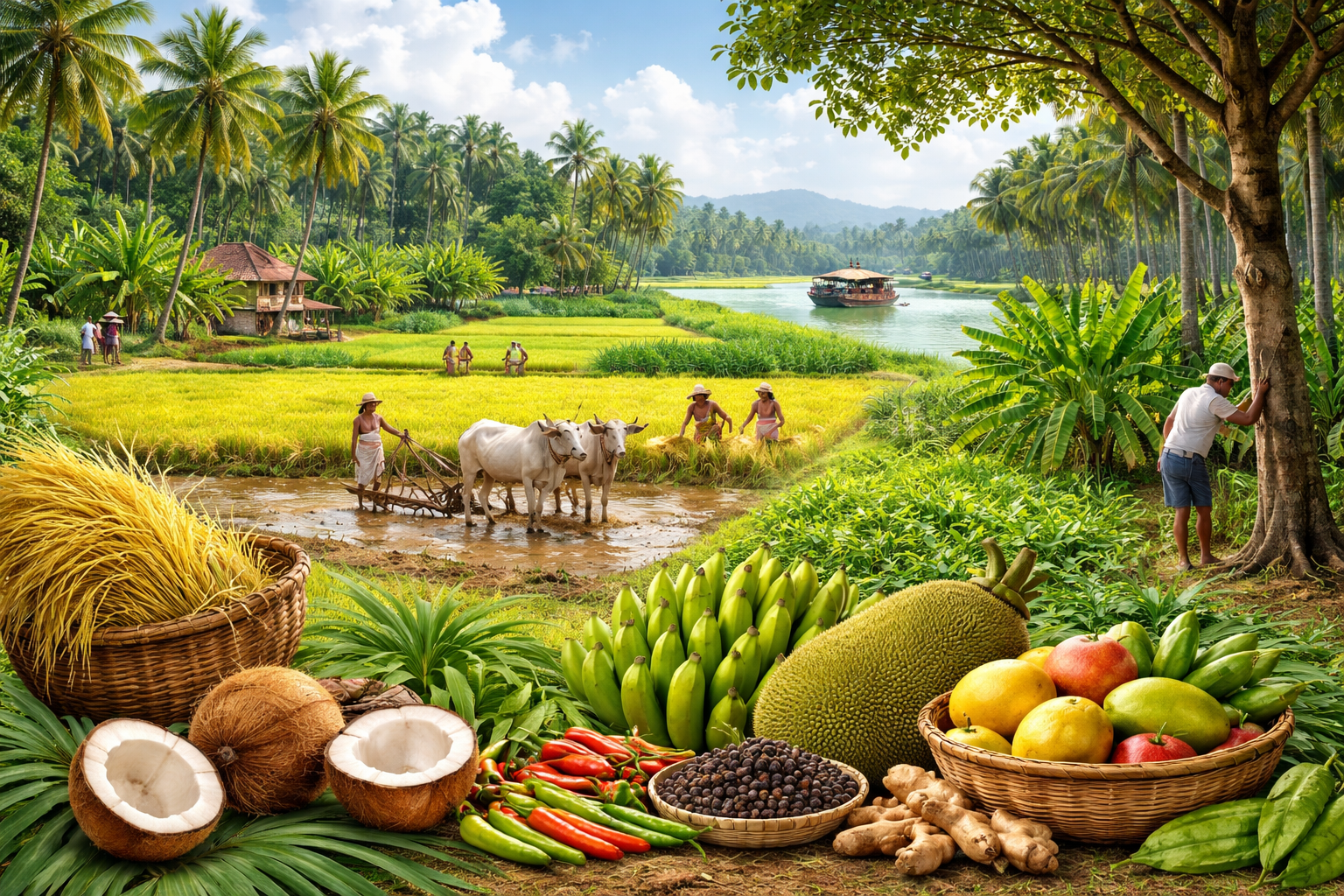
Top Agriculture in Kerala
A complete, ground-level look at the crops shaping Kerala’s economy, culture, and rural life
- Coconut
- Rubber
- Rice (Paddy)
- Black Pepper
- Cardamom
- Tea
- Coffee
- Banana
- Cashew
- Tapioca
Well-known Agriculture & Crops in Kerala
Agriculture in Kerala is a story of adaptation. Unlike large agrarian states with vast plains, Kerala operates on small landholdings, high rainfall, and plantation-driven farming systems. Yet, despite geographic limitations, the state has built one of the most unique and export-oriented agricultural ecosystems in India.
The backbone of the Kerala farming economy lies in a mix of plantation crops, spices, and food crops, each deeply tied to the state’s climate and history. Coconut trees line coastal belts, rubber dominates midlands, spices thrive in the Western Ghats, and paddy fields define traditional agrarian landscapes.
Over the years, Kerala has also shifted from subsistence farming to high-value crops, driven by global demand and changing consumption patterns. At the same time, challenges like labour shortages, climate variability, and land fragmentation continue to reshape farming practices.
This guide explores the major crops in Kerala, ranked by economic importance, cultural relevance, and cultivation scale. Together, they reveal how agriculture in Kerala is not just an occupation, but a system of identity, resilience, and transformation.
1. Coconut
Coconut is the most iconic and widely associated crop with Kerala, so much so that the state’s name itself is often linked to “land of coconuts.” It is one of the most significant plantation crops in Kerala, both economically and culturally.
Coconut is cultivated across almost all districts, with a strong presence in coastal regions like Alappuzha, Kozhikode, and Thrissur. The crop plays a central role in Kerala’s rural economy, supporting millions of small farmers.
Economically, coconut contributes to multiple industries, including edible oil production, coir manufacturing, handicrafts, and cosmetics. Kerala is one of India’s largest producers of coconut and coconut-based products.
Its versatility is unmatched. Every part of the coconut tree is used, from the fruit and oil to husk and leaves, making it a zero-waste crop.
However, the sector faces challenges such as fluctuating prices, pest attacks, and competition from other states.
Despite this, coconut remains the foundation of agriculture in Kerala, deeply embedded in daily life and economic activity.
2. Rubber
Rubber is one of the most economically important crops in Kerala, particularly in the midland regions like Kottayam, Pathanamthitta, and Idukki.
Kerala accounts for a significant share of India’s natural rubber production, making it a key contributor to the Kerala farming economy.
The crop thrives in Kerala’s humid tropical climate. Farmers tap latex from rubber trees, which is then processed into sheets and used in industries such as tyres, footwear, and manufacturing.
Rubber cultivation transformed Kerala’s agrarian landscape in the 20th century, shifting many farmers from traditional crops to plantation-based income systems.
However, the sector faces price volatility due to global market fluctuations and competition from synthetic rubber.
Despite these challenges, rubber remains a high-value cash crop, supporting thousands of farmers and contributing significantly to exports.
3. Rice (Paddy)
Rice is the traditional staple crop and a core part of Kerala’s agricultural heritage. Paddy fields, especially in regions like Kuttanad, represent one of the most unique farming systems in India, including cultivation below sea level.
Historically, rice dominated Kerala’s agriculture. However, over the years, the area under paddy cultivation has declined due to urbanisation and a shift to cash crops.
Despite this, rice remains crucial for food security and cultural identity.
The government has introduced initiatives to revive paddy farming, including subsidies and mechanisation support.
Rice cultivation in Kerala is labour-intensive and highly dependent on monsoon patterns.
It remains a symbol of traditional agriculture in Kerala, even as its economic share declines.
4. Black Pepper
Known as the “King of Spices,” black pepper is one of Kerala’s most historically significant crops.
Cultivated mostly in the Western Ghats regions like Wayanad and Idukki, pepper has been a major export commodity since ancient times, attracting global trade.
Kerala produces high-quality pepper with strong aroma and flavour, making it a premium product in international markets.
Pepper cultivation is often integrated with other crops, using trees as support for vines.
The crop faces challenges like disease and climate variability, but remains a key export-oriented spice crop.
5. Cardamom
Cardamom, often called the “Queen of Spices,” is a high-value crop cultivated in the high ranges of Idukki.
Kerala is one of the leading producers of cardamom in India, with strong export demand.
The crop requires specific climatic conditions, including high altitude and rainfall.
Cardamom contributes significantly to spice exports from Kerala, making it economically vital.
6. Tea
Tea is a major plantation crop grown in high-altitude regions like Munnar.
Kerala’s tea estates are known for their scenic beauty and high-quality production.
The industry contributes to employment and tourism.
Tea remains a key plantation crop in Kerala’s hill economy.
7. Coffee
Coffee is cultivated mostly in Wayanad, often alongside spices.
Kerala produces both Arabica and Robusta varieties.
The crop is export-oriented and contributes to rural income.
8. Banana
Banana is one of the most widely consumed and cultivated crops in Kerala.
Varieties like Nendran are culturally significant and used in traditional cuisine.
It is a key horticulture crop with strong local demand.
9. Cashew
Cashew is both an agricultural and an industrial crop in Kerala.
Kollam is known as the cashew capital, with a strong processing industry.
The crop supports exports and employment.
10. Tapioca
Tapioca, introduced during colonial times, became a staple food crop.
It is widely grown and used in traditional Kerala cuisine.
The crop is resilient and adaptable.
Finat Take
Kerala’s agricultural landscape is evolving rapidly.
Shift toward organic and sustainable farming
Growth of exotic fruits and high-value crops.
Increased focus on value-added products
Challenges from climate change and labour costs
Government initiatives and farmer innovation are driving a gradual transformation toward modern, sustainable agriculture.
Agriculture in Kerala is a balance between tradition and change.
From coconut and rubber to spices and tea, each crop tells a story of adaptation and resilience.
The major crops in Kerala are not just economic drivers. They are cultural markers.
And as the state moves forward, its agricultural future will depend on how well it blends
heritage with innovation.