Top 10 Traditional Onam Games and Activities
- Vallam Kali (Snake Boat Race)
- Pulikali (Tiger Dance)
- Onathallu (Onam Wrestling)
- Uriyadi (Pot-Breaking Game)
- Talappanthukali (Traditional Ball Game)
- Kummattikali
- Thiruvathirakali
- Onapottan
- Kaikottikali
- Tug-of-War (Vadamvali)
Introduction
Onam is more than a harvest festival in Kerala. It is a season when families come together, neighbourhoods become lively, and traditional games and cultural activities fill the festive days with excitement. Many of these activities have been passed down through generations and continue to bring people together regardless of age.
From the spectacular snake boat races held on Kerala’s backwaters to energetic village games, colourful folk performances and group dances, Onam activities reflect the state’s strong community spirit. While some traditions are closely associated with particular regions, others have become popular across Kerala during the festival season.
Here are 10 traditional Onam games and activities that showcase the fun, culture and togetherness of the festival.
1. Vallam Kali (Snake Boat Race)
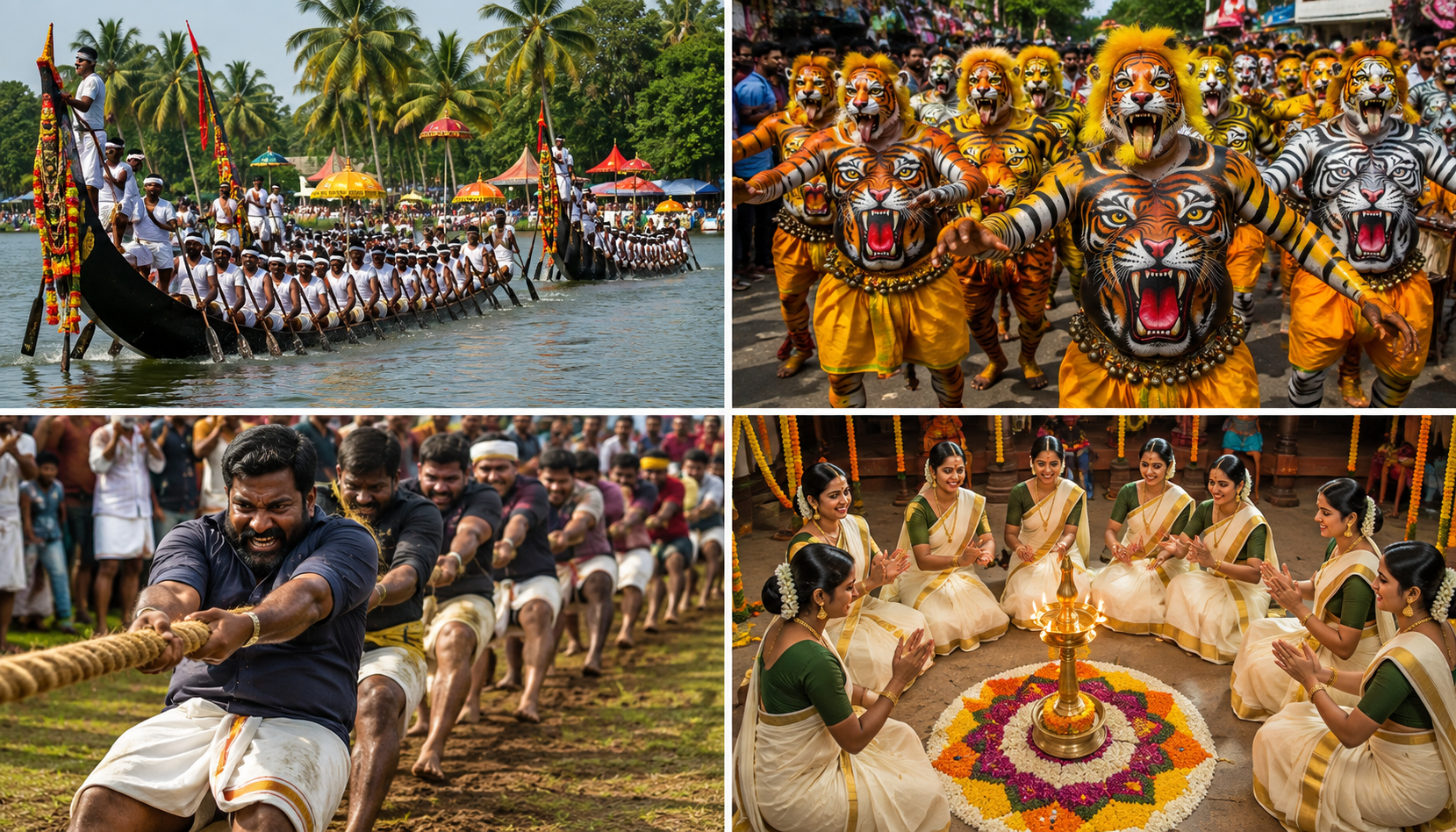
Vallam Kali, or the traditional boat race, is one of the most iconic spectacles associated with Onam. Long snake boats, known as chundan vallams, race through Kerala’s backwaters as hundreds of rowers work together to the rhythm of traditional songs.
The sight of rowers moving in perfect coordination, accompanied by cheering crowds and traditional music, makes Vallam Kali a major attraction during the Onam season. The Nehru Trophy Boat Race is among the best-known boat races in Kerala, although several other races are held across the state.
More than a competition, Vallam Kali represents teamwork, discipline and the strong connection between Kerala’s communities and its waterways.
2. Pulikali (Tiger Dance)
Pulikali is one of the most colourful and entertaining folk performances associated with Onam. Performers paint their bodies with tiger-like patterns and dress up as hunters and tigers before dancing to the beat of traditional percussion instruments.
The streets of Thrissur become particularly lively during the famous Pulikali celebrations. Performers move and dance to the rhythm while large crowds gather to watch the spectacle.
The combination of body painting, music, costumes and energetic movements makes Pulikali one of the most recognisable visual traditions of Onam.
3. Onathallu (Onam Wrestling)
Onathallu is a traditional form of wrestling that has historically been practised as part of Onam celebrations in parts of Kerala. Participants engage in physical contests that require strength, agility and technique.
Unlike modern competitive wrestling, Onathallu is deeply connected with local customs and community celebrations. It traditionally brought groups of people together and created an atmosphere of friendly competition.
Although the practice is not as widespread as it once was, it remains an important part of Kerala’s traditional sporting heritage.
4. Uriyadi (Pot-Breaking Game)
Uriyadi is a popular traditional game in which participants attempt to break a clay pot, usually suspended from a height. The challenge becomes more entertaining when the participant is blindfolded or the pot is moved, making it difficult to locate and strike.
The game requires coordination, concentration and a good sense of direction. It is often enjoyed by groups during festive gatherings and community celebrations.
The simplicity of Uriyadi is part of its appeal. All that is needed is a pot, a stick and a group of enthusiastic participants.
5. Talappanthukali (Traditional Ball Game)
Talappanthukali is a traditional outdoor game that has been associated with Onam celebrations, particularly among men and young people in parts of Kerala.
The game involves a ball and opposing groups competing through a combination of movement, strategy and physical skill. Traditionally played in open spaces, it offered an opportunity for young people to gather and participate in friendly competition.
Like many traditional games, Talappanthukali reflects the importance of outdoor community activities in Kerala’s cultural life.
6. Kummattikali
Kummattikali is a colourful folk performance traditionally seen during the Onam season in parts of Kerala. Performers wear distinctive masks and colourful costumes representing various characters and move from place to place entertaining people.
The performance combines music, dance and folklore, creating a festive atmosphere in villages and communities. The masks and costumes are particularly fascinating for children, while the traditional stories and performance style connect the activity with Kerala’s folk heritage.
Kummattikali is not simply entertainment; it is also a living expression of Kerala’s traditional performing arts.
7. Thiruvathirakali
Thiruvathirakali, also known as Kaikottikali in many contexts, is a graceful group dance traditionally performed by women. Dancers move in a circular formation around a traditional lamp, performing coordinated steps accompanied by songs.
Although associated with different cultural occasions in Kerala, the dance is also an important part of festive celebrations during Onam.
The performance highlights coordination, elegance and traditional music, making it a popular cultural activity during school programmes, family gatherings and community celebrations.
8. Onapottan
Onapottan is a traditional folk character associated with Onam celebrations, particularly in northern Kerala. A performer dressed in elaborate traditional attire, including colourful ornaments and a distinctive headgear, visits homes during the festive period.
Onapottan is associated with blessings, prosperity and the arrival of the festive spirit. The character’s striking appearance and traditional performance style make the practice an important part of the cultural traditions of the region.
It is an example of how Onam customs can vary considerably from one part of Kerala to another.
9. Kaikottikali
Kaikottikali is another traditional group dance closely associated with Kerala’s cultural celebrations. Women perform the dance in a circle, moving rhythmically while clapping their hands and singing traditional songs.
During Onam, Kaikottikali performances can be seen at homes, schools, cultural programmes and community events. The dance does not depend on elaborate stage equipment, which allows it to remain a participatory tradition.
Its simple formation, coordinated movements and traditional songs capture the warmth and togetherness associated with Onam.
10. Tug-of-War (Vadamvali)
Vadamvali, or tug-of-war, is one of the most popular group games during Onam celebrations. Two teams pull opposite ends of a rope, with each side attempting to bring the other team across a designated line.
The rules are simple, but the game can quickly become highly competitive. Friends, family members, students and neighbourhood groups often take part in Vadamvali during Onam gatherings.
The game perfectly represents the community spirit of the festival because success depends on teamwork rather than individual strength alone.
Conclusion
Traditional Onam games and activities add a lively and communal character to Kerala’s harvest festival. While some involve physical competition, others focus on music, dance, folk traditions and cultural storytelling.
From the powerful rhythm of Vallam Kali and the excitement of Vadamvali to the colourful performances of Pulikali and Kummattikali, each tradition offers a different glimpse into Kerala’s cultural heritage.
As modern celebrations continue to evolve, keeping these traditional games and activities alive can help younger generations understand and experience the community spirit that has always been at the heart of Onam.