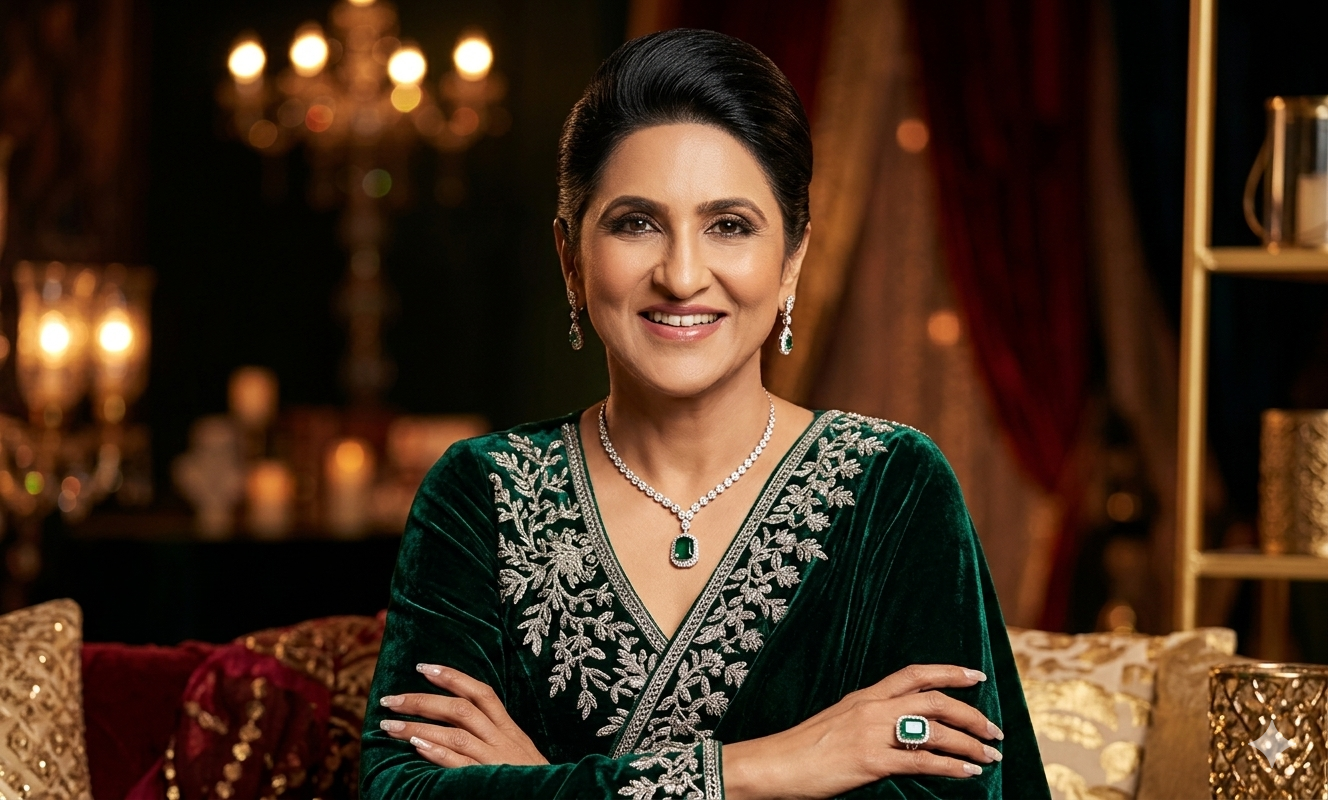
Beena Kannan
CEO and lead designer of Seematti textiles
Beena Kannan is an Indian businesswoman, who is the CEO and lead designer of Seematti textiles. Scion of the ‘Seematti’ family, Beena Kannan comes from a rich heritage of textile lovers. Born on 17th July 1960 in Kottayam, Beena Kanan is the daughter of V. Thiruvenkitam and Mrs Seetha Lakshmi Thiruvenkitam and the granddaughter of textile king Veeriah Reddiar. Under the leadership of Beena Kannan, the brand expanded from a local store to over 10 outlets across Kerala, boasting over 10 lakh sq ft of retail space.
Key Facts
Born: 17 July 1960 (age 65)
Place: Kottayam, Kerala, India
Title: CEO and lead designer of Seematti textiles
Beena Kannan: Weaving Power, Identity, and the Authority of Tradition
There is a moment inside every Seematti store when time seems to fold in on itself. Silk glides between fingers, gold threads catch light, and mirrors reflect not just garments, but memory. Somewhere in that carefully composed world stands Beena Kannan, not always visible, but unmistakably present.
She did not inherit a blank canvas. She inherited a name heavy with expectation, a legacy built by her father, V. Thiruvenkitam . But inheritance, as she would learn, is not possession. It is a negotiation.
Beena Kannan’s journey is not merely about sustaining a brand. It is about redefining what tradition means in a changing India.
In an industry that often confuses scale with success, she chose something quieter. Precision. Continuity. Control.
And in doing so, she transformed Seematti from a respected saree house into a cultural institution.
A Daughter of Seematti
Beena Kannan’s story begins inside fabric, quite literally.
As the daughter of V. Thiruvenkitam , founder of Seematti, she grew up watching the slow, disciplined building of one of Kerala’s most respected textile brands. The store was not just a business. It was a space where taste was curated, where customers trusted instinct over advertisement.
Unlike many second-generation entrepreneurs who arrive with disruption in mind, Beena entered with observation. She studied the rhythms of the business, the psychology of customers, and the delicate balance between aspiration and affordability.
This early immersion shaped her most defining instinct, respect the product, but understand the person buying it.
Taking Charge, Quietly
When Beena Kannan stepped into leadership, it was not marked by dramatic announcements or aggressive reinvention.
Her approach was measured. She did not dismantle what existed. She refined it.
Under her leadership, Seematti expanded its physical presence while retaining its identity as a premium saree destination. The Kochi flagship store evolved into a landmark, not just for shopping, but for experience.
She invested in design, display, and customer engagement, understanding that modern retail is as much about atmosphere as it is about inventory.
In a market flooded with discount-driven competition, she resisted dilution. Seematti would not become louder. It would become sharper.
Rewriting the Saree Narrative
Perhaps Beena Kannan’s most significant contribution lies in how she repositioned the saree itself.
At a time when younger consumers were drifting toward western wear and fast fashion, she reframed the saree as something contemporary, not nostalgic.
Through carefully curated collections, fashion shows, and campaigns, Seematti began speaking to a new generation of women. The saree was no longer just ceremonial. It became expressive. Individual. Relevant.
This was not reinvention for the sake of trend. It was a recalibration of meaning.
The Woman at the Helm
In Kerala’s traditionally male-dominated business landscape, Beena Kannan’s presence carries quiet significance.
She does not perform power. She exercises it with restraint.
Her leadership style is often described as intuitive yet disciplined. She is closely involved in design decisions, store aesthetics, and brand direction. Every detail reflects a certain consistency, a refusal to compromise on quality or perception.
There is also an emotional intelligence to her leadership. She understands that clothing, especially in Indian culture, is deeply tied to identity, ritual, and memory.
That sensitivity has become a strategic advantage.
Beyond Retail
Beena Kannan’s influence extends beyond commerce.
She has been active in cultural and social initiatives, supporting platforms that celebrate Kerala’s heritage and craftsmanship. Through Seematti, she has also contributed to charitable efforts, particularly in times of crisis.
Her work reflects a belief that legacy businesses must engage with the communities that sustain them.
In this sense, Seematti is not just a retail space. It is part of a larger cultural ecosystem.
Holding Ground in a Changing Market
The Indian retail landscape has changed dramatically, with e-commerce, fast fashion, and aggressive pricing reshaping consumer behavior.
Yet Beena Kannan has held her ground.
Rather than chasing volume, she has focused on value. Rather than competing on price, she has competed on trust.
This strategy has allowed Seematti to maintain its positioning as a premium, experience-driven brand in an increasingly transactional market.
It is a slower path. But it is also a more enduring one.
Reflection
Beena Kannan’s story resists easy narratives. It is neither a tale of rebellion nor one of passive inheritance.
It is something more nuanced, a study in stewardship.
She did not set out to change the world of textiles overnight. She chose instead to understand it deeply, to move with intention, to refine rather than replace.
In an era obsessed with speed, scale, and noise, her approach feels almost radical. Because sometimes, the most powerful transformation does not come from disruption.
It comes from knowing exactly what must remain untouched.
Contributions
2007 – Entered the Guinness Book of World Records for designing the world’s longest saree.
Released a book titled ‘Book of Indian Silk Sarees’ in collaboration with The Times of India, which explains the silk sarees of India, where they are made, and what are the characteristics of each saree