
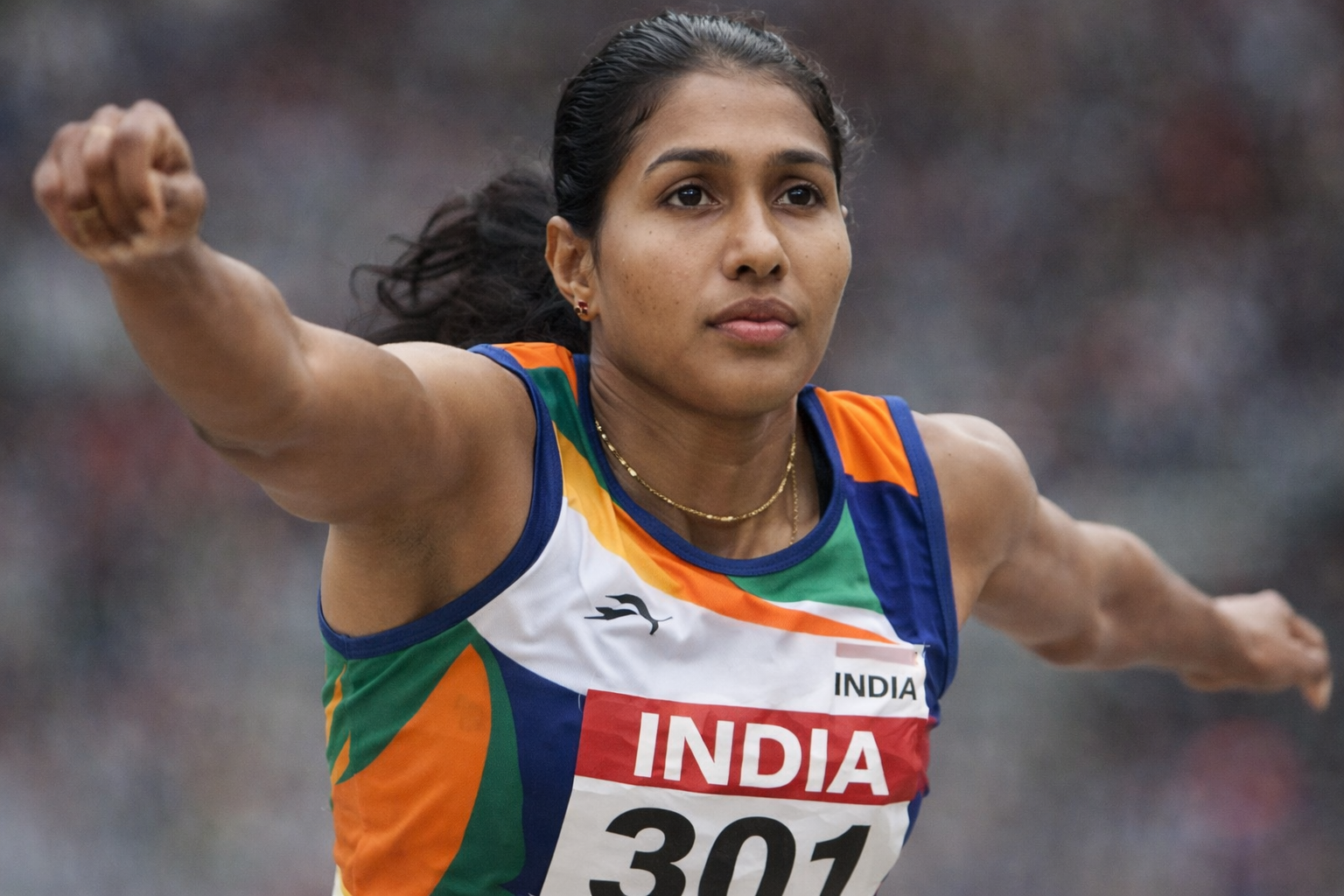
Anju Bobby George
Anju Bobby George is one of India’s most celebrated athletes, known for bringing international recognition to Indian athletics through her achievements in long jump. With her determination and historic performances on the global stage, she inspired a new generation of athletes from Kerala and across the country.
Born: 19 Apr 1977 (48 years)
Place: Changanassery, Kerala, India
Education: Vimala College Thrissur, University of Calicut
A Measured Run, A Moment Suspended
There is a quiet before the sprint, a narrow corridor of focus where the world recedes into rhythm. On the runway in Paris, under the gaze of a global field that had long excluded Indian names from its podium conversations, Anju Bobby George begins her approach. Each stride is calibrated, neither rushed nor hesitant. The board arrives, she hits it clean, and for a fraction of a second, she is suspended, balanced between ambition and gravity.
It is an outstanding image, not because of spectacle, but because of its defiance. When she lands, the mark reads 6.70 metres. It is enough. Enough to place India, for the first time, on the podium at the 2003 World Athletics Championships. Enough to shift a narrative that had lingered for decades.
This was not just a jump. It was a breach.
Early Life and Roots in Kerala: Built in Small Spaces
Born on April 19, 1977, in Changanassery, Kerala, Anju grew up in a state where athletics had visibility but not always infrastructure. Kerala’s sporting culture leaned heavily on school competitions, inter-district meets, and a system that relied more on individual persistence than institutional depth.
Her family recognized her athletic ability early. Unlike many young girls of her time, Anju received encouragement rather than resistance. She was drawn to multiple events initially, high jump, sprinting, heptathlon, but it was the long jump that would eventually define her.
The conditions were modest. Training facilities were basic, equipment limited, and exposure to international standards almost nonexistent. Yet, Kerala’s school sports system provided something crucial, frequency. Competitions were regular, and talent, if persistent, found ways to surface.
Anju’s early success at the school and national junior levels hinted at potential, but not yet at history. At that stage, Indian athletics had produced moments, not movements. She was entering a system where global success was still an exception, not expectation.
Rise in Indian Athletics: Structure Meets Talent
Anju’s transition from promising athlete to elite competitor was neither automatic nor smooth. It required recalibration, technical refinement, and, crucially, the right mentorship.
That mentorship came in the form of Bobby George, a former national triple jumper who would become both her coach and husband. His role in her career cannot be overstated.
The Turning Point
Under Bobby George’s guidance, Anju’s training became Scientifically structured, focused on run-up consistency and take-off precision and built around strength conditioning and biomechanics
This was a shift from the largely intuitive training systems prevalent in India at the time.
Early Milestones
- Dominance at national championships
- Increasing consistency in the 6.50m+ range
- Qualification for major international events
Yet, challenges persisted. Injuries interrupted momentum. The gap between Indian and global standards remained significant. Competing internationally meant confronting athletes with access to superior facilities, coaching, and competition cycles.
Anju’s rise was not just about improving distances. It was about closing systemic gaps.
Historic Breakthrough: Paris 2003 and the Rewriting of Limits
The 2003 World Athletics Championships was not expected to produce Indian history.
The long jump field featured some of the best athletes in the world, competitors who regularly crossed the 6.80m and 7.00m marks. Anju entered as an outsider, respected, but not favored.
The Jump: 6.70 Metres
Her best attempt, 6.70m, was not her personal best, but it was executed under pressure, at the right moment, in a final where margins were unforgiving.
Technical Breakdown
Run-up: Controlled acceleration, avoiding overstriding
Take-off: Clean board contact, minimal loss of horizontal velocity
Flight phase: Efficient hang technique, maximizing extension
Landing: Balanced, minimizing backward drag
In elite long jump, distances are not just about power. They are about precision across phases. Anju’s jump was technically sound, not spectacularly explosive, but remarkably efficient.
Significance
- First Indian athlete to win a World Championships medal in athletics
- A moment that expanded the scope of Indian sporting ambition
- Validation of structured coaching and international exposure
It was a breakthrough that carried symbolic weight far beyond the distance measured.
Olympic Journey and Global Competitions: Close to the Edge
Anju’s Olympic journey, particularly at the 2004 Athens Olympics, represented both progress and frustration.
She finished sixth in Athens, with a best jump of 6.83m, a national record at the time. It was a performance that placed her within reach of the podium, but not on it.
Contextual Analysis
- The winning distances exceeded 7 metres
- Margins between podium positions were narrow
- Anju competed in one of the strongest long jump fields in Olympic history
Global Standing
During her peak years, Anju consistently ranked among the top long jumpers globally:
- Regular finalist in international competitions
- Competed against legends like Tatyana Lebedeva
- Maintained performance levels close to elite benchmarks
Her Olympic story is not one of medals, but of proximity, of how close Indian athletics came to breaking another barrier.
Struggles, Setbacks, and Comebacks: The Weight of Expectation
Anju’s career was punctuated by interruptions. Recurring injuries, particularly affecting her ankle and knee, disrupted training cycles and competitive rhythm.
Post-2003, expectations shifted dramatically: Every performance was measured against her Paris success
Institutional Challenges: Limited access to sustained international competition, Gaps in sports science support and Financial and logistical constraints.
Her ability to remain competitive despite these factors reflects resilience beyond physical capability.
Changing the Frame
Anju Bobby George’s legacy operates on multiple levels.
1. A Pioneer for Indian Athletics
She demonstrated that:
- Indian athletes could compete at the highest level
- Structured coaching could bridge global gaps
- Women could lead India’s athletics narrative
2. Inspiration for Future Generations
Athletes who followed, including Olympic medalists, emerged in a landscape where global success felt more attainable.
3. Institutional Contributions
Post-retirement, she has contributed through:
- Talent identification programs
- Administrative roles in athletics bodies
- Advocacy for better infrastructure
Critical Perspective: Individual Brilliance vs Systemic Gaps
Anju’s career highlights a recurring theme in Indian sport, success driven by individuals rather than systems.
- Structural Limitations of Her Era
- Lack of world-class training facilities
- Limited exposure to elite competition
- Inconsistent support structures
Her World Championship medal was not just achievement. It was an anomaly that exposed both potential and deficiency.
Had she emerged within a more advanced system, her ceiling might have been higher. Yet, it is precisely these constraints that make her achievements significant.
The Distance That Still Resonates
There is something enduring about that jump in Paris. Not because it was the longest of her career, but because of what it represented, a shift in possibility, a refusal to remain peripheral.
Anju Bobby George did not just win a medal. She altered expectation.
In the years since, Indian athletics has evolved, producing Olympic medalists and global contenders. But her moment remains foundational, a reference point for what belief, structure, and persistence can achieve.
It is an outstanding legacy, not defined by a single distance, but by the space it created for others to travel further.
Awards and recognitions
2002–2003: Arjuna award
2003–2004: Rajiv Gandhi Khel Ratna award
2004: Padma Shri