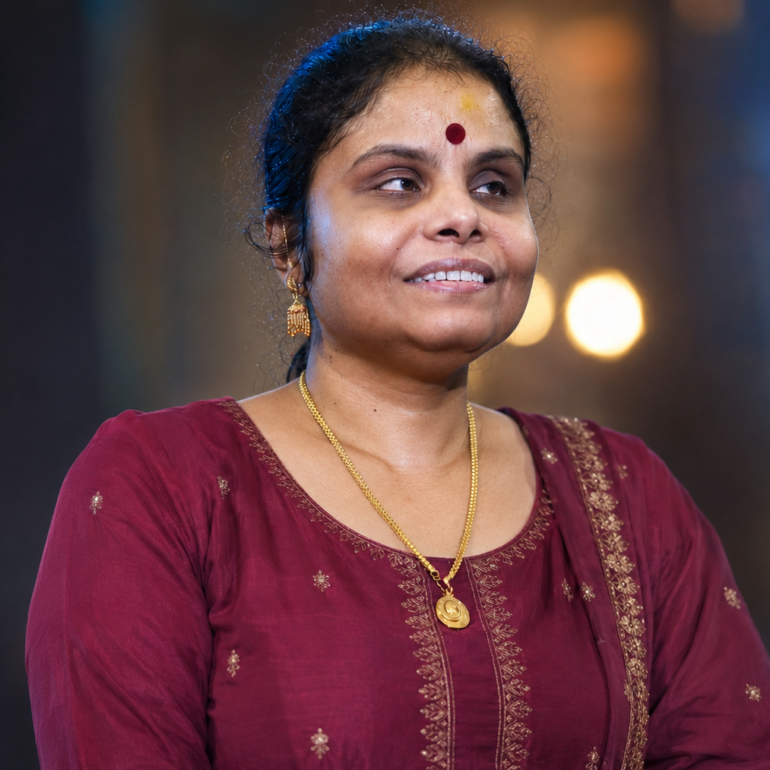

Sithara Krishnakumar
Indian Playback Singer
Sithara Krishnakumar is an Indian playback singer, composer, lyricist, classical dancer and an occasional actor. She predominantly works in Malayalam cinema in addition to Tamil, Telugu and Kannada films. Sithara is a well known singer who is trained in Hindustani and Carnatic classical music traditions and is also a recognised ghazal singer. Sithara was born at Vengara. Sithara was introduced to the world of music as a child and started singing at the early age of four.
Key Factors
Full Name: Sithara Krishnakumar
Date of Birth: 1 July 1986
Birthplace: Vengara, Malappuram, Kerala
Occupation: Playback Singer, Composer, Lyricist, Performer
Musical Genres: Carnatic, Hindustani, Ghazal, Folk, Fusion, Film Music
Languages Worked In: Malayalam, Tamil, Telugu, Kannada
Sithara Krishnakumar occupies a rare and deeply emotional space in contemporary Malayalam music. At a time when playback singing often moves rapidly between commercial trends and digital virality, Sithara emerged as a voice rooted in tradition yet fearlessly modern in spirit. Whether singing a delicate ghazal, a rustic folk melody, a film song filled with heartbreak, or an experimental fusion composition, she brings an outstanding emotional honesty that instantly connects with listeners. Her voice does not merely perform music; it inhabits memory, language, and lived experience.
Over the past two decades, Sithara has grown far beyond the identity of a playback singer. Trained in both Hindustani and Carnatic classical music, she evolved into a multidisciplinary artist who moves fluidly across film music, independent projects, composition, lyric writing, stage performance, and collaborative musical experimentation. For many Malayali audiences, especially younger listeners navigating between tradition and modernity, Sithara represents a new artistic possibility: an artist who can carry Kerala’s classical soul into contemporary cultural spaces without losing authenticity.
From the classical corridors of Malappuram to global concert stages, Sithara Krishnakumar transformed herself into one of the defining voices of modern Malayalam music.
The Voice That Carries Kerala’s Musical Soul
The stage lights dim for a brief second before the music begins.
Somewhere in the crowd, thousands of Malayalis wait with an anticipation that feels strangely intimate. Sithara Krishnakumar walks toward the microphone quietly, almost without theatricality. Then comes the first note, soft, textured, emotionally precise, and suddenly the atmosphere changes. A concert hall in Dubai, Kochi, London, or Doha begins to feel like a shared emotional memory.
This is the peculiar power of Sithara’s voice.
It carries familiarity without predictability. It can sound deeply classical one moment and startlingly contemporary the next. She sings with the discipline of someone shaped by years of rigorous training, yet also with the emotional looseness of a storyteller who trusts instinct.
Over the years, Sithara became more than a successful playback singer in Malayalam cinema. She evolved into a cultural presence, an artist who reflects Kerala’s changing musical identity itself, rooted in tradition, curious about experimentation, emotionally open, and unafraid of crossing boundaries between genres.
A Childhood Filled With Music and Language
Sithara was born in Vengara, Malappuram, into a family where music and artistic sensibility were deeply woven into everyday life. Her parents, K. M. Krishnakumar and Saly, recognized her musical instincts early. Long before formal performances or television appearances, there was simply a child absorbing sound.
Kerala during the late 1980s and 1990s possessed a uniquely layered musical culture. Classical concerts coexisted with Mappila songs, devotional music, film melodies, ghazals, and radio programs that shaped emotional memory across households. Sithara grew up inside this rich sonic landscape.
Music entered her life almost naturally at the age of four.
Yet what shaped her artistic personality was not merely exposure, but curiosity. She pursued academics seriously alongside music, later studying English Literature while continuing intensive musical training. That dual engagement with literature and music became significant. Even today, there is a literary sensitivity in the way Sithara approaches lyrics and phrasing.
Her later higher studies in Hindustani Khyal Music from Rabindra Bharati University in Kolkata expanded her musical worldview further. It exposed her to traditions beyond Kerala’s immediate cultural geography and strengthened her command over emotional improvisation.
For Sithara, music was never treated as only performance. It was study, language, discipline, and emotional inquiry.
The Classical Foundation Beneath the Modern Voice
One reason Sithara stands apart from many contemporary playback singers is the depth of her classical grounding.
She trained extensively in both Carnatic and Hindustani traditions, an uncommon combination that gave her voice unusual flexibility. Carnatic music sharpened technical precision and rhythmic control. Hindustani music expanded emotional phrasing and melodic fluidity.
She also trained in ghazal singing, a form requiring subtle emotional restraint rather than overt dramatic delivery. This became particularly important later in her playback career, where emotional understatement often became one of her strengths.
Her artistic training extended beyond music. Under Kalamandalam Vinodini, Sithara studied classical dance as well. Dance deepened her understanding of rhythm, body movement, expression, and emotional timing.
All these disciplines merged invisibly inside her singing.
When Sithara performs a folk-inspired melody, listeners hear spontaneity. When she sings a semi-classical composition, they hear discipline. But underneath both lies years of structured artistic training.
That foundation gave her something invaluable in modern playback culture: versatility without superficiality.
Reality Shows and the Arrival of a New Voice
The early 2000s transformed Malayalam music television. Reality shows emerged as powerful gateways for young singers, changing how audiences discovered talent.
Sithara entered this ecosystem through competitions such as Saptha Swarangal, Gandharva Sangeetham, Voice 2004, and Apple Megastars. But unlike many contestants shaped primarily by performance charisma, Sithara immediately stood out because of musical depth.
Judges and audiences noticed the classical maturity in her singing.
Television competitions during that era often rewarded loudness and dramatic range. Sithara brought something quieter: emotional intelligence. She understood how to inhabit a song rather than merely execute it.
These programs gave her visibility, but more importantly, they introduced Malayalam audiences to a singer capable of crossing musical categories effortlessly.
That ability would soon define her career.
The Rise of a Playback Singer
Sithara’s playback debut came through Athishayan, but her real ascent happened gradually through a series of emotionally resonant songs that revealed different shades of her voice.
Malayalam cinema during the late 2000s and early 2010s was itself changing. Film music was moving away from the heavy orchestral style of earlier decades toward more intimate, mood-driven compositions. Composers wanted singers capable of emotional subtlety.
Sithara fit perfectly into this musical transition.
Composers like M. Jayachandran used the classical elegance in her voice beautifully. Gopi Sundar explored her softness and contemporary appeal. Bijibal utilized her folk sensitivity, while Shaan Rahman often tapped into her youthful emotional accessibility.
Her pronunciation became one of her defining strengths. Sithara sings Malayalam with unusual clarity and emotional texture. Words never feel mechanically delivered. They breathe.
This mattered enormously in Kerala, where listeners remain deeply attentive to lyrical nuance.
Over time, she became one of Malayalam cinema’s most trusted female playback voices, equally capable of romantic melodies, melancholic songs, devotional compositions, folk numbers, and experimental pieces.
Unlike singers confined to a single musical identity, Sithara remained fluid.
Beyond Cinema: Folk, Fusion, and Reinvention
Perhaps the most fascinating phase of Sithara’s artistic journey began when she moved beyond playback singing into independent musical experimentation.
She possessed a genuine affection for folk traditions and regional musical memory. Rather than treating folk music as decorative nostalgia, Sithara approached it as living culture.
This philosophy became central to projects like Eastraga, a women-centric musical collaboration blending multiple traditions and voices. The project carried symbolic significance too. In an industry often dominated by male composers and band structures, Sithara helped create collaborative spaces centered around female artistic energy.
Then came Project Malabaricus, where folk influences, classical structures, and modern sound design intersected beautifully.
These works reflected something important about contemporary Kerala culture itself. Younger audiences were searching for music that felt rooted yet modern, traditional yet emotionally immediate. Sithara understood this instinctively.
She helped make independent Malayalam music emotionally fashionable again.
Composer, Writer, and Expanding Artistic Identity
As her confidence expanded, Sithara gradually moved into composing and lyric writing.
Her single Ente Akasham reflected this transition powerfully. The work carried themes of womanhood, emotional freedom, introspection, and identity. Rather than depending entirely on external composers and lyricists, Sithara began shaping artistic narratives herself.
Her work in projects like Udalaazham further revealed her interest in music as emotional storytelling rather than merely commercial playback performance.
This evolution mattered culturally.
Indian playback singers, especially women, are often confined within limited professional roles. Sithara quietly resisted that structure by becoming multidimensional, singer, composer, curator, collaborator, and creative thinker.
The Performer Audiences Feel Close To
For all her studio achievements, Sithara remains fundamentally a live performer.
Her stage concerts possess unusual emotional warmth. Unlike highly choreographed pop performances, Sithara’s concerts often feel conversational. She moves comfortably between classical improvisation, folk storytelling, film songs, and audience interaction.
Malayali diaspora audiences across the Gulf, Europe, and North America connect intensely with this quality. Her performances often become emotional cultural gatherings rather than merely entertainment events.
She understands the emotional geography of migration, how songs become temporary homes for displaced communities.
That intimacy explains her enduring popularity beyond cinema alone.
A Grounded Public Presence
Despite fame, Sithara has largely maintained a grounded and approachable public image.
Married to Dr. Sajish M. and balancing motherhood alongside a demanding artistic career, she often speaks openly about the complexities of navigating family life and creative ambition simultaneously.
In Kerala’s public culture, where celebrity personas are constantly scrutinized, Sithara’s authenticity has become one of her greatest strengths. Younger musicians frequently describe her as supportive and collaborative rather than competitive.
That emotional accessibility extends naturally into her music.
Awards, Recognition, and Cultural Influence
Over the years, Sithara’s work earned major recognition, including multiple Kerala State Film Awards for Best Female Playback Singer.
But her cultural influence extends beyond trophies.
She represents a generation of artists preserving classical sensitivity within rapidly modernizing music culture. At a time when digital platforms often reward speed over depth, Sithara continues to emphasize training, emotional nuance, and artistic sincerity.
Her appointment to bodies such as the Kerala State Chalachitra Academy General Council reflected recognition of her wider cultural significance, not merely her success as a playback singer.
Today, many younger singers openly cite her as an influence because she proved that versatility and artistic integrity can coexist.
Conclusion
There are singers who dominate charts for a season, and there are singers whose voices slowly become woven into emotional memory itself.
Sithara Krishnakumar belongs unmistakably to the second category.
Across film songs, folk experiments, ghazals, classical performances, independent projects, and live concerts, she has built an artistic identity rooted not in trend, but in emotional truth. Her music carries the softness of Kerala’s musical traditions while remaining open to modern experimentation. She can sing with classical precision one moment and startling vulnerability the next, always sounding unmistakably human.
More importantly, Sithara represents a larger cultural shift in contemporary Malayalam music, where women artists are no longer confined to playback singing alone, but are increasingly shaping creative direction, collaboration, composition, and artistic discourse itself.
Years from now, listeners may remember particular songs differently. Musical trends will evolve. Playback styles will change. But Sithara’s voice will likely remain where it already lives for countless listeners, inside memory, emotion, and the quiet spaces where music becomes personal. And that enduring emotional intimacy is what makes her one of the most outstanding voices of contemporary Indian music.