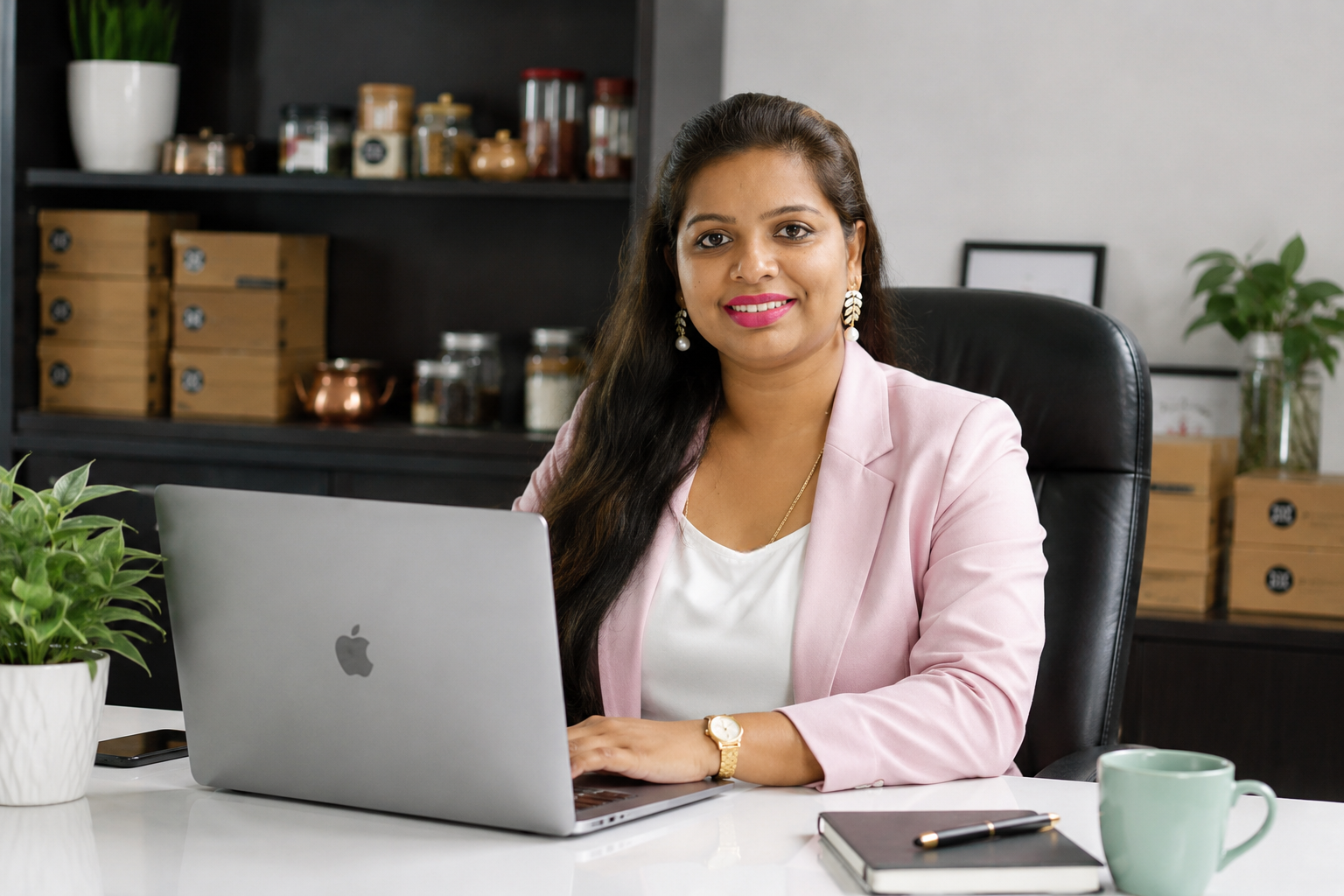
Harsha Thachery
Founder and CEO Masalabox
Harsha Thachery is an Indian entrepreneur and chartered accountant best known as the founder and CEO of Masalabox, a food delivery platform specializing in home-cooked meals. During her maternity leave, she began to explore healthy and preservative free food options when she found out that there were numerous home chefs mostly women who catered these healthy home cooked food. Seeing the potential she soon launched her e platform masalabox delivering fresh, healthy and preservative free meals on pre booking system. Launched in 2014-2015, Masalabox operates in Kochi and Bengaluru, enabling over 200 home chefs (mostly women) to sell their culinary creations, selling over a million meals. She has been featured as a notable woman entrepreneur, using digital tools like WhatsApp Business to scale her venture. She was also listed among women to be honoured for empowerment efforts in Kerala. Her initiative has been praised for creating a platform for home makers to showcase their culinary skills and generate income.
Key Facts
Full Name: Harsha Thachery
Occupation: Entrepreneur, Chartered Accountant
Title: Founder and CEO of Masalabox
Place: Kochi, Kerala, India
The Story of Harsha Thachery and Masalabox
Before sunrise in Kochi, long before office traffic thickens and food delivery riders begin crossing the city, lights switch on quietly inside dozens of home kitchens. Pressure cookers hiss. Coconut is grated. Curry leaves crackle in coconut oil. Lunches are packed not inside industrial kitchens but inside ordinary homes where mothers, homemakers, and passionate cooks prepare meals shaped by memory rather than mass production. Somewhere within this network of kitchens lies the idea that transformed Harsha Thachery into one of Kerala’s most closely watched women entrepreneurs.
The story of Masalabox did not begin inside a corporate boardroom or a venture capital pitch deck. It emerged from something far more personal and emotionally familiar to urban India: the search for healthy, preservative-free food during a vulnerable stage of life. During maternity leave, Harsha Thachery found herself questioning the quality of food available through conventional restaurant delivery systems. At the same time, she noticed a hidden economy of talented home chefs, many of them women, cooking exceptional meals from their own kitchens without structured market access.
That realization eventually evolved into an outstanding entrepreneurial experiment, one that blended technology, food culture, and women’s economic empowerment into a single platform. Over the last decade, Masalabox has grown beyond a startup into a larger conversation about how India eats, works, and reimagines domestic labour.
Early Life and Professional Background
Before becoming a startup founder, Harsha Thachery built her career in finance.
Trained as a chartered accountant, she belonged to a generation of highly educated Indian women entering professional corporate spaces while also navigating evolving expectations around family, career, and entrepreneurship. Her academic and financial background gave her analytical discipline, operational thinking, and a strong understanding of risk, scalability, and business sustainability.
Yet entrepreneurship often emerges not from expertise alone, but from lived frustration.
Urban India during the early 2010s was witnessing a dramatic transformation in food consumption habits. Dual-income households were increasing. Professionals were working longer hours. Food delivery apps were beginning to expand aggressively. But despite growing convenience, many consumers still struggled to find meals that felt healthy, fresh, and emotionally familiar.
Restaurant food solved hunger. It did not always solve nourishment.
Harsha noticed this gap personally during maternity leave. Like many new mothers, she became increasingly conscious about food quality, preservatives, nutrition, and hygiene. What began as a personal search slowly revealed a larger structural opportunity.
Behind Kerala’s domestic spaces existed thousands of skilled home cooks, many of them women whose culinary abilities remained economically invisible.
Harsha saw business potential where others saw informal labour.
The Birth of Masalabox
The origin story of Masalabox is deeply tied to Kerala’s food culture itself.
In Malayali households, home cooking carries emotional significance beyond nutrition. Meals are linked to memory, care, and identity. Fish curry tastes different depending on district. Sambar changes from one home to another. Lunch is not merely functional; it reflects family traditions and regional habits.
Harsha understood that emotional connection.
During her search for healthy food options, she encountered numerous women preparing preservative-free meals from their homes. Some cooked for neighbours. Others accepted small catering orders. Many possessed extraordinary culinary skill but lacked digital visibility, marketing infrastructure, delivery systems, or financial independence.
The insight behind Masalabox was deceptively simple: what if technology could connect urban consumers with trusted home kitchens?
Around 2014–2015, she launched Masalabox with a pre-booking meal system focused on fresh home-cooked food rather than instant restaurant-style delivery. The concept differed sharply from mainstream food-tech platforms chasing speed, discounts, and scale.
Masalabox instead emphasized trust, nutrition, and authenticity.
The model also challenged assumptions about what constituted a “professional kitchen.” Harsha believed that home chefs, particularly women who had spent years cooking within domestic spaces, possessed culinary expertise equal to or greater than many commercial establishments.
The challenge was not talent. It was access.
Building a Food-Tech Startup
Turning that vision into a scalable company proved difficult.
India’s food delivery ecosystem was becoming increasingly competitive during the mid-2010s. Major players were aggressively expanding operations, investor funding dominated industry conversations, and consumers were becoming accustomed to restaurant aggregation models.
Masalabox entered the market with an entirely different proposition.
Unlike restaurants designed for volume production, home kitchens operated on smaller scales with varying cooking styles, capacities, and schedules. Standardization became one of the company’s earliest operational hurdles. Logistics posed another challenge. Delivering fresh meals prepared across decentralized kitchens required coordination, timing precision, and quality consistency.
Harsha approached these problems with the mindset of both an entrepreneur and systems builder.
Technology became critical.
The company used digital tools, including platforms like WhatsApp Business, to streamline communication, manage orders, coordinate chefs, and build customer trust. Social media and digital communities also helped create emotional engagement around the idea of “food from home.”
The pre-booking system itself was strategically important. Instead of preparing excessive inventory like restaurants, home chefs cooked according to planned demand, reducing food waste and maintaining freshness.
Gradually, Masalabox expanded operations in Kochi and Bengaluru, cities with strong migrant professional populations seeking meals resembling home cooking.
Its appeal extended beyond convenience.
Customers often described the food emotionally. Meals reminded them of mothers, hometown kitchens, hostel memories, and regional flavours absent from standardized restaurant chains.
That emotional layer became one of Masalabox’s strongest differentiators.
Empowering Women Through Entrepreneurship
The most significant dimension of Masalabox may not be technological at all.
It is social.
At the center of the platform are home chefs, many of whom are women balancing domestic responsibilities, caregiving, and limited economic opportunities. For decades, cooking inside Indian homes remained undervalued labour despite requiring immense skill, discipline, and time.
Masalabox converted that invisible labour into entrepreneurship.
The platform reportedly enabled over 200 home chefs, primarily women, to generate income by selling their culinary creations professionally. Many of these women had never previously viewed themselves as entrepreneurs.
Some cooked between caring for children and managing households. Others rediscovered professional confidence after long gaps away from formal employment. For many, financial independence emerged gradually through food.
This model reflected a larger shift occurring across India’s startup ecosystem, where technology increasingly enabled micro-entrepreneurship rather than only large-scale employment.
Harsha’s contribution lies partly in recognizing that empowerment does not always require radical reinvention. Sometimes it requires building systems around existing strengths.
Kerala’s domestic culinary expertise already existed. Masalabox simply gave it visibility, logistics, and market access.
That distinction matters.
The company’s social impact became one of the reasons Harsha gained recognition within Kerala’s women entrepreneurship landscape. She was acknowledged not merely as a startup founder but as someone creating sustainable opportunities for homemakers often excluded from formal business ecosystems.
Business Growth and Industry Impact
Over time, Masalabox evolved from a niche idea into a recognizable regional food-tech brand.
The company crossed major operational milestones, reportedly serving over one million meals while building a significant catalogue of regional home-style cuisine. Its success reflected changing consumer behaviour across urban India.
Health-conscious eating was becoming mainstream.
Professionals increasingly questioned processed food habits, restaurant oils, preservatives, and industrial cooking practices. Simultaneously, the COVID-19 pandemic later intensified public awareness around hygiene, immunity, and home-style food.
Masalabox occupied a unique position within that shift.
Unlike mainstream delivery giants focused on restaurant aggregation, Masalabox emphasized curation, trust, and emotional familiarity. Customers were not merely ordering meals; they were often choosing specific home chefs whose cooking styles they preferred.
This created unusually strong customer loyalty.
Within India’s broader food-tech ecosystem, Masalabox also represented an important regional model. Rather than competing directly through scale with national delivery corporations, it focused on depth within the home-cooked meals segment.
That strategic positioning helped it maintain a distinct identity.
Recognition and Public Image
As Masalabox expanded, Harsha Thachery increasingly emerged as a recognizable face within Kerala’s startup and entrepreneurship ecosystem.
Media profiles often highlighted her journey as a woman entrepreneur navigating food-tech, logistics, and digital business while building a socially conscious company. She was also acknowledged in discussions around women empowerment initiatives in Kerala.
But Harsha’s public image differs noticeably from many startup founders associated with hyper-growth narratives or aggressive corporate branding.
Her story resonates because it feels grounded.
The emotional language surrounding Masalabox is not built around disruption alone. It revolves around dignity, domestic labour, trust, and nourishment.
That distinction has helped the brand maintain authenticity even within a crowded startup landscape.
Leadership Style and Vision
Harsha’s leadership philosophy appears rooted in sustainability rather than spectacle.
Masalabox operates within a difficult business category. Food delivery carries thin margins, operational complexity, and intense customer expectations. Scaling while maintaining quality remains a persistent challenge.
Yet the company’s model suggests a long-term focus on community ecosystems rather than short-term visibility alone.
Its success depends heavily on relationships, between chefs and customers, kitchens and technology, domestic spaces and urban consumption habits.
Harsha’s approach also reflects an important shift in Indian entrepreneurship: the emergence of businesses designed around social value alongside commercial viability.
In many ways, Masalabox functions simultaneously as a logistics company, culinary platform, women’s entrepreneurship network, and emotional food brand.
Balancing those layers requires nuanced leadership.
Challenges and the Future Ahead
The future of Masalabox remains tied to broader changes within India’s food economy.
Competition in food delivery continues to intensify. Consumer expectations evolve rapidly. Maintaining quality control across decentralized home kitchens becomes increasingly difficult as scale expands. Regulatory standards, delivery infrastructure, and profitability pressures all remain major operational concerns.
There is also the challenge of preserving authenticity while professionalizing operations.
The very intimacy that makes home-cooked meals attractive can become harder to sustain at larger scale.
Yet Masalabox’s long-term relevance may lie precisely in that authenticity. As Indian consumers increasingly seek healthier food habits and emotionally familiar meals, platforms rooted in trust and regional culinary identity could gain deeper importance.
The home-chef economy itself is likely to expand further, especially as digital platforms continue lowering entry barriers for women entrepreneurs.
Conclusion
At its core, the story of Harsha Thachery is not only about building a startup. It is about recognizing value where society often overlooks it. Inside ordinary kitchens across Kerala and Bengaluru, she saw entrepreneurial talent hidden beneath routine domestic work. She saw women capable of running businesses long before they called themselves businesswomen. And she understood that food carries emotional meaning far beyond commerce.
Masalabox succeeded because it tapped into something deeply human: the longing for meals that feel personal, familiar, and trustworthy in an increasingly industrialized food culture. In doing so, Harsha transformed home cooking into economic opportunity and built a platform where technology amplified care rather than replacing it.
In India’s rapidly evolving startup ecosystem, that may be her most outstanding achievement of all.