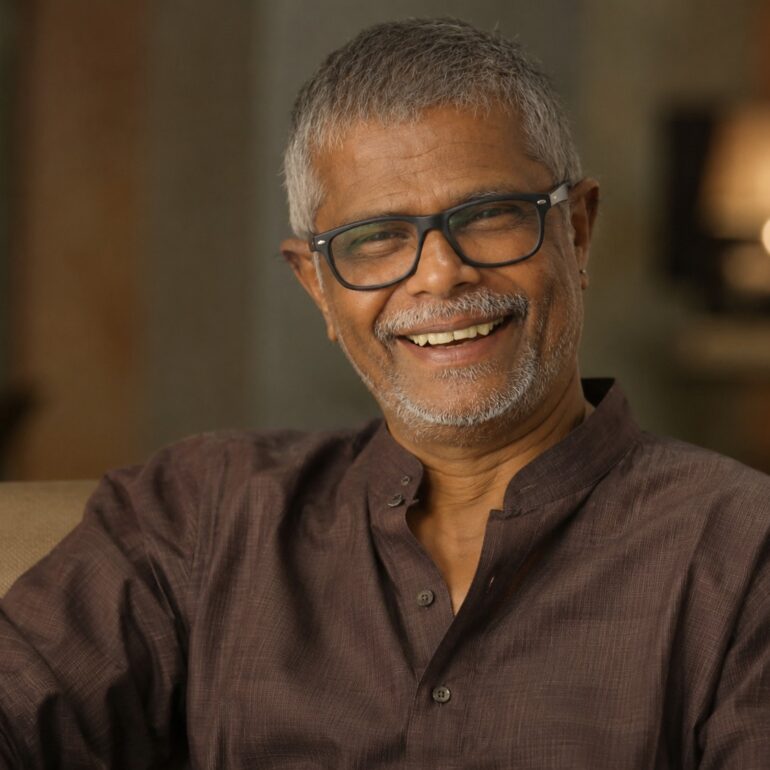

Vijay Yesudas
Singer & Actor
Vijay Yesudas (born 23 March 1979) is an Indian playback singer, actor, and composer. He has sung over 1000 film songs. Vijay works predominantly in the South Indian film industry, mostly in Malayalam, Telugu, Tamil, Kannada, and Hindi. He is the son of acclaimed singer K. J. Yesudas.
Key Factors
Full Name: Vijay Yesudas
Born: 23 March 1979
Place: Chennai, India
Title: Playback Singer, Actor, Composer
Occupation: Musician, Performer
Known As: Versatile South Indian playback singer with a distinctive voice and emotional depth
Musical Roots
To understand Vijay Yesudas, one must begin with the inevitability of music in his life. Born to K. J. Yesudas, one of India’s most revered playback singers, and Prabha, Vijay grew up in an environment where music was not just a profession but a way of life. His grandfather, Augustine Joseph, was himself a stage singer, making music a multi-generational inheritance.
Yet, inheritance does not automatically translate into identity. For Vijay, early exposure to music came with both opportunity and expectation. He began learning Carnatic music in the late 1990s, grounding himself in classical discipline before stepping into the fluid, often unpredictable world of playback singing.
His education reflects a balance between tradition and modernity. After schooling in Chennai, he moved to the United States, graduating from Florida International University with a degree in music. This exposure to global musical environments would later shape his adaptability across genres and languages.
Stepping Out of a Giant Shadow
Few artists begin their careers under the weight of comparison as heavily as Vijay Yesudas. Being the son of K. J. Yesudas meant that every note he sang would be measured against a benchmark that was almost impossible to match.
His playback debut in Millennium Stars (2000), composed by Vidyasagar, marked the beginning of this journey. The song itself did not instantly redefine his career, but it opened a door into the industry.
The early years were marked by a careful negotiation of identity. Vijay did not attempt to replicate his father’s style, a choice that would have been both easy and limiting. Instead, he leaned into his own tonal qualities, a voice slightly huskier, more contemporary, yet capable of classical nuance.
This phase was less about immediate success and more about persistence. In an industry where lineage can both open doors and invite scrutiny, Vijay chose the slower route of building credibility through consistency.
Rise in South Indian Cinema
Over time, Vijay Yesudas expanded his presence across multiple film industries, Malayalam, Tamil, Telugu, Kannada, and even Hindi. His versatility became one of his defining strengths.
Collaborations played a crucial role in this growth. Working with composers like Ilaiyaraaja, A. R. Rahman, and Yuvan Shankar Raja exposed him to different musical philosophies. Each composer demands a distinct approach, and Vijay adapted accordingly, whether it was the layered orchestration of Rahman or the melodic depth of Ilaiyaraaja.
Among these, his association with Yuvan Shankar Raja stands out, particularly in Tamil cinema, where Vijay’s voice found a space that resonated with younger audiences.
What distinguishes Vijay’s career trajectory is its breadth rather than singular peaks. He did not become the voice of a single era or genre. Instead, he became a reliable presence across evolving musical landscapes.
Defining Songs and Career Milestones
Certain songs, however, have defined his journey more than others.
“Kolakkuzhal Vili Ketto” from Nivedyam (2007) marked a turning point, earning him the Kerala State Film Award for Best Singer. The song’s classical undertones and emotional resonance showcased his ability to handle nuanced compositions.
“Akaleyo Nee” (Grandmaster) and “Mazhakondu Mathram” (Spirit, 2012) further cemented his reputation, both earning him recognition for his expressive depth. These songs are not just technically accomplished; they carry an emotional weight that lingers.
Then came “Malare” from Premam (2015), a song that transcended its film to become a cultural phenomenon. Shared widely across digital platforms, it introduced Vijay’s voice to a new generation of listeners. The song’s simplicity, combined with its emotional pull, made it instantly memorable.
“Poomuthole” from Joseph (2018) represents a more mature phase in his career, where restraint becomes as powerful as expression.
These songs illustrate a pattern, Vijay’s strength lies not in vocal flamboyance but in emotional precision.
Awards and Recognition
Recognition has followed his work consistently rather than sporadically. Vijay Yesudas has won multiple Kerala State Film Awards for Best Singer, along with several Filmfare Awards South and SIIMA Awards.
These accolades reflect more than popularity. They indicate sustained excellence across different phases of his career. In an industry where trends shift rapidly, maintaining relevance over decades is itself an achievement.
Acting Career and Experimentation
Vijay’s foray into acting adds another dimension to his artistic identity. His debut in the Malayalam film Avan marked an initial step, but it was his role as a villain in the Tamil film Maari (2015) that drew wider attention.
Playing an antagonist is a deliberate choice, especially for someone primarily known as a singer. It signals a willingness to take risks and step outside established comfort zones.
His lead role in Padaiveeran (2018) further explored this path, though acting remains a secondary pursuit in his career. On screen, Vijay brings a certain restraint, mirroring his musical style, understated, controlled, and measured.
The Voice: Technical and Emotional Analysis
Technically, Vijay Yesudas’s voice occupies an interesting space. It does not aim for the sheer power or classical dominance often associated with traditional playback singing. Instead, it leans toward texture and mood.
His tonal quality, slightly husky yet smooth, allows him to navigate romantic, melancholic, and introspective compositions with ease. He excels in songs that require emotional subtlety rather than dramatic vocal flourishes.
Compared to contemporaries, Vijay’s strength lies in consistency. He may not always dominate charts, but his songs often endure, revisited not for spectacle but for feeling.
Public Persona and Personal Life
Away from the microphone, Vijay maintains a relatively grounded public image. His marriage to Darshana, whom he met at a concert in Dubai in 2002, reflects a life that remains closely tied to music.
The couple married in 2007 and have two children, Ammeya and Avyan. Despite his lineage and success, Vijay has largely avoided the trappings of celebrity excess, choosing instead to remain focused on his craft.
His interactions with fans and media are marked by a certain quietness, a contrast to the often larger-than-life personas in the entertainment industry.
Vijay Yesudas as a Malayali Icon
In Kerala, where music is deeply embedded in cultural identity, Vijay Yesudas occupies a unique position. He is both a continuation and a departure.
While his roots are firmly Malayali, his career reflects a broader, pan-Indian sensibility. Yet, his contributions to Malayalam cinema remain central to his identity. Songs like “Kolakkuzhal Vili Ketto” and “Poomuthole” are not just hits; they are part of Kerala’s musical memory.
He represents a generation of Malayali artists who are rooted in tradition but unafraid to engage with contemporary forms.
Reflection
Vijay Yesudas’s journey is not defined by a single breakthrough or a defining moment. Instead, it is shaped by steady evolution, by choices that prioritise authenticity over imitation.
He began as the son of a legend, a position that could have easily confined him. Yet, over time, he has carved out a space that is distinctly his own, marked by emotional depth, versatility, and quiet resilience.
In an industry that often celebrates spectacle, Vijay’s strength lies in understatement. His voice does not demand attention; it earns it.
And in that quiet, persistent pursuit of individuality, Vijay Yesudas stands today as an outstanding Malayali artist, not because he inherited a legacy, but because he redefined what it means to carry one forward.
Awards
Kerala State Film Awards
- 2007– Best Singer – Nivedyam
- 2012– Best Singer – Grandmaster
- 2018– Best Singer – Joseph
Filmfare Awards South
- 2011 – Filmfare Award for Best Male Playback Singer – Indian Rupee
- 2012 – Filmfare Award for Best Male Playback Singer – Spirit
- 2013 – Filmfare Award for Best Male Playback Singer – Memories
- 2015 – Filmfare Award for Best Male Playback Singer – Premam
- 2018 – Filmfare Award for Best Male Playback Singer – Joseph
IIFA Utsavam
- 2016–1st IIFA Utsavam for playback singer male – Malayalam
- 2017–2nd IIFA Utsavam for playback singer male – Malayalam
Nandi Awards
- 2014–Nandi Award for Best Male Playback Singer for the song “Nee Kanti Choopullo” from Legend
South Indian International Movie Awards
- 2012–SIIMA Award for Best Male Playback Singer – ee Puzhayum
- 2013–SIIMA Award for Best Male Playback Singer – Mazha Kondu
- 2014 – SIIMA Award for Best Male Playback Singer – Thirayum Theeramum
- 2016–SIMA Award for Best Male Playback Singer – Malare
Asiavision Awards
- 2011– Asiavision Awards – Best Male Singer
- 2013 – Asiavision Awards – Best Male Singer
- 2015 – Asiavision Awards – Best Male Singer
Asianet Film Awards
- 2012 – Asianet Film Award – Best Male Singer
- 2013 – Asianet Film Award – Best Male Singer
- 2015– Asianet Film Award – Best Male Singer
Vanitha Film Awards
- 2012 – Best singer male
- 2016 – Best singer male
- 2018 – Best singer male
Edison Awards (India)
- 2014-Best Male Playback singer
North American Film Awards
- 2016-Best Male singer – Premam and Ennu Ninte Moideen
- 2018-Best Male singer
Anand TV awards
- 2016-Best Male singer
CERA BIG Malayalam Music Awards
- 2014 – CERA BIG Malayalam Music Awards – Best Male Singer
Mangalam Music awards
- 2017 – Best Playback Singer
Flowers Music awards
- 2018 – Best Playback Singer