Thomas Kailath
Indian-American engineer
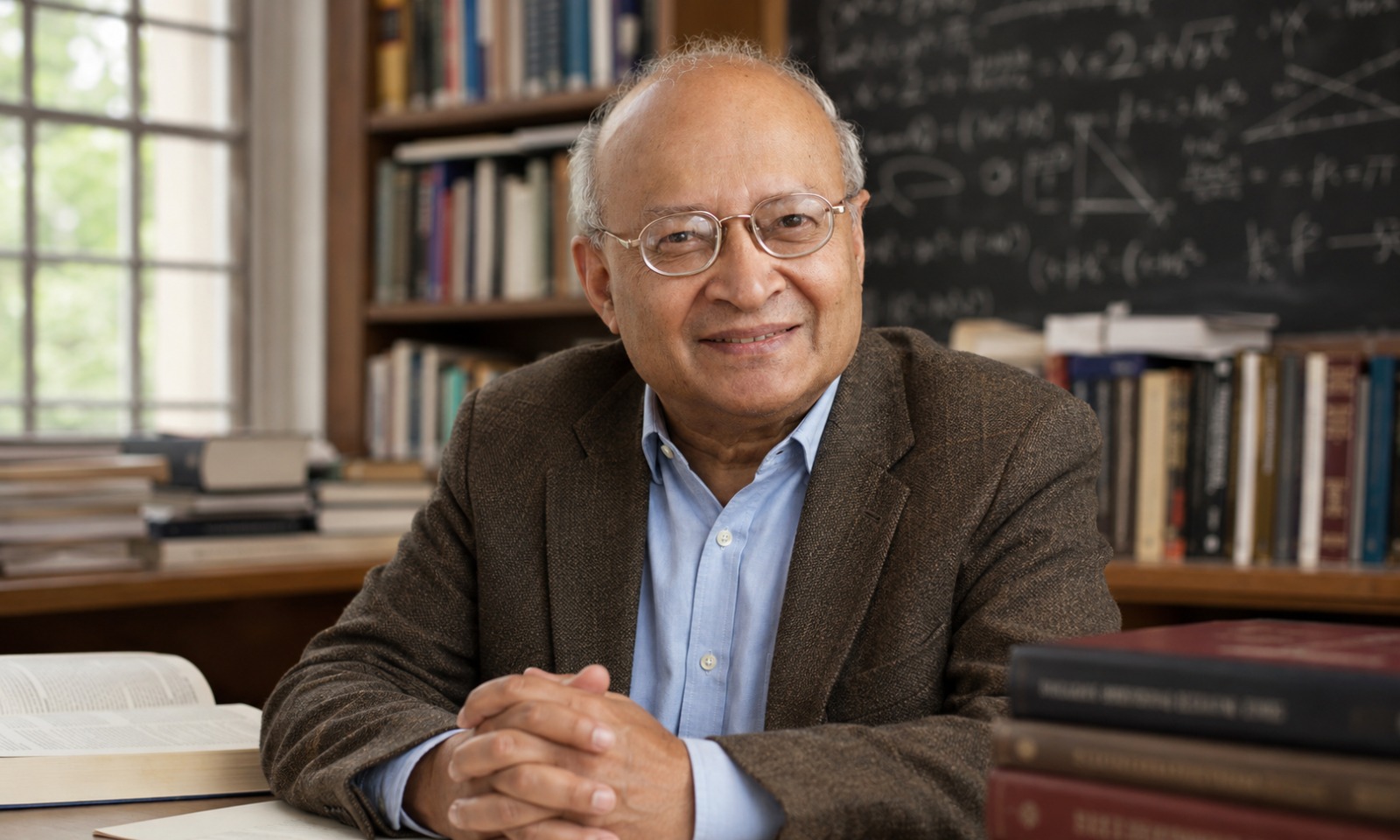
Thomas Kailath is an Indian-American electrical engineer, information theorist, control engineer, entrepreneur and the Hitachi America Professor of Engineering emeritus at Stanford University. Professor Kailath has authored several books, including the well-known Linear Systems. Kailath was born in Pune, Maharashtra, to a Malayali Syrian Christian family from Kerala. He received his Bachelor’s degree in telecommunications engineering from the Government College of Engineering, University of Pune in 1956. He earned his Master’s degree in 1959 and doctorate (ScD) in 1961 from the Massachusetts Institute of Technology (MIT), becoming the first India-born student to receive a doctorate in electrical engineering from the institution.
Key Facts
Full Name: Thomas Kailath
Date of Birth: June 7, 1935
Nationality: Indian-American
Occupation: Electrical Engineer, Information Theorist, Entrepreneur, Professor
Academic Title: Hitachi America Professor of Engineering Emeritus, Stanford University
Known For: Signal processing, linear systems, estimation theory, information theory, control systems
Major Fields: Communications, Computing, Signal Processing, Information Science
Notable Books: Linear Systems, Linear Estimation
Companies Founded: Integrated Systems, Numerical Technologies, Excess Bandwidth Corporation
In February 2014, inside the White House, Thomas Kailath stood among America’s most distinguished scientists as President Barack Obama presented him with the National Medal of Science. It was a moment of national recognition for a man whose work had already become inseparable from the invisible architecture of modern technology. The equations he developed helped shape the foundations of communications, signal processing, computing, control systems, and information science, disciplines quietly powering everything from mobile phones and satellites to medical imaging and digital networks.
Yet the story of Thomas Kailath does not begin in Silicon Valley laboratories or elite American universities. It begins in pre-independence India, in Pune, where a young boy from a Malayali Syrian Christian family displayed an unusual fascination with mathematics, systems, and engineering. Decades later, he would become one of the defining intellectual figures of twentieth-century electrical engineering, an outstanding scholar whose influence extended far beyond academia into entrepreneurship, mentorship, and technological innovation across the world.
For generations of engineers, researchers, and students, Kailath represented something rare: a scientist capable of combining mathematical elegance with practical impact. His career transformed not only modern engineering, but also the very way information travels through the contemporary world.
Early Life and Roots in India
Thomas Kailath was born in 1935 in Pune to a Malayali Syrian Christian family whose ancestral roots traced back to Kerala. India at the time was still under British rule, and higher education in engineering remained limited to a small intellectual elite. Yet the decades surrounding Indian independence also produced a generation of scientists and engineers determined to participate in the technological future of the modern world.
Kailath grew up in an environment where education was deeply valued. At St. Vincent’s High School in Pune, he quickly distinguished himself through academic brilliance and analytical curiosity. Mathematics attracted him not simply because of precision, but because it offered a language capable of explaining systems, patterns, and structure.
He later enrolled at the Government College of Engineering Pune, earning a bachelor’s degree in telecommunications engineering in 1956.
India during the 1950s was investing heavily in scientific education as part of its post-independence national development strategy. Engineering symbolized progress. For talented young Indians, the field carried both intellectual excitement and social responsibility.
But Kailath’s ambitions soon extended beyond national borders.
Journey to MIT and Breaking Barriers
When Thomas Kailath moved to the United States for graduate studies, America was entering one of the most transformative scientific eras in modern history. The Cold War had accelerated investments in electronics, computing, aerospace, and communications. Universities like Massachusetts Institute of Technology had become epicentres of technological experimentation.
For a young Indian student arriving in that environment during the late 1950s, the transition demanded more than intelligence. It required adaptation, confidence, and extraordinary resilience.
Kailath earned his master’s degree in 1959 and completed his doctorate in electrical engineering in 1961, becoming the first India-born student to receive a doctorate in electrical engineering from MIT.
The achievement carried symbolic importance far beyond personal success. At a time when Indian scientists were only beginning to establish global visibility within advanced technological research, Kailath emerged as proof that intellectual excellence from India could compete at the highest international level.
MIT exposed him to a rapidly evolving world of systems theory, communications engineering, and applied mathematics. Those disciplines would later define much of his career.
The Stanford Years and Academic Influence
If MIT shaped Thomas Kailath intellectually, Stanford became the institution through which he transformed global engineering culture.
At Stanford University, Kailath developed one of the world’s most respected research environments in electrical engineering and information science. Over the decades, he supervised around eighty doctoral students, many of whom later became leading researchers, entrepreneurs, and professors themselves.
Former students often described him as intellectually demanding but deeply encouraging. He believed engineering research should combine mathematical rigor with relevance to real-world systems. The classroom, for Kailath, was not merely a place for instruction. It was a laboratory for intellectual independence.
Stanford during the rise of Silicon Valley was uniquely positioned between academia and technological industry. Kailath flourished inside that ecosystem because his work naturally connected theoretical research to practical application.
He helped cultivate an academic culture where mathematics, computation, communication systems, and entrepreneurship could coexist.
That interdisciplinary mindset would become increasingly important as the digital revolution accelerated.
Revolutionizing Information and Signal Science
Many people use technologies shaped by Thomas Kailath’s work every day without ever hearing his name.
His research focused on fields such as signal processing, estimation theory, control systems, filtering, and information theory. Though these concepts sound highly technical, they form the backbone of modern digital communication.
Signal processing, for example, involves extracting meaningful information from complex signals, audio, images, wireless communication, radar systems, and medical imaging all depend on it. Filtering and prediction allow systems to separate useful information from noise. Estimation theory helps machines interpret uncertain data accurately.
These ideas became central to technologies ranging from telecommunications and GPS systems to autonomous navigation and data transmission.
Kailath’s landmark textbook, Linear Systems, became one of the most influential engineering texts of its era. Engineers across the world studied it not merely as a textbook, but as a conceptual framework for understanding complex systems mathematically.
What distinguished Kailath was clarity.
He possessed the rare ability to make highly abstract mathematics structurally elegant and practically usable.
That combination transformed him into one of the defining engineering thinkers of his generation.
The Entrepreneur and Innovator
Unlike many academic researchers who remain confined to universities, Thomas Kailath actively participated in Silicon Valley’s entrepreneurial evolution.
He co-founded several technology companies, including Integrated Systems, Numerical Technologies, and Excess Bandwidth Corporation.
These ventures reflected his belief that research should not remain isolated from industry. Engineering ideas, he believed, must eventually interact with society through practical implementation.
Integrated Systems became influential in embedded systems technology. Numerical Technologies contributed to semiconductor manufacturing software during a period of explosive growth in computing hardware.
Kailath belonged to the generation of engineers who helped establish Silicon Valley’s culture of academic entrepreneurship, where university research increasingly generated commercial innovation.
He moved comfortably between equations and industry strategy.
That versatility became one of his defining characteristics.
Awards, Recognition, and Scientific Prestige
Thomas Kailath’s list of recognitions reflects extraordinary standing within the scientific world.
He was elected to the US National Academy of Engineering in 1984 for “outstanding contributions in prediction, filtering, and signal processing.” He later became a member of the National Academy of Sciences and the American Academy of Arts and Sciences.
In 2007, he received the prestigious IEEE Medal of Honor for contributions to communications, computing, control, and signal processing.
India honored him with the Padma Bhushan in 2009.
The BBVA Foundation Frontiers of Knowledge Award recognized the transformative impact of his work on information and communication technologies.
Then came the National Medal of Science, America’s highest scientific honor, awarded for transformative contributions to information and system science and for sustained mentorship of young scholars.
In engineering circles, these recognitions positioned him among the most influential scientific minds of the modern era.
Personal Life and Human Side
Behind the scientific achievements existed a deeply personal life shaped by family, mentorship, and philanthropy.
Kailath was married to Sarah Kailath from 1962 until her death in 2008. They raised four children together. In 2013, he married Dr. Anuradha Luther Maitra, an economist and academic leader.
Beyond engineering, Kailath supported education and South Asian studies initiatives. In 2022, he and Maitra established the Anuradha Luther Maitra and Thomas Kailath Endowed Professorship in South Asian Studies at the University of California, Santa Cruz.
Colleagues frequently emphasized his generosity toward students and younger researchers. Mentorship remained central to his identity throughout his career.
For Kailath, knowledge carried responsibility.
Thomas Kailath’s Legacy
Thomas Kailath belongs to a generation of engineers whose work fundamentally reshaped modern civilization, even if their names remain less publicly visible than the technologies they enabled.
The digital world now depends on mathematical systems that quietly manage information, reduce noise, optimize communication, and interpret data. Kailath helped build that intellectual infrastructure.
His influence extends across universities, research laboratories, startups, semiconductor companies, communication systems, and engineering classrooms around the world.
For Indian scientists abroad, he also represented something historically significant: proof that intellectual leadership from India could shape the highest levels of global science and technology.
Yet perhaps his greatest legacy lies in synthesis.
Thomas Kailath demonstrated that scholarship, mentorship, entrepreneurship, and innovation need not exist separately. He moved between them with remarkable fluency, helping create a model of engineering leadership that still feels strikingly modern.
Long after technologies evolve and industries change, the mathematical foundations he helped establish will continue operating silently beneath contemporary life, an outstanding intellectual legacy hidden inside the everyday machinery of the digital age.
Honors and Recognition
1970: Elected a Fellow of the Institute of Electrical and Electronics Engineers (IEEE)
Member of the US National Academy of Engineering (NAE), the US National Academy of Sciences (NAS), American Academy of Arts and Sciences (AAAS), the Indian National Academy of Engineering and the Silicon Valley Engineering Hall of Fame
2007: IEEE Medal of Honor for “exceptional development of powerful algorithms in the fields of communications, computing, control and signal processing”
2006: IEEE Jack S. Kilby Signal Processing Medal
1996: IEEE Donald G. Fink Prize Paper Award (together with Ali H. Sayed)
1986: John R. Ragazzini Award
2009: Padma Bhushan award by the Government of India
2009: BBVA Foundation Frontiers of Knowledge Award in Information and Communication Technology “for creating knowledge with transformative impact on the information and communication technologies that permeate everyday life”.
2012: Recipient of the National Medal of Science, presented by President Barack Obama in 2014 for “transformative contributions to the fields of information and system science, for distinctive and sustained mentoring of young scholars, and for translation of scientific ideas into entrepreneurial ventures that have had a significant impact on industry.”
2012: National Medal of Science at the White House
2017: The Marconi Society honored Kailath with the Lifetime Achievement Award for “his many transformative contributions to information and system science and his sustained mentoring and development of new generations of scientists.”