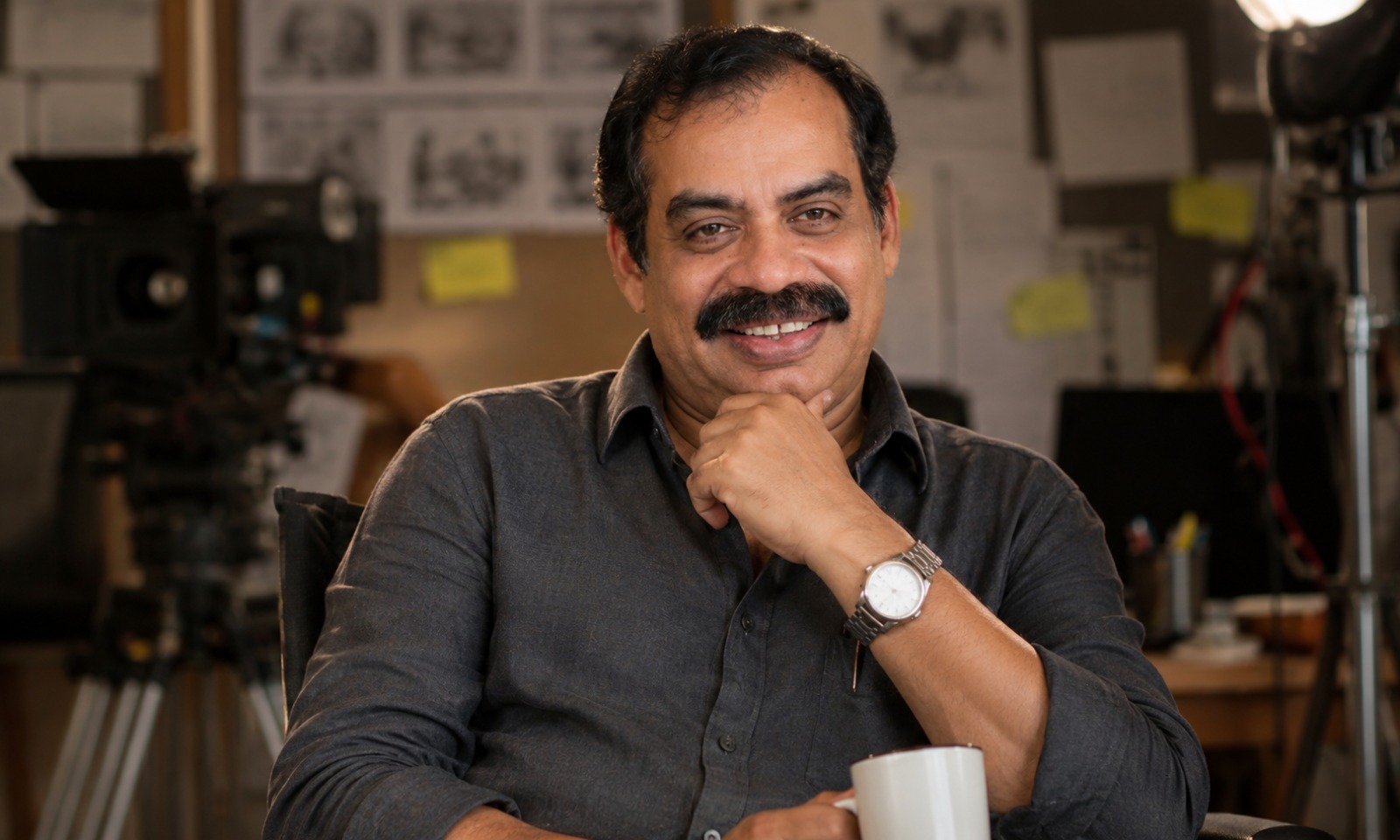
Sathyan Anthikad
Indian film director
Sathyan Anthikad is an Indian film director, screenwriter, and lyricist who predominantly works in Malayalam cinema. In a career spanning five decades he has directed more than 50 films, been the lyricist for 12 films and been the scriptwriter for 6 films. Sathyan Anthikad was born at Anthikad in the Thrissur district of Kerala.
Key Factors
Full Name: Sathyan Anthikad
Birthplace: Anthikad, Thrissur district, Kerala, India
Date of Birth: January 3, 1954
Occupation: Film Director, Screenwriter, Lyricist
Active Years: 1973 onwards
Known For: Middle-class family dramas, social satire, emotionally grounded storytelling
For generations of Malayali audiences, the cinema of Sathyan Anthikad has felt less like entertainment and more like memory itself. His films carry the smell of wet earth after monsoon rain, the noise of crowded family courtyards, the quiet anxieties of middle-class homes, and the humour hidden inside ordinary conversations. In an industry that often moved between melodrama and spectacle, Sathyan Anthikad built an outstanding cinematic language rooted in simplicity, emotional intelligence, and deep observation of Kerala society.
Across more than four decades, he became one of Malayalam cinema’s most enduring storytellers, directing over fifty films that reflected the changing moral, political, and emotional landscape of Kerala. Whether through satire, family drama, or gentle humour, his films consistently explored ordinary lives with uncommon empathy. Collaborations with writers like Sreenivasan and actors such as Mohanlal, Mammootty, Jayaram, and Innocent helped create some of Malayalam cinema’s most beloved films, works that remain endlessly revisitable because they captured something emotionally truthful about Malayali life.
Sathyan Anthikad’s cinema never relied on noise to remain relevant. Its power came from recognition. Audiences saw themselves in his characters, their ambitions, hypocrisies, humour, disappointments, and fragile hopes.
Inside the cinema, humour, and humanism of Sathyan Anthikad
Anthikad, the village that became permanently attached to Sathyan’s identity, was more than a birthplace. It became the emotional geography of his cinema.
Located in Thrissur district, Anthikad belonged to the Kerala that existed before rapid urban transformation altered much of the state’s social landscape. Villages were built around conversation, family networks, temple festivals, political debates, tea shops, and agricultural rhythms. Humour existed naturally inside everyday life, not as performance but as survival.
Sathyan Anthikad was born to M. V. Krishnan and M. K. Kalyani Amma. The cultural atmosphere of Kerala during the 1950s and 1960s deeply shaped his sensibility. Literature, theatre, political awareness, and social realism had already begun influencing Malayalam arts. Writers such as Vaikom Muhammad Basheer, Thakazhi Sivasankara Pillai, and M. T. Vasudevan Nair were redefining how ordinary Malayali lives could become powerful artistic subjects.
That literary realism would later echo strongly in Sathyan Anthikad’s films.
Unlike filmmakers drawn toward larger-than-life spectacle, he remained fascinated by the emotional drama hidden inside familiar spaces, dining tables, village roads, government offices, and crowded family homes.
Kerala’s village life did not merely influence his storytelling. It became its emotional foundation.
Entry Into Cinema
Like many filmmakers of his generation, Sathyan Anthikad entered cinema through apprenticeship rather than formal film education.
In 1973, he began working as an assistant director under Dr. Balakrishnan at Rekha Cine Arts. Malayalam cinema during the 1970s was undergoing important transitions. Parallel cinema movements were growing alongside commercial storytelling, while filmmakers experimented with realism, politics, and literary adaptation.
For young assistants entering the industry, film sets functioned as practical classrooms.
Sathyan later worked as associate director under P. Chandrakumar and assisted director Jeassy on several projects. These years exposed him to the mechanics of filmmaking, camera blocking, actor management, production realities, and storytelling rhythms.
Yet what distinguished him was patience.
Rather than rushing toward immediate directorial recognition, he slowly absorbed the industry’s creative grammar. By the time he directed his debut feature, Kurukkante Kalyanam, he had already spent nearly a decade understanding Malayalam cinema from inside.
The film announced a filmmaker interested less in spectacle and more in human observation.
That identity would soon become unmistakable.
The Sathyan Anthikad Style
Few directors in Indian cinema developed a storytelling signature as emotionally recognizable as Sathyan Anthikad.
His films often revolved around middle-class Malayali families navigating social change, economic pressure, political absurdity, and interpersonal conflict. Yet despite recurring themes, the films rarely felt repetitive because they were built around emotional detail rather than formula.
Humour in his cinema emerged naturally from behaviour. Characters argued over trivial matters, misunderstood one another, exaggerated problems, and exposed social hypocrisy without becoming caricatures.
His Kerala was deeply lived-in.
Tea shops, narrow roads, crowded buses, modest homes, village libraries, political processions, and noisy kitchens all became part of the cinematic texture. Audiences recognized these environments immediately because they mirrored real life rather than fantasy.
What made his storytelling timeless was emotional restraint.
Unlike melodramatic family films common in many Indian industries, Sathyan Anthikad preferred quieter emotional payoffs. Characters evolved through conversation and realization rather than dramatic transformation.
The realism felt comforting but never simplistic.
Beneath the humour, his films often explored loneliness, failed ambition, migration anxiety, political opportunism, generational conflict, and moral compromise.
That balance between warmth and critique became his greatest strength.
The Sreenivasan Partnership
No discussion of Sathyan Anthikad is complete without acknowledging his legendary creative partnership with Sreenivasan.
Together, they created some of Malayalam cinema’s sharpest social satires.
Films such as Nadodikkattu, Sandesam, and Thalayanamanthram combined humour with piercing observations about Kerala society.
Nadodikkattu captured unemployment, migration dreams, and middle-class desperation through comedy that still feels contemporary decades later. Dasan and Vijayan became cultural archetypes because they represented ordinary Malayalis trapped between aspiration and absurdity.
Sandesam remains perhaps one of the most politically relevant Malayalam films ever made. Through family conflict and satire, it dissected ideological extremism, political tribalism, and the erosion of personal relationships in politically polarized societies.
Remarkably, the film never felt preachy.
Its intelligence came through humour.
Even today, dialogues from Sandesam continue circulating in Kerala’s political culture because the film identified behavioural patterns that remain recognizable across generations.
Mohanlal, Jayaram, Mammootty, and the Emotional Universe of His Cinema
Sathyan Anthikad’s collaborations with actors often brought out some of their most emotionally grounded performances.
With Mohanlal, he created films balancing humour and vulnerability. In films such as Pingami, Rasathanthram, and Sanmanassullavarkku Samadhanam, Mohanlal’s performances carried remarkable emotional accessibility.
Pingami, though commercially underappreciated during its release, later developed a cult following for its layered storytelling and atmospheric tension.
With Jayaram, Sathyan Anthikad built some of Malayalam cinema’s defining family dramas, including Veendum Chila Veettukaryangal. Jayaram’s screen persona aligned perfectly with the director’s interest in emotionally conflicted but fundamentally humane protagonists.
Meanwhile, actors like Innocent became essential to the tonal identity of Sathyan Anthikad films. Innocent’s performances added social realism and comic rhythm without descending into exaggeration.
Even collaborations with Mammootty reflected the director’s interest in restrained characterization rather than heroic spectacle.
His films prioritized human behaviour over star image.
That creative philosophy helped many actors deliver career-defining performances.
Social Commentary Through Everyday Stories
One reason Sathyan Anthikad’s films continue resonating is their ability to document Kerala’s social evolution without becoming historically rigid.
His cinema quietly chronicled migration to Gulf countries, changing family structures, political cynicism, consumerism, and generational disconnection.
Unlike overtly ideological filmmakers, he embedded commentary within emotional storytelling.
In Thalayanamanthram, class anxiety and social comparison become deeply recognizable domestic tensions. In Sandesam, politics invades family life. In Manassinakkare, modernity collides with emotional responsibility toward aging parents.
These films endure because the social anxieties they explored remain unresolved.
Sathyan Anthikad understood that humour could communicate difficult truths more effectively than anger.
His cinema invited audiences to reflect rather than react.
Literature, Lyrics, and the Writer Within
Beyond directing, Sathyan Anthikad also worked as lyricist and screenwriter. Literature always remained central to his creative sensibility.
His films frequently carried literary rhythms, carefully observed dialogue, emotional layering, and interest in human contradiction rather than simplistic morality.
He adapted literary works into cinema, including Appunni and Irattakkuttikalude Achan, demonstrating respect for Malayalam literature’s influence on storytelling traditions.
In 2019, he received the Kerala Sahitya Akademi Award for Humour for his book Eeswaran Mathram Sakshi.
The recognition reflected something long evident in his cinema, humour for Sathyan Anthikad was never merely entertainment. It was observation, philosophy, and social critique.
Family, Continuity, and a New Generation
Sathyan Anthikad’s personal life remained relatively private despite his public stature. Married to Nimmy, he raised three sons, Arun Sathyan, and twins Anoop Sathyan and Akhil Sathyan.
Cinema eventually became a generational legacy.
Anoop Sathyan debuted with Varane Avashyamund, a film that reflected emotional warmth and character-driven storytelling associated with his father’s cinematic tradition while adapting to contemporary sensibilities.
Akhil Sathyan later directed Pachuvum Athbutha Vilakkum, continuing that familial connection to Malayalam storytelling.
The continuity feels emotionally fitting.
Sathyan Anthikad spent decades preserving the emotional landscapes of Malayali life through cinema. Now, a new generation within his own family carries fragments of that storytelling legacy forward.
Legacy in Malayalam Cinema
Modern Malayalam cinema has evolved dramatically through realism, experimentation, darker themes, and global storytelling influences. Yet even within this transformation, Sathyan Anthikad’s films remain deeply rewatchable.
Part of that endurance comes from emotional honesty.
His films captured a Kerala that audiences continue remembering nostalgically, not because it was perfect, but because it felt emotionally coherent. Families still argued together, neighbours interfered constantly, politics entered everyday conversation, and humour softened hardship.
Younger filmmakers influenced by realism and socially grounded storytelling often inherit techniques Sathyan Anthikad helped normalize decades earlier.
His cinema proved that ordinary people could carry extraordinary emotional weight on screen.
And perhaps that remains his greatest achievement.
Sathyan Anthikad did not simply direct films. He documented the emotional history of Malayali middle-class life with empathy, humour, and remarkable consistency. Long after trends fade and cinematic fashions change, audiences continue returning to his work because it reminds them not only of Kerala, but of themselves.
In the history of Malayalam cinema, that kind of emotional permanence is rare, and truly outstanding.
Awards
2024: Mazhavil Entertainment Awards Master Entertainer (Director) Award
2001: National Film Awards-Best Feature Film in Malayalam (Kochu Kochu Santhoshangal)
1986: Kerala State Film Awards Best Story (T. P. Balagopalan M. A.)
1999: Best Film with Popular Appeal and Aesthetic Value (Veendum Chila Veettukaryangal)
2005: Best Film with Popular Appeal and Aesthetic Value (Achuvinte Amma)
2007: Best Screenplay (Vinodayathra)
2008: Best Film with Popular Appeal and Aesthetic Value (Innathe Chintha Vishayam)
1996: Filmfare Awards South Best Director (Thooval Kottaram)
2003: Best Film (Manassinakkare)
2003: Best Director (Manassinakkare)
2003: Asianet Film Awards Best Director (Manassinakkare)
2005: Best Film (Achuvinte Amma)
1999: Best Film (Veendum Chila Veettukaryangal)
2006: Mathrubhumi Film Awards Best Director (Rasathanthram)
2019: South Indian International Movie Awards Best Director (Njan Prakashan)