Vimala Menon
Indian Dancer
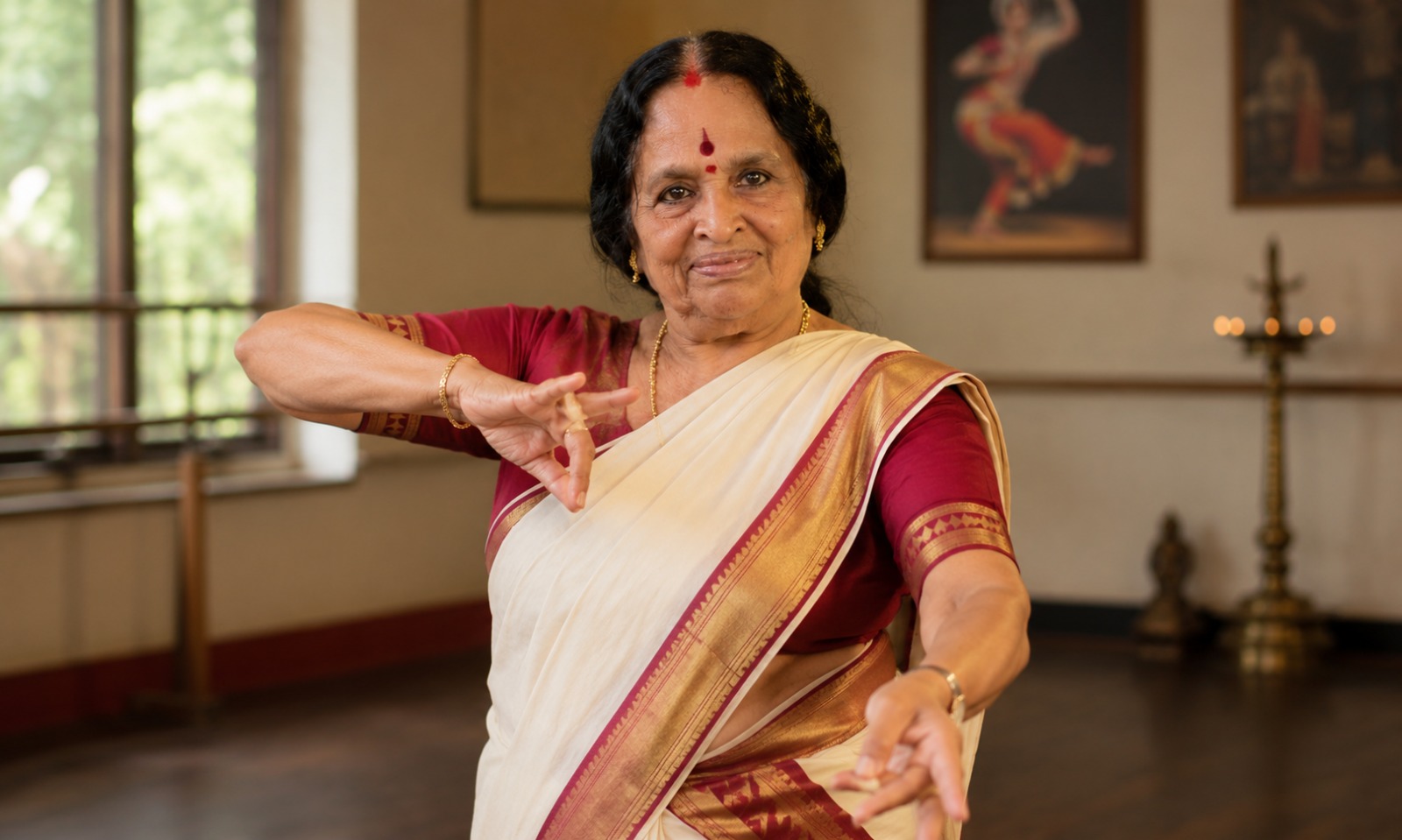
Vimala Menon, known popularly as Kalamandalam Vimala Menon, is a prominent Indian dance teacher and exponent of Mohiniyattam from Kerala. She is the founder and director of the Kerala Natya Academy in Thiruvananthapuram, established in 1972. Under her guidance, the academy has trained numerous dancers in various classical dance forms, including Mohiniyattam, Bharatanatyam, and Kuchipudi.
Key Factors
Full Name: Vimala Menon
Popular Name: Kalamandalam Vimala Menon
Date of Birth: 7 January 1943
Place: Irinjalakuda, Thrissur district, Kerala
Occupation: Classical Dancer, Dance Teacher, Choreographer
Art Form: Mohiniyattam and Bharatanatyam
Years Active: 1960s onward
In Kerala’s classical arts landscape, where traditions are often carried not merely through institutions but through memory, discipline, and devotion, few figures embody that continuity as completely as Kalamandalam Vimala Menon. For more than six decades, the outstanding Mohiniyattam exponent has lived inside the rhythm of dance, preserving one of Kerala’s most graceful classical forms while quietly shaping generations of performers through teaching, choreography, and cultural stewardship.
To watch Vimala Menon perform or teach is to witness an artistic philosophy rooted in patience and emotional depth rather than spectacle. Her movements carry the softness central to Mohiniyattam, yet beneath that gentleness lies remarkable rigor. Through performances, research, and the founding of Kerala Natya Academy in Thiruvananthapuram, she helped sustain a dance tradition that once struggled for institutional recognition in post-independence India. Long before classical dance became widely globalized through festivals and digital platforms, Vimala Menon was already carrying Kerala’s artistic identity across borders, from the halls of Kerala Kalamandalam to classrooms in Bhutan.
Her journey mirrors the evolution of Mohiniyattam itself, from a vulnerable classical form recovering from neglect into an internationally respected artistic tradition. The Padma Shri conferred upon her in 2026 recognized not merely a performer, but a lifelong custodian of Kerala’s cultural memory.
A Childhood Rooted in Kerala’s Cultural Soil
The Kerala into which Vimala Menon was born in 1943 was deeply intertwined with temple arts, classical music, ritual performance, and oral storytelling traditions. Her hometown, Irinjalakuda in Thrissur district, occupied an especially important place in Kerala’s cultural imagination. Temple festivals, percussion ensembles, Kathakali performances, and classical recitals shaped the atmosphere of everyday life.
Born into an affluent Nair family, Vimala was the second among seven children of S. K. Krishnan Nair, a civil engineer, and Vishalakshy Amma. Yet privilege alone does not create artists. What distinguished her childhood was early immersion in artistic discipline.
The first seeds of dance entered her life through training under Thripunithura Vijaya Bhanu. Alongside dance, she also studied Carnatic music under M. R. Madhusudhana Menon. That musical foundation would later become crucial to her artistic expression because Mohiniyattam depends profoundly on rhythmic sensitivity and emotional interpretation.
Kerala’s classical arts during the 1950s and early 1960s existed in an important transitional period. Institutions such as Kerala Kalamandalam had begun reviving classical forms that had once declined under colonial disruption and changing social structures. Mohiniyattam in particular was still rebuilding its institutional identity.
Young women pursuing classical dance professionally during that era often faced social conservatism and limited cultural infrastructure. Choosing dance was rarely a simple career decision. It demanded commitment, resilience, and social courage.
Vimala Menon entered that world with unusual seriousness.
Learning Under Legendary Gurus
In 1960, she joined Kerala Kalamandalam for a four-year diploma course in dance.
The institution represented more than a school. Kerala Kalamandalam functioned as a cultural movement dedicated to preserving Kerala’s classical traditions after decades of decline. Students there lived within an immersive artistic environment where dance, music, literature, and discipline shaped daily life.
At Kalamandalam, Vimala Menon trained under two of Mohiniyattam’s most respected gurus, Thottassery Chinnammu Amma and Kalamandalam Satyabhama. Both women belonged to a generation that played a crucial role in reconstructing Mohiniyattam’s grammar and performance tradition in modern India.
From them, she absorbed not only technique but artistic temperament.
Mohiniyattam is often misunderstood as merely graceful dance. In reality, it demands extraordinary control. The form relies on restrained emotional expression, circular movement patterns, subtle abhinaya, and rhythmic fluidity. Unlike more aggressive or dramatic dance forms, Mohiniyattam communicates through softness and internalized emotional states.
Vimala Menon’s later performances reflected precisely that discipline.
She also studied Bharatanatyam under Thanjavoor Bhaskara Rao, broadening her technical understanding of South Indian classical dance traditions. That cross-training enriched her choreographic sensibility and strengthened her stagecraft.
The years at Kalamandalam became foundational to everything she would later build.
Marriage, Bhutan, and a New Artistic Journey
After completing her studies, Vimala Menon briefly worked as a dance teacher at the Jawahar School of Neyveli Lignite Corporation. Soon afterward, she married Viswanatha Menon in 1966.
Marriage often interrupted or ended artistic careers for many women performers of her generation. In Vimala Menon’s case, it unexpectedly expanded her cultural journey.
Following the marriage, she moved with her husband to Bhutan, where he served as an officer with the Bhutan government. For an artist deeply rooted in Kerala’s classical traditions, relocating to a Himalayan kingdom during the 1960s represented both emotional dislocation and creative possibility.
In Bhutan, she taught dance at Bhutan Government School and performed South Indian classical dance across multiple venues.
The imagery itself feels cinematic, a Mohiniyattam dancer from Kerala carrying the aesthetics of temple-born South Indian classical movement into distant mountain landscapes.
Yet the significance of this period goes beyond symbolism.
At a time when Indian classical arts had limited global institutional reach, artists like Vimala Menon informally became cultural ambassadors. Their performances introduced regional Indian traditions to audiences unfamiliar with the language, mythology, or musical systems behind them.
Bhutan also appears to have deepened her understanding of teaching itself. Living away from Kerala’s artistic ecosystem required her to preserve tradition through pedagogy rather than institutional support alone.
That experience would later influence the creation of her own academy.
Building Kerala Natya Academy
Back in Kerala, Vimala Menon founded Kerala Natya Academy in Thiruvananthapuram, an institution that became central to her life’s work.
Unlike large state-backed institutions, dance academies founded by individual artists often survive through relentless personal commitment. Teachers become administrators, choreographers, mentors, archivists, and cultural negotiators simultaneously.
For Vimala Menon, Kerala Natya Academy was never merely a training center. It became an extension of her artistic philosophy.
Students trained not only in movement vocabulary but in emotional discipline, musical sensitivity, and respect for tradition. Her approach emphasized depth over theatrical excess. Mohiniyattam, in her vision, remained rooted in inward emotional experience rather than superficial glamour.
Over decades, the academy trained generations of dancers who carried her artistic lineage forward across Kerala and beyond.
This contribution matters enormously within classical arts traditions because preservation depends less on fame than continuity of transmission.
Artists survive through disciples.
The Artistry of Vimala Menon
Critics and cultural observers frequently described Vimala Menon’s Mohiniyattam as deeply expressive yet restrained.
Her performances reflected the essential characteristics of the form, graceful torso movements, lyrical transitions, nuanced facial expression, and rhythmic softness. But beyond technical precision, audiences often responded to emotional clarity in her abhinaya.
Mohiniyattam traditionally explores feminine emotional worlds through poetry, devotion, longing, memory, and spiritual introspection. Vimala Menon approached these themes without exaggeration. Her performances carried maturity and emotional intelligence rather than theatrical display.
She also contributed intellectually to the form through research. Her Senior Fellowship Award from the Government of India’s Cultural Department recognized her work on “Ramanattom in Mohiniyattom.”
That research reflected an important aspect of her career often overshadowed by performance itself. Classical dance preservation requires historical scholarship alongside stage performance. Understanding older narrative forms, performance structures, and cultural transitions helps sustain authenticity within evolving artistic environments.
Vimala Menon belonged to a generation of dancers who balanced performance with cultural stewardship.
Recognition and National Honour
Over the years, her contributions received increasing institutional recognition.
The Kerala Sangeetha Nataka Akademi Award in 1991 acknowledged her growing stature within Kerala’s classical arts community. The Kendra Sangeet Natak Akademi Award in 2006 elevated that recognition nationally, placing her among India’s respected classical artists.
She later received the Kerala Kalamandalam Award for Dance and the Kerala Sangeetha Nataka Akademi Fellowship, honours that reflected not merely performance excellence but lifetime contribution to cultural preservation.
The Padma Shri awarded in 2026 carried especially profound symbolic significance.
For many classical artists, national recognition arrives after decades of relatively quiet work far from mainstream visibility. Unlike cinema celebrities, classical dancers often dedicate entire lifetimes to teaching, research, and performance without widespread commercial attention.
The Padma Shri acknowledged Vimala Menon as one of the important custodians of Kerala’s artistic heritage.
It also recognized the broader cultural journey of Mohiniyattam itself, a dance form once marginalized, now internationally respected.
An Enduring Cultural Legacy
Today, Kalamandalam Vimala Menon represents more than an accomplished dancer.
She belongs to the generation that helped stabilize and institutionalize Mohiniyattam during a fragile period in its history. Without artists like her, many classical traditions risk becoming museum artifacts rather than living practices.
Her career also reflects the often underrecognized labour of women in Indian classical arts. These artists balanced family responsibilities, social expectations, teaching obligations, and artistic discipline long before institutional support systems became stronger.
Through Kerala Natya Academy, her artistic lineage continues across younger generations of dancers. Through research, choreography, and teaching, she contributed not only to performance culture but to Kerala’s intellectual and aesthetic identity itself.
And perhaps that is the deepest measure of her legacy.
Long after applause fades and performances end, certain artists remain present through the traditions they protected, the students they shaped, and the cultural memory they carried forward with extraordinary care.
In that enduring landscape of Indian classical dance, Kalamandalam Vimala Menon remains an outstanding presence.
Awards and honours
1972: All Kerala Social Service Association Award for Bharata Natyam
1991: Kerala Sangeetha Nataka Akademi Award
2004: Senior Fellowship Award for her research work in “Ramanattom in Mohiniyattom” by the Government of India’s Cultural Department
Kerala Kalamandalam Award for her contribution to South Indian Classical Dances
2006: Kendra Sangeeta Nataka Akademi Award
2014: Kerala Sangeetha Nataka Akademi Fellowship
2026: Padma Shri