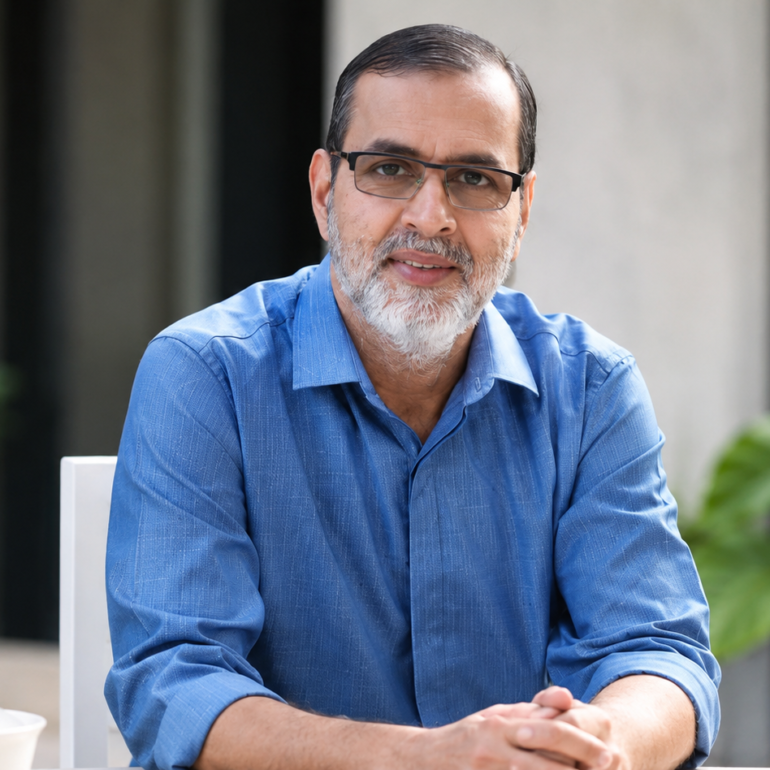
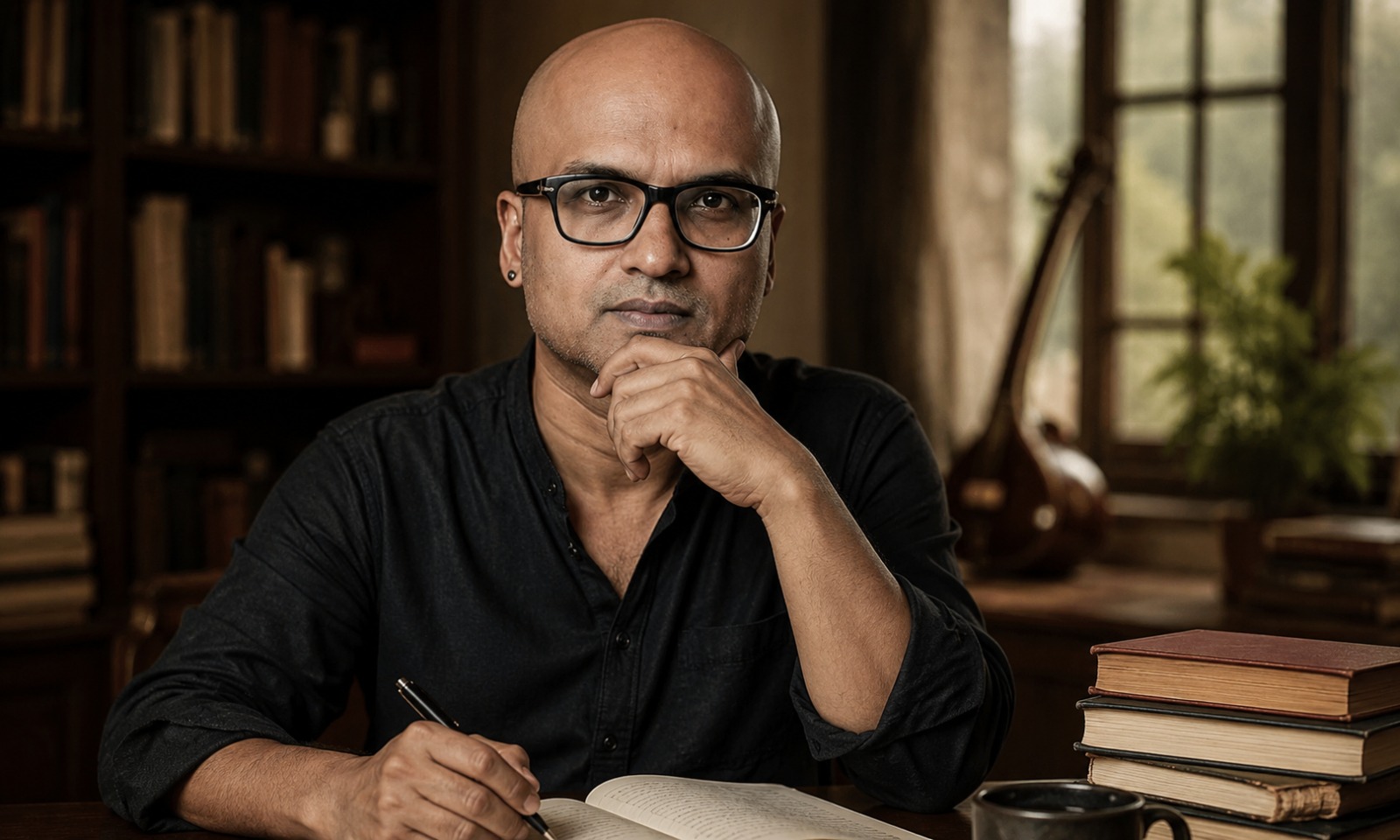
Jeet Thayil
Indian Poet, Novelist, Librettist and Musician
Jeet Thayil is an Indian poet, novelist, librettist and musician. He is the author of several poetry collections, including These Errors Are Correct (2008), which won the Sahitya Akademi Award. His first novel, Narcopolis, (2012), won the DSC Prize for South Asian Literature, and was shortlisted for the 2012 Man Booker Prize and The Hindu Literary Prize. Thayil was born in Kerala, India. His father is writer and editor Thayil Jacob Sony George, and the family moved with his work. Thayil was raised in Mumbai until age 8, then moved to Hong Kong, and returned to Mumbai at age 18 where he graduated from Wilson College.
Key Factors
Full Name: Jeet Thayil
Born: 1959
Birthplace: Kerala
Occupation: Poet, Novelist, Librettist, Musician, Editor
In the shadowed lanes of old Bombay, where opium smoke once drifted through cramped rooms above crowded streets and forgotten lives dissolved into the city’s endless noise, Jeet Thayil found the material that would eventually redefine contemporary Indian English literature. His writing does not look away from ruin. It walks directly into it, patiently observing addicts, drifters, lovers, outcasts, and dreamers with a poet’s tenderness and a journalist’s brutal clarity. Few modern Indian writers have documented the psychic landscape of urban India with such unsettling intimacy.
Thayil emerged first as a poet, long before the global acclaim of Narcopolis. His verses carried loneliness, exile, memory, desire, and spiritual exhaustion in rhythms that felt both cosmopolitan and deeply personal. Later, as a novelist, librettist, editor, and musician, he built a body of work that resisted sentimentality and rejected polished narratives about India. Instead, he wrote about what cities erase, what societies fear, and what memory refuses to bury.
Today, he stands as one of the most outstanding Malayali literary voices of the modern era, a restless artist whose work stretches from Kerala’s intellectual traditions to the underground worlds of Bombay, from poetry readings to opera stages, from addiction and survival to literary immortality.
Roots: A Malayali Childhood Across Borders
Jeet Thayil’s story begins in Kerala, but it never stayed within one geography. His father, Thayil Jacob Sony George, was a writer and editor whose profession carried the family across cities and countries. Literature, journalism, and political conversation were part of everyday life long before Jeet himself became a writer.
He spent his early childhood in Mumbai before moving to Hong Kong at the age of eight. Migration became routine. Borders shifted repeatedly around him. Cities changed, languages changed, social worlds changed. Yet those movements quietly shaped one of the central emotional tensions in his writing: the feeling of being both inside and outside every place.
Many writers romanticize displacement. Thayil rarely does. In interviews over the years, he has spoken about movement not as glamour but as fragmentation, an experience that sharpened his sense of observation while deepening emotional solitude.
Even while growing up across continents, Kerala remained a psychological inheritance. Like many globally dispersed Malayalis, he carried with him a cultural memory rooted in literature, argument, political awareness, and intellectual restlessness. That inheritance later surfaced not through nostalgia, but through his refusal to simplify identity.
He belonged everywhere and nowhere at once.
Bombay, Addiction, and the Making of a Writer
When Thayil returned to Bombay at eighteen, the city entered him permanently.
This was not the sanitized Mumbai of tourism campaigns or cinematic fantasies. It was the Bombay of the 1970s and 1980s, chaotic, bruised, nocturnal, and unforgiving. The city’s underground economies, opium dens, artists, addicts, musicians, hustlers, and drifting intellectuals became the ecosystem in which he lived and eventually wrote.
In later interviews with publications including The Hindu and Gulf News, Thayil spoke openly about his long struggle with addiction and alcoholism. He described spending nearly two decades trapped in substance dependency before eventually recovering in his forties.
What distinguished these confessions was their lack of self-mythology. He never framed addiction as glamorous destruction. Instead, he treated it as memory, grief, and survival.
During these years, he worked as a journalist across Mumbai, Bengaluru, Hong Kong, and New York. Journalism sharpened his eye for detail and social observation, while poetry became a space where emotional truths could survive beyond reportage.
Bombay itself became both subject and wound.
The city in his work is rarely stable. It mutates constantly, swallowing identities while creating new ones. For Thayil, Bombay was not merely a setting. It was a living organism capable of tenderness and brutality in the same breath.
The Poet Before the Novelist
Long before Narcopolis made him internationally famous, Jeet Thayil had already established himself as one of India’s most distinctive poets.
His early collections, including Gemini and Apocalypso, announced a voice that resisted decorative lyricism. The poems were stripped, intimate, urban, and emotionally alert. Later works like English and These Errors Are Correct deepened these concerns, exploring alienation, mortality, addiction, exile, sexuality, and spiritual exhaustion with startling precision.
The poet Dom Moraes once observed that Thayil did not burden himself with performative “Indianness.” Instead, he worked through mood, emotional colouration, and psychological atmosphere. That observation remains central to understanding his poetry.
Thayil’s poems rarely announce political themes loudly, yet politics exists everywhere beneath the language, in class, in migration, in urban loneliness, in bodies abandoned by systems and cities.
In 2012, These Errors Are Correct received the Sahitya Akademi Award for English literature. The recognition confirmed what literary circles had long acknowledged: Thayil had become one of the defining voices in modern Indian English poetry.
His poems carried a rhythm shaped equally by jazz, prayer, intoxication, and insomnia.
Narcopolis and Literary Immortality
When Narcopolis appeared in 2012, it altered the landscape of Indian English fiction almost immediately.
Set largely in Bombay’s opium dens during the 1970s and 1980s, the novel abandoned conventional realism for something far stranger and more immersive. The prose drifted between hallucination and memory, moving through addicts, eunuchs, gangsters, migrants, and forgotten dreamers with hypnotic fluidity.
The novel’s structure itself felt intoxicated, fragmented, nonlinear, haunted.
At the center of Narcopolis was not merely addiction, but disappearance. Entire worlds vanish inside the novel, languages, communities, bodies, and forms of intimacy erased by urban change and heroin’s arrival into Bombay’s underground culture.
Thayil later explained in interviews that he wrote the book partly as memorial. He wanted to preserve the names and lives of people society dismissed as disposable. That emotional core gave Narcopolis its unusual humanity.
The novel was shortlisted for the Booker Prize and became one of the most internationally discussed Indian novels of the decade. It also won the DSC Prize for South Asian Literature.
Critics praised its hallucinatory prose and fearless portrayal of Bombay’s hidden worlds. Some readers found the novel overwhelming or disturbing. But even its critics acknowledged its ambition.
Narcopolis refused to flatter readers. That refusal became part of its power.
The Bombay Trilogy and the Dark Soul of the City
Thayil later revealed that Narcopolis emerged from a massive 800-page manuscript that eventually evolved into multiple books.
That larger literary architecture continued through The Book of Chocolate Saints and Low, works that together form what he has described as the “Bombay Trilogy.”
These novels deepen his exploration of Bombay as both seductive and grotesque. In Thayil’s fiction, the city is never romanticized through soft monsoon nostalgia or cinematic sentimentality. He once remarked that the grotesque may be a more honest way of writing Bombay than nostalgia.
That philosophy runs through all three novels.
His Bombay is crowded with failed artists, damaged intellectuals, spiritual exhaustion, chemical escape, and fractured desire. Yet it remains profoundly alive. Even in decay, his city pulses with dangerous beauty.
This rejection of sentimental India-writing distinguished Thayil sharply from many internationally marketed versions of Indian fiction.
Music, Opera, and Multidisciplinary Creativity
Literature alone has never been enough for Jeet Thayil.
As one half of the music project Sridhar/Thayil, he explored songwriting and performance alongside poetry and fiction. Music influenced the rhythm of his prose deeply, especially its repetitions, tonal shifts, and improvisational flow.
His creative range expanded further when he wrote the libretto for Babur, an opera commissioned in Europe with music by composer Edward Rushton.
The opera examined faith, extremism, migration, and multicultural anxiety through an imagined encounter between religious fundamentalists and the ghost of the Mughal emperor Babur. Like much of Thayil’s work, it refused easy binaries.
Across genres, he remained fascinated by fractured identities and unstable moral landscapes.
Literary Style and Intellectual Identity
Jeet Thayil writes prose like a poet and poetry like someone listening carefully to silence.
His fiction often abandons straightforward chronology in favor of drifting memory and layered consciousness. Sentences stretch, loop, fracture, and return. Urban realism collides with surrealism. Bodies become archives of history and addiction.
Critics have frequently noted how musical his prose feels. Rhythm matters deeply in his writing. So does atmosphere.
At the same time, Thayil resists literary nationalism. He distrusts simplified portraits of India designed for easy consumption abroad. His work insists on complexity, ugliness, contradiction, and ambiguity.
That intellectual refusal has made him both admired and difficult, precisely the kind of writer literary cultures need.
Jeet Thayil as an Outstanding Malayali Voice
Kerala has produced generations of writers shaped by intellectual dissent, political awareness, and literary experimentation. Jeet Thayil belongs to that tradition, even though much of his life unfolded outside the state itself.
He represents a global Malayali identity, multilingual, migratory, culturally fluid, yet emotionally tied to Kerala’s deep literary inheritance.
What makes Thayil especially significant is his fearlessness. He writes openly about addiction, sexuality, violence, loneliness, and social marginality without moral simplification. In doing so, he expanded the emotional and thematic possibilities of Indian English literature.
He stands alongside a generation of Malayali-origin artists who carried Kerala’s intellectual seriousness into international cultural spaces while refusing to become culturally predictable.
Thayil is not merely a novelist or poet. He is a literary dissenter.
Legacy and Continuing Relevance
Jeet Thayil’s work continues to matter because it documents the lives most societies try to erase.
At a time when cities increasingly market themselves through polished skylines and curated identities, his writing returns to forgotten rooms, damaged bodies, hidden histories, and unresolved grief. Younger Indian writers have drawn inspiration from his formal experimentation, emotional honesty, and refusal to romanticize either suffering or nationhood.
His influence extends beyond literature itself. He helped redefine what contemporary Indian writing could sound like, fragmented, musical, morally uncertain, cosmopolitan, and fiercely intimate.
In the end, Jeet Thayil remains one of the most outstanding Malayali literary voices of the modern era because he understood something essential about art and memory: cities disappear, people vanish, addictions consume, and histories collapse into silence, but language, when wielded fearlessly enough, can still preserve the shadows long after the lights go out.
Awards and honours
2012 – Sahitya Akademi Award for English (Thayil’s poetry collection These Errors are Correct)
2012 – Shortlisted for the Man Booker Prize
2013 – Shortlisted for The Hindu Literary Prize (Narcopolis)
2013 – Became the first Indian author to win the DSC Prize for South Asian Literature, worth $50,000, for the novel Narcopolis.