Sreedhanya Suresh
IAS Officer
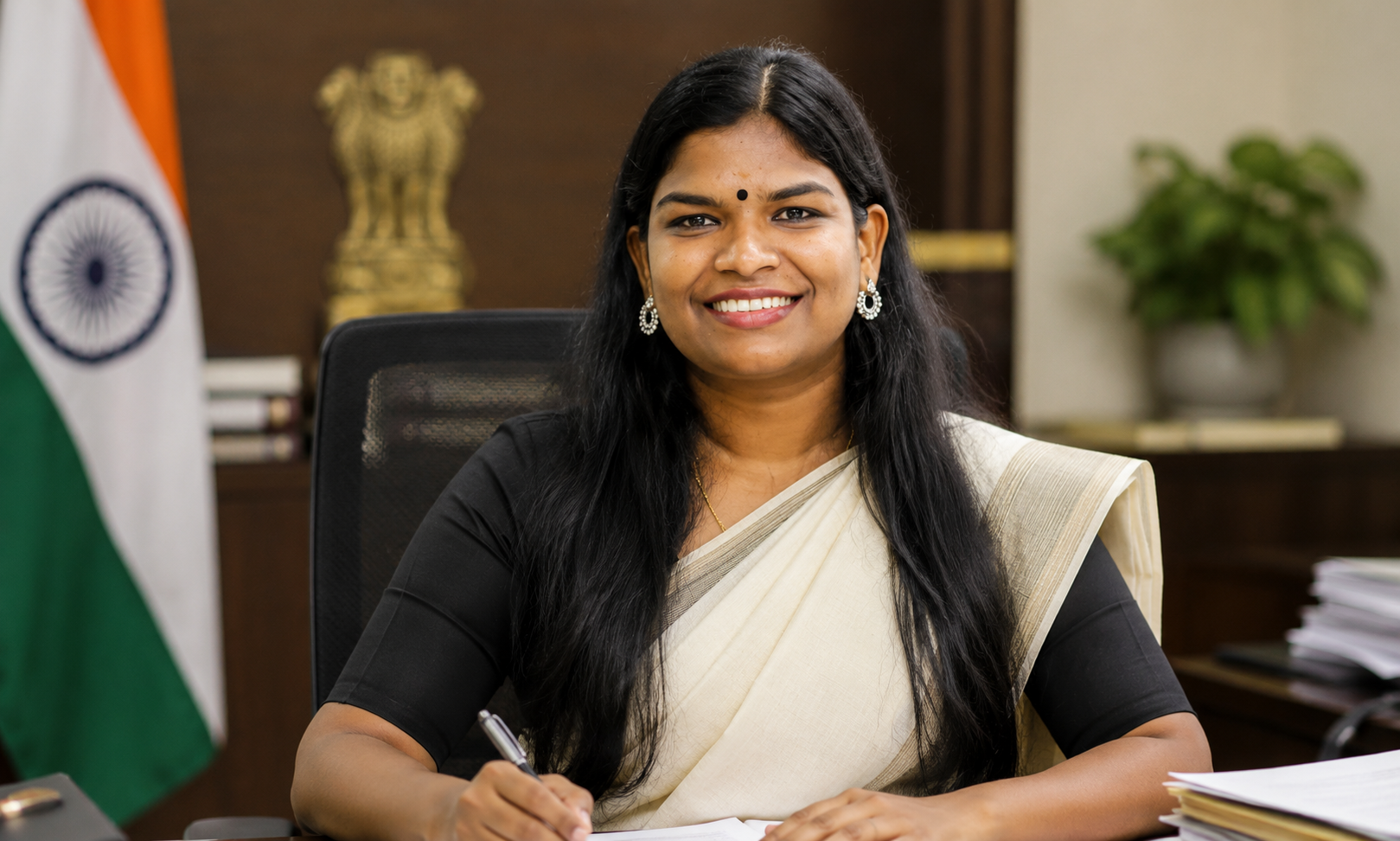
Sreedhanya Suresh is an Indian Administrative Service officer. She is the First Tribal Woman from Kerala to have cleared Civil Services Examination conducted by Union Public Service Commission, India. She secured an all India Rank of 410 in the 2018 UPSC Civil Services Examination. She is currently serving as (IG) Inspector General of Registration in the Department of Registration, Government of Kerala. Sreedhanya Suresh was born and raised in Kerala, India. She hails from the Kurichiya tribal community, an indigenous group in the Wayanad district of Kerala. She completed her schooling from a local government school and then pursued a Bachelor’s degree in Zoology from St. Joseph’s College, Devagiri.
Key Factors
Full Name: Sreedhanya Suresh
Born: 30 December 1991
Native Place: Ambalkkolly, Wayanad
Occupation: Indian Administrative Service Officer
Current Position: Inspector General of Registration, Government of Kerala
Known For: First tribal woman from Kerala to clear UPSC Civil Services Examination
In the mist-covered hills of Wayanad, where tribal settlements remain tucked away from Kerala’s urban narratives of progress and prosperity, a young girl once studied beneath a leaking roof in a partially built house. When rainwater entered through gaps above, clothes were hung across open spaces to serve as temporary walls. Electricity and comfort were uncertain. But inside that fragile home in the Ambalkkolly tribal settlement, education was treated not as privilege, but as survival. Years later, that same girl would walk through the gates of the Lal Bahadur Shastri National Academy of Administration as the first tribal woman from Kerala to clear the UPSC Civil Services Examination and join the Indian Administrative Service.
Sreedhanya Suresh did more than secure an All India Rank of 410 in the 2018 UPSC examination. Her achievement altered the imagination of possibility for thousands of tribal students across Kerala and India. In a state that prides itself on literacy and social development, her success exposed both the persistence of marginalisation and the transformative power of education. Today, as a senior IAS officer serving Kerala, she represents not only administrative accomplishment, but also the quiet emergence of voices historically excluded from India’s centres of power. Her journey remains one of the most emotionally resonant and socially outstanding stories in contemporary Kerala.
A Childhood Shaped by Hardship
The story of Sreedhanya Suresh begins far away from the polished coaching centres and urban privilege commonly associated with India’s civil services examinations.
Ambalkkolly, her tribal settlement in Wayanad, existed on the margins of mainstream visibility. The landscape was beautiful, dense greenery, winding roads, monsoon rain, and forested hills, but beauty often concealed deprivation. Many tribal families in the region struggled with poverty, limited access to resources, and generations of social exclusion.
Sreedhanya grew up in a Kurichiya tribal family where survival required daily labour. Her parents, Suresh and Kamala, earned their livelihood through physically demanding work and by selling traditional bows and arrows in local markets. Their home remained unfinished for years. During heavy rain, water leaked through the roof. Makeshift cloth partitions replaced proper walls.
Yet within that uncertainty, one thing remained steady: education mattered.
Like many families from historically marginalised communities, Sreedhanya’s parents saw education not merely as academic achievement, but as a path toward dignity. Even when financial hardship shaped daily life, they encouraged her to continue studying.
People who knew her during childhood often recalled her discipline and quiet determination. She was not raised in an atmosphere of ambition shaped by elite expectations. Her aspirations emerged slowly from observation, struggle, and persistence.
The emotional power of her story lies partly in its ordinariness. There were no dramatic shortcuts or privileged access. Her rise was built through years of consistency against circumstances designed to discourage ambition.
The Kurichiya Legacy and Tribal Identity
To understand why Sreedhanya Suresh’s achievement resonated so deeply across Kerala, one must understand the history of the Kurichiya community.
The Kurichiya community is one of the prominent indigenous tribal groups of Wayanad. Historically known for their agricultural knowledge and resistance movements during colonial rule, particularly their association with Pazhassi Raja’s rebellion against the British, the community possesses a rich cultural legacy rooted in land, ecology, and collective identity.
Yet despite Kerala’s reputation for social development, tribal communities in regions like Wayanad have continued to face deep inequalities. Educational access, healthcare, land rights, and political representation often remain limited compared to mainstream populations.
Representation in elite institutions, especially the Indian bureaucracy, was historically rare.
For many tribal students in Kerala, the civil services existed as something distant, associated with cities, wealth, and social capital unavailable to them. Sreedhanya’s success disrupted that psychological barrier.
Her achievement was not symbolic in a superficial sense. It represented entry into one of India’s most influential governance structures by someone from a community historically excluded from such spaces.
That mattered profoundly.
Education and Academic Determination
Sreedhanya studied in a local government school, an educational environment far removed from the high-pressure corporate schooling systems often associated with UPSC toppers.
The challenges extended beyond academics. Financial limitations shaped nearly every stage of her education. Travel expenses, study materials, accommodation, and access to preparation resources required constant adjustment and sacrifice.
Yet she continued forward.
After school, she joined St. Joseph’s College Devagiri to pursue a degree in Zoology. Moving from Wayanad into broader academic spaces exposed her to different social realities and opportunities. Like many first-generation learners from marginalised communities, higher education required navigating invisible social and cultural barriers alongside financial ones.
Friends and teachers often described her as focused, observant, and deeply disciplined.
There was no public performance around her ambition. She approached education with seriousness and patience rather than spectacle. That quiet persistence later became one of the defining emotional aspects of her public image.
The UPSC Dream
The UPSC Civil Services Examination is often described as one of the toughest competitive examinations in India, but statistics alone do not capture its emotional and structural inequalities.
For aspirants from economically secure urban backgrounds, preparation may involve expensive coaching institutions, extensive study resources, and stable environments. For someone like Sreedhanya Suresh, the journey demanded something much more difficult: sustaining belief despite limited resources.
Her preparation period was marked by financial constraints and emotional pressure. One of the most widely discussed moments in her story came when she lacked funds to travel to Delhi for official procedures connected to the civil services process. Public contributions and community support reportedly helped bridge that gap.
That moment deeply moved Kerala.
Not because it reflected charity, but because people recognised the broader reality it represented. Talent alone is often insufficient without structural support. Sreedhanya’s journey exposed both the barriers faced by marginalised students and the collective hope invested in her success.
Then came 2018.
In her very first attempt, she secured an All India Rank of 410 in the UPSC Civil Services Examination.
The achievement immediately became historic. She had become the first tribal woman from Kerala to clear the examination and enter the IAS.
For many families across Wayanad’s tribal settlements, the result felt personal.
Becoming Kerala’s First Tribal Woman IAS Officer
Kerala responded to Sreedhanya’s achievement with extraordinary emotion.
Political leaders across ideological lines congratulated her. Figures including Pinarayi Vijayan, Rahul Gandhi, Priyanka Gandhi, and former Governor P. Sathasivam publicly acknowledged her success.
Media coverage spread nationally.
Yet what distinguished public response was not merely admiration for an examination rank. People recognised the symbolic weight of representation. In a bureaucracy historically dominated by socially privileged groups, Sreedhanya’s presence carried emotional significance for tribal communities, rural students, and women across Kerala.
For many young aspirants, especially from marginalised backgrounds, she transformed the abstract idea of “possibility” into something visible and tangible.
Training at LBSNAA and Administrative Career
Following her success, Sreedhanya underwent training at the Lal Bahadur Shastri National Academy of Administration in Mussoorie, India’s premier institution for civil service training.
The academy represented a dramatic shift from her childhood environment in Wayanad. Yet observers noted her groundedness throughout the transition.
Allocated to the Kerala cadre in 2019, she began administrative service as Assistant Collector in Kozhikode before later serving as Sub Collector of Perinthalmanna.
Her administrative image gradually developed around accessibility, discipline, and humility rather than aggressive self-promotion. In public perception, she continued to represent social mobility through education rather than elite bureaucratic distance.
Today, as Inspector General of Registration in Kerala’s Registration Department, she occupies an influential administrative role while continuing to remain a powerful public symbol.
Why Sreedhanya Suresh Matters Beyond UPSC
It is easy to reduce stories like Sreedhanya’s into simplistic “success narratives.” But her importance extends far beyond motivational storytelling.
Her journey reveals how structural inequality operates even within relatively progressive states like Kerala. It highlights the distance many tribal communities continue to travel for educational access and representation.
At the same time, her success demonstrates the transformative power of inclusive education and public institutions.
For women from marginalised backgrounds, especially tribal communities, visibility matters enormously. Representation within governance structures influences aspiration, confidence, and public imagination.
Sreedhanya’s achievement challenged stereotypes surrounding tribal identity. She entered spaces where indigenous communities have historically been underrepresented and proved that exclusion often reflects unequal access rather than absence of talent.
In Kerala’s social context, her story also reopened conversations around development, equity, and who gets to participate in state power.
Recognition and Public Legacy
In 2019, the Government of Kerala honoured her with the Kudumbashree Award for her achievement in civil services.
The recognition reflected how quickly she became a public role model.
Schools, colleges, and civil service aspirants across Kerala began discussing her journey not merely as inspiration, but as evidence that systemic barriers can be challenged through persistence and educational access.
Importantly, her influence extends most strongly into rural and tribal communities where representation often feels psychologically distant. Young students from similar backgrounds increasingly cite her story as motivation to pursue higher education and competitive examinations.
Reflection
The journey of Sreedhanya Suresh is not simply the story of an examination rank or bureaucratic success. It is the story of a girl from an unfinished house in Wayanad entering one of India’s most powerful administrative institutions without abandoning the memory of where she came from.
Her achievement altered public imagination in Kerala. It forced society to look more carefully at questions of representation, inequality, and access. It reminded people that brilliance exists far beyond cities, privilege, and visibility. Sometimes it grows quietly inside homes with leaking roofs and uncertain futures.
Today, Sreedhanya Suresh stands as far more than an IAS officer. She represents dignity earned through perseverance, education shaped by sacrifice, and the emergence of historically unheard voices into positions of national importance. In that sense, she remains not only an accomplished civil servant, but an outstanding Malayali whose journey continues to inspire Kerala to imagine a more inclusive future.