
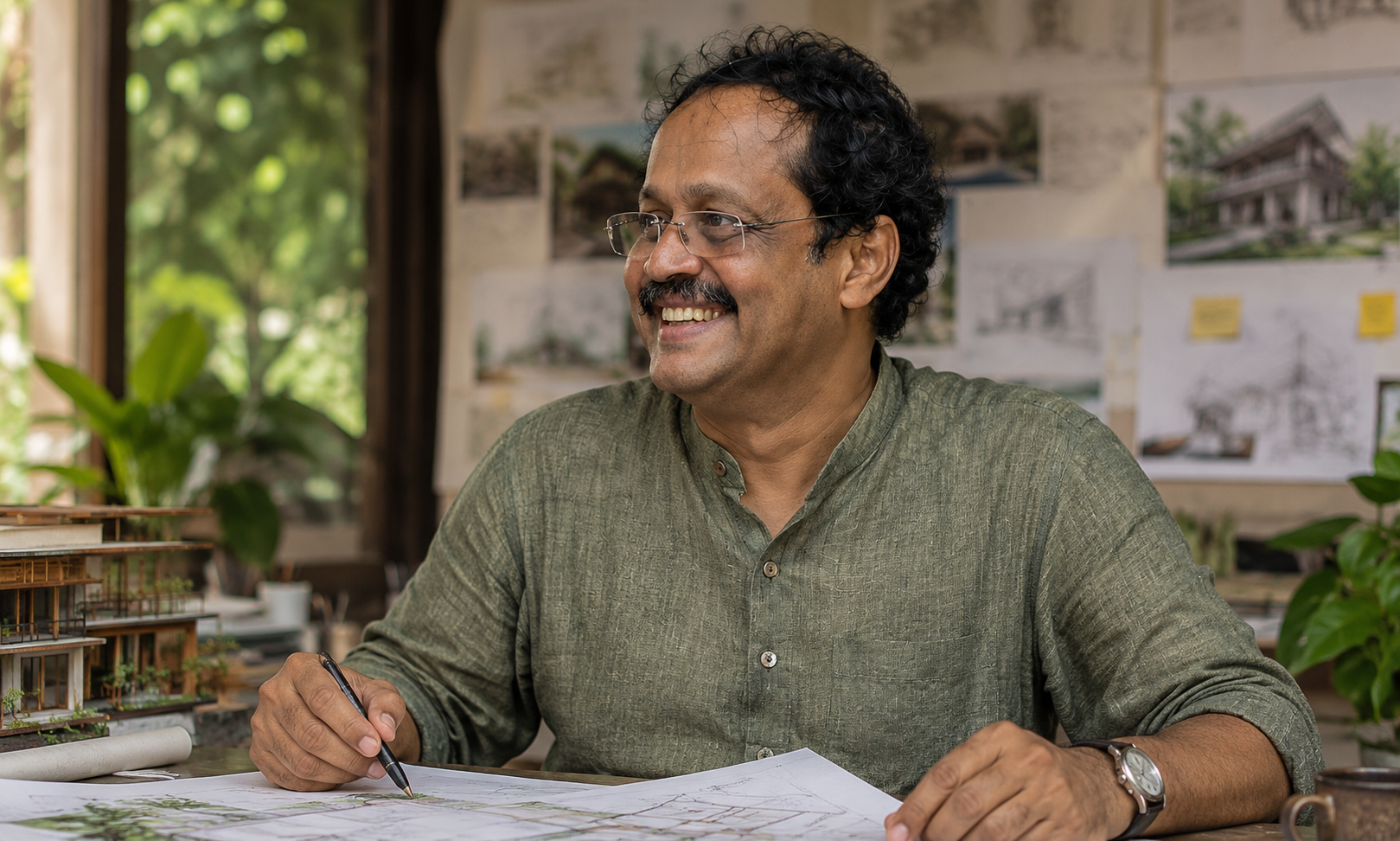
Eugene Pandala
Indian architect
Eugene Pandala is an Indian architect, known for building with values of environmental sustainability. He was the founding head of the second school of Architecture in Kerala (1985) located at Kollam where he spent time educating and researching on traditional building technologies of India. Pandala while studying at Delhi School of Planning and Architecture met the legendary architect Hassan Fathy, and was inspired to build with mud. As a nature lover, and cultural heritage conservation activist, he designs buildings with natural materials, landscapes with biodiversity conservation, and native vegetation, preferring interesting organic forms.
Key Factors
Full Name: Eugene Pandala
Occupation: Architect, Conservationist, Educator
Recognition: Pioneer of sustainable and ecological architecture in India
Known For: Mud architecture, heritage conservation, biodiversity-conscious design
Mist rises slowly over the hills of Wayanad at dawn. The air smells of wet earth, bamboo, stone, and forest leaves. Hidden within that landscape, almost as if it had emerged naturally from the soil itself, stands the Banasura Hill Resort, one of the most celebrated examples of ecological architecture in India. There are no aggressive concrete statements here, no architectural vanity trying to dominate the terrain. The buildings bend quietly into the contours of the hill, respecting the wind, the rain, and the memory of the land. This relationship between architecture and nature has defined the life’s work of Eugene Pandala, one of the most outstanding Malayali architects of modern India.
For decades, while Indian cities rushed toward glass towers and energy-hungry urban expansion, Pandala remained committed to another architectural language, one rooted in mud, local materials, biodiversity, and cultural memory. His buildings do not merely occupy space. They breathe with the landscape. They age with dignity. They invite silence. Through sustainable design, heritage conservation, and deeply climate-sensitive architecture, Eugene Pandala created a body of work that challenged the assumptions of modern Indian development and reintroduced the idea that architecture could still remain humane.
Roots in Kerala and Early Inspirations
To understand Eugene Pandala’s architecture, one must first understand Kerala itself.
Kerala’s traditional architecture evolved through centuries of dialogue with monsoon rain, tropical heat, dense vegetation, and layered cultural histories. Nalukettu courtyards, sloping tiled roofs, shaded verandas, laterite walls, and intricate timber craftsmanship were not simply aesthetic choices. They were ecological responses shaped by climate and community.
Pandala grew up deeply aware of this relationship between land and architecture. Unlike many modern architects trained to see nature as something to conquer or reshape, he absorbed Kerala’s older wisdom, the idea that buildings should belong to their environment rather than dominate it.
His formal architectural education at the College of Engineering Trivandrum gave him technical grounding, but it was his later studies in urban design at the School of Planning and Architecture that broadened his intellectual framework. There, architecture became not merely construction, but culture, politics, memory, and environmental responsibility.
A transformative moment arrived when Pandala encountered the legendary Egyptian architect Hassan Fathy, whose advocacy for mud architecture and vernacular design profoundly influenced generations of ecological architects worldwide. Fathy’s philosophy challenged modern industrial architecture by arguing that traditional materials and indigenous knowledge possessed deep environmental intelligence.
For Pandala, the encounter was revelatory.
He began to rethink what Indian architecture had abandoned in its race toward modernity. Mud was no longer a symbol of poverty or backwardness. It became a material of dignity, sustainability, thermal intelligence, and cultural continuity.
His later fellowship in heritage conservation at the University of York and Fort Brockhurst English Heritage Training Centre further sharpened his understanding of architectural memory and conservation ethics.
These experiences would eventually shape one of the most distinctive ecological architectural practices in India.
Building with Earth: The Philosophy of Sustainable Architecture
Eugene Pandala’s architecture is rooted in resistance.
Not loud political resistance, but a quieter resistance against environmental destruction, homogenised urban design, and the emotional sterility of contemporary construction culture.
At a time when Indian cities increasingly embraced steel-and-glass architecture disconnected from climate realities, Pandala argued for buildings that responded naturally to wind, sunlight, rainfall, vegetation, and terrain.
Mud became central to this philosophy.
For Pandala, mud was not merely a nostalgic material. It was environmentally intelligent. It regulated indoor temperatures naturally, reduced energy dependency, and created structures with emotional warmth impossible to replicate through industrial surfaces.
His work also rejected the rigid geometry of corporate architecture. Organic forms, textured surfaces, shaded courtyards, water-sensitive layouts, and biodiversity-rich landscapes became defining characteristics of his projects.
Importantly, Pandala’s ecological thinking extended beyond individual buildings. He understood architecture as part of larger ecosystems. Native vegetation, rainwater relationships, terrain preservation, and minimal ecological disruption became integral to his design process.
Today, in an era increasingly shaped by climate anxiety and ecological collapse, his architectural philosophy feels remarkably prescient.
Long before sustainability became fashionable branding language, Pandala was already practicing architecture that genuinely respected ecological limits.
The House That Changed Everything: BODHI
In 1996, Eugene Pandala built a house called BODHI.
What appeared initially to be a modest residential project would eventually become one of the defining moments of his career and a landmark in Indian sustainable architecture.
Constructed primarily with mud and natural materials, the 2,500-square-foot home challenged dominant assumptions about what modern Indian housing should look like. At a time when aspirational middle-class architecture often equated status with concrete excess, BODHI offered another vision entirely.
The house felt alive.
Its walls carried the texture of earth. Its interiors remained naturally cool despite Kerala’s humid climate. Light entered gently through carefully considered openings. The building seemed to emerge from the landscape rather than interrupt it.
Architects, environmentalists, and ordinary visitors were fascinated.
The project brought Pandala national attention because it demonstrated that sustainable architecture could also be aesthetically profound. BODHI was not an environmental compromise. It was emotionally rich, visually poetic, and deeply comfortable.
In many ways, the house became a manifesto.
It declared that ecological architecture in India did not need imported Western sustainability models. Indigenous materials and traditional intelligence already offered powerful alternatives.
Major Architectural Works and Legacy
Over the years, Eugene Pandala developed a body of work remarkable for its ecological sensitivity and cultural rootedness.
At Banasura Hill Resort, perhaps his most internationally recognised project, architecture dissolves almost entirely into landscape. Constructed using rammed earth techniques and natural materials, the resort avoids artificial luxury aesthetics. Instead, it creates an immersive ecological experience where architecture feels inseparable from the hills, rain, and forests surrounding it.
Similarly, The Raviz Resort and Spa Ashtamudi reflects Pandala’s ability to balance hospitality design with environmental consciousness. Located beside Kerala’s backwaters, the project avoids visual aggression. Water, vegetation, and open-air relationships dominate the experience.
His work on Revathy Kala Mandir demonstrated another dimension of his philosophy, architecture as cultural space. Designed as a film academy, the building emphasised openness, artistic dialogue, and contextual sensitivity rather than institutional rigidity.
Then there is OWIYUM, the artist retreat at Marayoor. Here, Pandala intentionally minimised built footprint to protect fragile ecosystems. The project reflected his belief that architecture sometimes achieves more by occupying less.
His memorial work for Pazhassi Raja Tomb approached heritage not as static nostalgia but as emotional continuity. The design carried dignity without monumental excess.
Even outside Kerala, projects like Sarai at Toria revealed his extraordinary sensitivity to site and ecology. Situated near Khajuraho beside a river, the accommodation blended vernacular forms with landscape responsiveness, creating architecture that felt regionally rooted rather than transplanted.
Perhaps most socially significant were his tsunami rehabilitation projects, where sustainable design principles intersected with humanitarian responsibility. Instead of imposing generic disaster-relief architecture, Pandala sought culturally and climatically responsive rebuilding.
Heritage Conservation and Kerala Identity
Eugene Pandala’s work in heritage conservation remains equally important to his legacy.
Projects in Fort Kochi and East Fort demonstrated that conservation is not merely about preserving old structures. It is about preserving collective memory.
Kerala’s heritage architecture faces enormous pressure from rapid urbanisation, speculative real estate development, and changing lifestyle aspirations. Pandala consistently argued that losing architectural heritage also meant losing cultural identity.
His conservation initiatives helped the Kerala government receive recognition associated with the PATA award, reinforcing the importance of heritage-sensitive urban planning.
For Pandala, old buildings were not obstacles to progress. They were repositories of ecological intelligence and cultural continuity.
Awards, Recognition, and International Presence
Recognition followed naturally, though Pandala’s work rarely sought spectacle.
In 2011, the Lalit Kala Akademi honoured him with the inaugural Laurie Baker Award, a particularly meaningful recognition given Baker’s own legacy in sustainable Kerala architecture.
The Inside Outside design magazine awarded him Designer of the Year in 2007 for eco-friendly design. Earlier, his East Fort conservation project received commendation recognition from the same publication.
His mud house BODHI earned a commendation at the J.K. Foundation Architect of the Year Awards in 1999.
Beyond awards, Pandala became an influential voice in architectural discourse. He delivered keynote talks at major conferences including the 361 Degree Conference in Mumbai and participated in the British Council’s Great Talk Series.
His work increasingly entered national debates around affordable sustainable housing, especially through discussions connected to India’s green building movement and GRIHA initiatives.
Eugene Pandala in Contemporary India
Today, Eugene Pandala’s ideas feel more urgent than ever.
Indian cities are confronting severe environmental crises, heat islands, flooding, ecological fragmentation, and emotionally alienating urban environments. Much contemporary development continues to prioritise short-term commercial efficiency over long-term environmental resilience.
Pandala’s architecture offers an alternative imagination.
Younger architects across India increasingly revisit vernacular building methods, local materials, passive cooling systems, and biodiversity-sensitive planning, ideas Pandala championed decades earlier.
Importantly, his work also questions the cultural emptiness of globalised architecture. In many Indian cities, buildings increasingly resemble interchangeable international templates disconnected from local climate or memory.
Pandala resisted that homogenisation.
His projects insisted that architecture should emerge from place, climate, history, and human experience.
Reflection
Eugene Pandala’s buildings rarely shout for attention. They whisper. They listen to rain, absorb wind, protect shade, and honour silence. In a world obsessed with speed and spectacle, that quietness may be his greatest architectural achievement.
Across resorts, homes, conservation projects, memorials, and ecological landscapes, he demonstrated that architecture could still remain ethical, rooted, and emotionally intelligent. He showed that sustainability is not simply technological efficiency but a deeper cultural relationship between humans and the earth they inhabit.
For Kerala, his work carries special meaning. It preserves the ecological wisdom embedded in traditional architecture while reimagining it for contemporary life. For India, it offers a powerful counterpoint to environmentally destructive urbanisation. And for younger architects searching for meaningful design philosophies, Eugene Pandala remains an outstanding Malayali visionary who proved that the future of architecture may ultimately depend on rediscovering humility before nature.