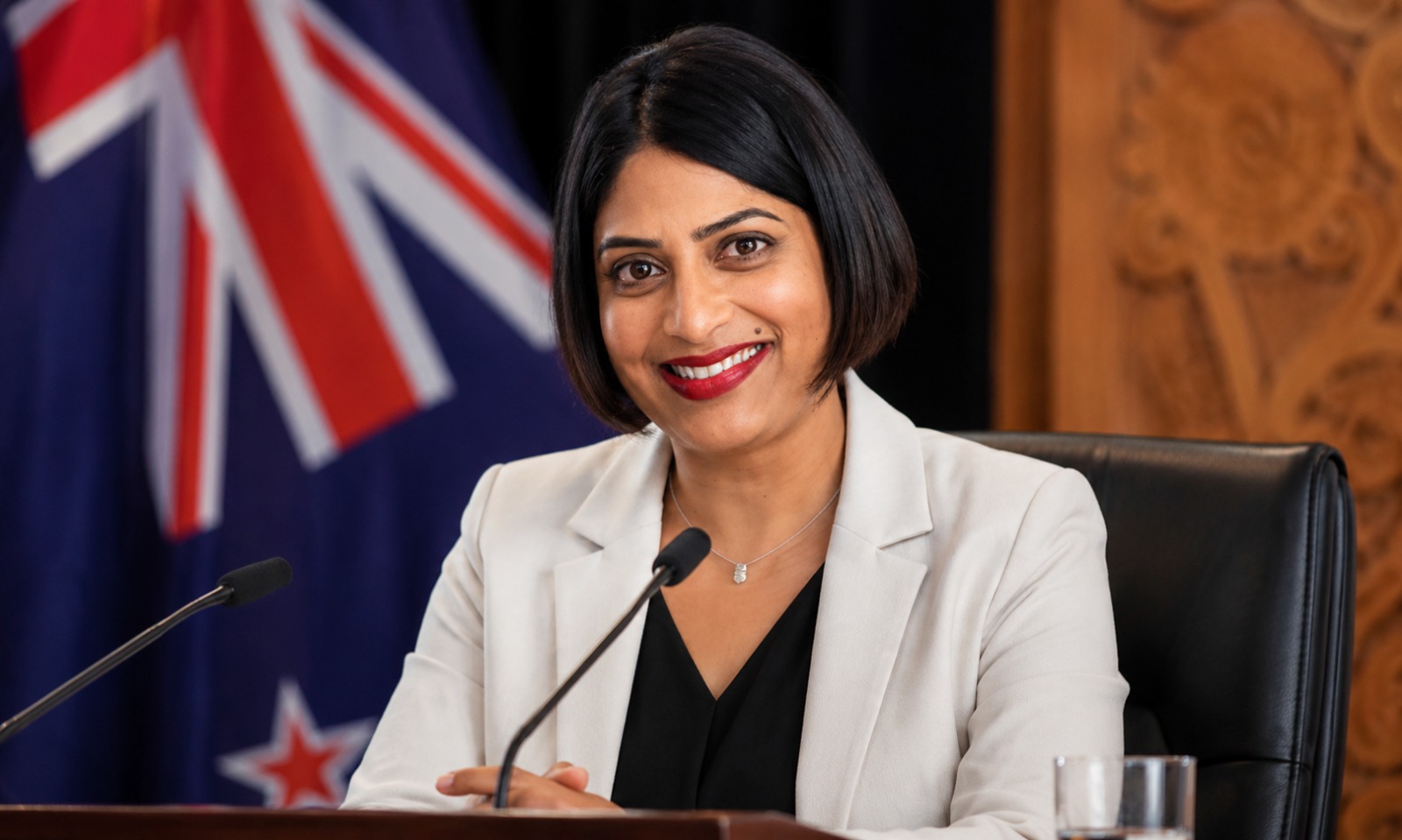
Priyanca Radhakrishnan
New Zealand’s Minister of Community and Voluntary Sector
Priyanca Radhakrishnan MP is a New Zealand politician who has been elected to the New Zealand parliament since the 2017 general election as a representative of the New Zealand Labour Party and was Minister for the Community and Voluntary Sector from 2020 to 2023. Priyanca was born in Chennai, India, to Malayali Nair parents. Her great-grandfather, Dr C. R. Krishna Pillai, was associated with left-wing politics in India, and played an instrumental role in the formation of the state of Kerala. She grew up in Singapore before moving to New Zealand. In Singapore she got her first job at around 16 years of age as an educational entertainer, performing educational skits for kindergarten children. She attended Victoria University of Wellington and graduated with a master’s degree in development studies.
Key Factors
Full Name: Priyanca Radhakrishnan
Born: 1979
Occupation: Politician, Former Social Worker
Known For: First Indian-origin minister in New Zealand
On election nights in New Zealand, politics often unfolds with quiet precision rather than theatrical spectacle. Yet when Priyanca Radhakrishnan stood before cameras after entering Parliament and later becoming New Zealand’s first minister of Indian origin, the moment carried significance far beyond Wellington’s political corridors. For immigrant communities across the world, especially for Malayalis who had built lives far from Kerala’s coastline, her rise represented something larger than personal success. It was about visibility, belonging, and the gradual reshaping of global democracies.
Born in Chennai to Malayali Nair parents, raised partly in Singapore, and politically shaped in New Zealand, Priyanca Radhakrishnan belongs to a generation of diaspora leaders whose identities cannot be confined to one geography alone. Her journey from social worker to cabinet minister reflects not only persistence within electoral politics, but also a deep commitment to inclusion, community advocacy, and progressive public service. In an era when debates around migration and multiculturalism increasingly define democratic politics worldwide, Radhakrishnan has emerged as an outstanding Malayali voice navigating those conversations from within government itself. Her story is not merely about representation. It is about how migration transforms political imagination across borders and generations.
Early Life: From Chennai to the World
Priyanca Radhakrishnan’s political worldview was shaped long before she entered Parliament.
She was born in Chennai in 1979 into a Malayali Nair family whose intellectual and political consciousness stretched deep into Kerala’s modern history. Her great-grandfather, Dr. C. R. Krishna Pillai, was associated with left-wing political movements in India and played a role in the formation of Kerala as a state. Politics, social awareness, and questions of public responsibility therefore existed within family memory itself.
Yet her childhood was not rooted in one place alone.
Much of her early life unfolded in Singapore, where she encountered multicultural society at an early age. The experience mattered profoundly. Singapore exposed her to ethnic diversity not as abstraction but as everyday reality. Different languages, religions, immigrant experiences, and social hierarchies existed side by side.
She has often spoken about beginning work at around sixteen years of age as an educational entertainer performing skits for kindergarten children. It was an unusual first job, but in retrospect it hinted at qualities that would later define her public career: communication, empathy, and the ability to connect across communities.
Migration to New Zealand added another layer to her identity. Like many immigrants, she had to negotiate belonging while adapting to a new society. Those experiences would later influence her politics around diversity, inclusion, and ethnic representation.
At Victoria University of Wellington, she pursued a master’s degree in development studies, a discipline deeply concerned with inequality, governance, poverty, and social justice. Education sharpened her understanding of structural disadvantage, but it was her later work among immigrant communities that transformed theory into lived political conviction.
Social Work Before Politics
Before politics came community work.
After graduating, Radhakrishnan worked as a social worker among Auckland’s Indian and migrant communities. It was during these years that she encountered the quieter realities often hidden beneath successful immigrant narratives, isolation, employment insecurity, language barriers, domestic violence, and difficulties navigating institutions in an unfamiliar country.
These experiences shaped her political instincts permanently.
Unlike politicians who arrive through elite ideological pipelines, her entry point into public life came through direct human interaction. She worked with people facing everyday struggles rather than abstract policy debates. That grounding gave her politics a practical social dimension.
New Zealand’s migrant communities were also changing rapidly during this period. South Asians, particularly Indians, were becoming increasingly visible economically and culturally, yet political representation remained limited. Questions about inclusion, multicultural citizenship, and systemic equity were becoming more urgent.
Radhakrishnan increasingly understood politics not simply as electoral competition, but as a mechanism capable of influencing institutional fairness.
That understanding drew her toward the Labour Party.
Entering Politics and the Labour Party
Priyanca Radhakrishnan joined the New Zealand Labour Party in 2006.
The decision aligned naturally with her background in social work and development studies. Labour’s focus on welfare, workers’ rights, diversity, and public services reflected many of the concerns she had already encountered through grassroots engagement.
Her rise within the party, however, was gradual rather than immediate.
She became involved in policy development processes and organisational work at local and regional levels, building credibility internally before becoming publicly prominent. That phase is often overlooked in political storytelling, but it mattered significantly. For immigrant women in democratic politics, advancement frequently requires navigating invisible institutional barriers while simultaneously proving competence repeatedly.
The 2014 general election became an important early test.
Radhakrishnan was ranked twenty-third on Labour’s party list, an impressive position for a newcomer, yet Labour’s reduced vote share meant she narrowly missed entering Parliament. For many aspiring politicians, such setbacks become exit points.
Instead, she stayed.
Persistence inside party politics often matters as much as charisma, and Labour leadership increasingly recognised both her organisational abilities and her importance as a representative of New Zealand’s changing demographics.
By 2017, she had risen dramatically to number twelve on Labour’s list and was selected as the candidate for the Maungakiekie electorate.
The trajectory reflected growing confidence in her political future.
Becoming a Member of Parliament
The 2017 election marked Priyanca Radhakrishnan’s entry into Parliament.
Although she did not initially win the Maungakiekie electorate, Labour’s strong overall performance enabled her to enter Parliament through the party list system. It was a significant moment not only personally but symbolically.
New Zealand politics has historically been more inclusive than many democracies, particularly regarding women’s representation. Yet immigrant women of South Asian origin remained relatively rare within national political leadership structures.
Radhakrishnan’s visibility therefore carried representational significance immediately.
Her early parliamentary years also revealed the intensely human side of political life. Shortly after returning from a visit to Bangladesh, she was mugged in broad daylight in Auckland, an incident that drew public attention and reminded observers that politicians themselves are often vulnerable within the societies they serve.
In 2019, Prime Minister Jacinda Ardern appointed her Parliamentary Private Secretary for Ethnic Affairs. The role aligned naturally with her background and marked the beginning of her rise within executive government.
Breaking Barriers: New Zealand’s First Indian-Origin Minister
In November 2020, Priyanca Radhakrishnan made history.
Following Labour’s election victory, Jacinda Ardern appointed her Minister for the Community and Voluntary Sector, Minister for Diversity, Inclusion and Ethnic Communities, Minister for Youth, and Associate Minister for Social Development and Employment.
She became New Zealand’s first minister of Indian origin.
For diaspora communities across New Zealand, India, and especially among Malayalis abroad, the appointment resonated deeply. Representation alone does not guarantee transformation, but symbolic milestones matter within democracies. They alter public imagination about who belongs within national leadership.
Radhakrishnan’s portfolios were also politically significant. Diversity and inclusion were no longer peripheral issues in contemporary New Zealand politics. They sat at the centre of conversations about migration, social cohesion, inequality, and national identity.
Her leadership style differed from more confrontational political personalities. She projected calmness, administrative seriousness, and community-focused engagement rather than ideological theatrics. That approach reflected New Zealand’s political culture but also her own background in social work.
In 2022, she was promoted further into Cabinet and became Associate Minister for Workplace Relations and Safety, expanding her policy influence.
Leadership, Diversity, and Public Service
Much of Priyanca Radhakrishnan’s political identity has been built around inclusion.
Her work consistently focused on ethnic communities, youth empowerment, workplace rights, disability issues, and community development. Unlike politicians who frame diversity purely symbolically, she approached it through institutional and policy frameworks.
This distinction matters.
For immigrant communities, representation becomes meaningful when linked to practical access, employment opportunities, social protections, and public participation.
Radhakrishnan’s politics therefore combined progressive values with grassroots orientation. Even as her profile rose nationally, she maintained close engagement with local communities and migrant organisations.
In opposition after Labour’s 2023 defeat, she continued holding major portfolios including conservation, disability issues, and later Accident Compensation Corporation matters under Labour leader Chris Hipkins.
Her continued prominence suggested long-term political relevance beyond ministerial office alone.
Political Setbacks and Resilience
Democratic politics rarely moves in straight lines.
In the 2023 election, Radhakrishnan lost the Maungakiekie electorate to National Party candidate Greg Fleming by more than four thousand votes. On paper, it was a significant defeat.
Yet New Zealand’s mixed-member proportional system allowed her return to Parliament through Labour’s party list.
What followed demonstrated political resilience rather than retreat.
Instead of disappearing from national visibility, she continued serving in prominent opposition roles. The episode reflected an important reality about mature democratic systems: political influence is not always determined solely by electoral victories in individual constituencies.
Her career increasingly appears defined not by singular triumphs or defeats, but by sustained institutional presence.
The 2026 Virginity Testing Bill
In 2026, Radhakrishnan again entered national conversation through a deeply sensitive issue.
Her private member’s bill proposed criminalising virginity testing and hymenoplasty, aligning New Zealand law with broader efforts by the World Health Organization and UN Women to end such practices globally.
She described virginity testing and hymenoplasty as invasive and harmful practices violating women’s human rights.
The proposal carried significance beyond legislative technicalities. It touched on difficult intersections between culture, gender, bodily autonomy, migration, and public health.
Supporters viewed the bill as an important human rights intervention protecting women from coercive and pseudoscientific practices. Critics from some communities expressed concerns about cultural sensitivity and state intervention.
Radhakrishnan approached the issue firmly but within the language of rights-based policy rather than moral sensationalism.
A Global Malayali Voice
For many Malayalis living outside India, Priyanca Radhakrishnan represents a familiar yet evolving diasporic story.
Her identity cannot be reduced to nationality alone. She belongs simultaneously to Kerala’s intellectual traditions, Indian migration histories, and New Zealand’s multicultural democratic landscape.
That layered identity explains why her journey resonates widely among global Malayali communities.
Kerala has long produced migrants, professionals, academics, and political thinkers who travelled internationally while retaining strong emotional connections to cultural roots. Radhakrishnan fits within that broader historical pattern, yet her rise within foreign democratic politics gives the story unique significance.
She represents not simply professional success abroad, but participation in shaping national governance itself.
Honours and Recognition
Recognition followed naturally as her public profile expanded.
In 2021, she received the Pravasi Bharatiya Samman for public service, one of India’s highest honours for overseas Indians. The award acknowledged both her political achievements and her role in representing the Indian diaspora internationally.
In 2023, she was granted retention of the title “The Honourable” in recognition of her service on New Zealand’s Executive Council.
Such honours matter not merely ceremonially, but historically. They reflect how diaspora identities increasingly operate across interconnected political worlds rather than singular national boundaries.
Reflection
Priyanca Radhakrishnan’s story is ultimately about movement, across countries, cultures, political systems, and generations. From a Chennai-born child in a Malayali family to a minister in New Zealand’s government, her journey reflects the changing realities of global citizenship in the twenty-first century. Yet what makes her political career compelling is not simply symbolic representation. It is the consistency with which she has tied identity to public service, migration to empathy, and diversity to democratic participation.
At a time when politics worldwide is increasingly shaped by fear around difference and belonging, her career offers another possibility, one where immigrant histories strengthen rather than weaken democratic institutions. For Malayalis watching from Kerala, Auckland, Dubai, London, or Toronto, Priyanca Radhakrishnan stands as an outstanding example of how deeply local roots can still produce globally relevant leadership.
Honours and awards
2021 – Pravasi Bharatiya Samman award for public service
2023 – Granted retention of the title The Honourable, in recognition of her term as a member of the Executive Council.