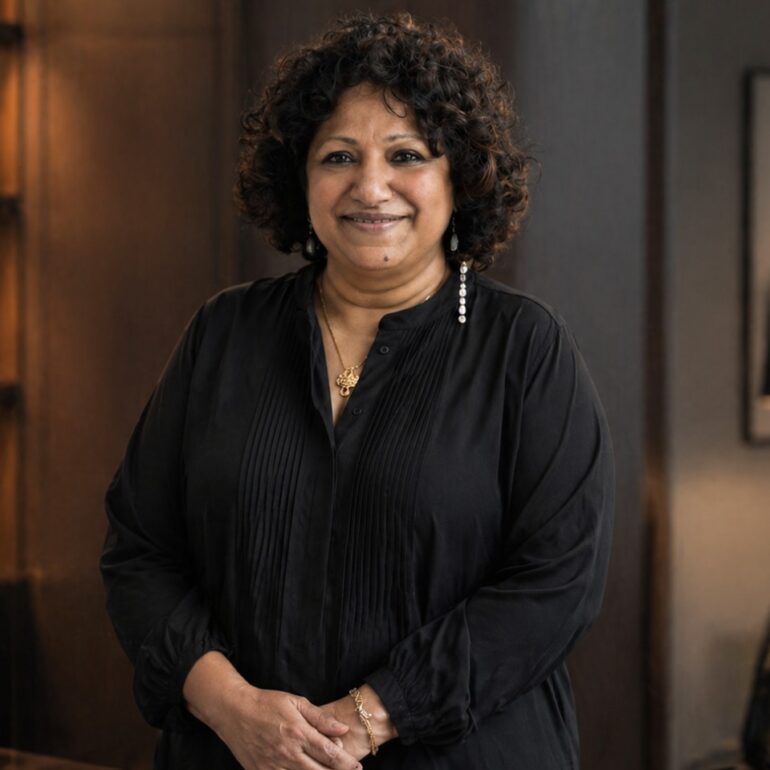
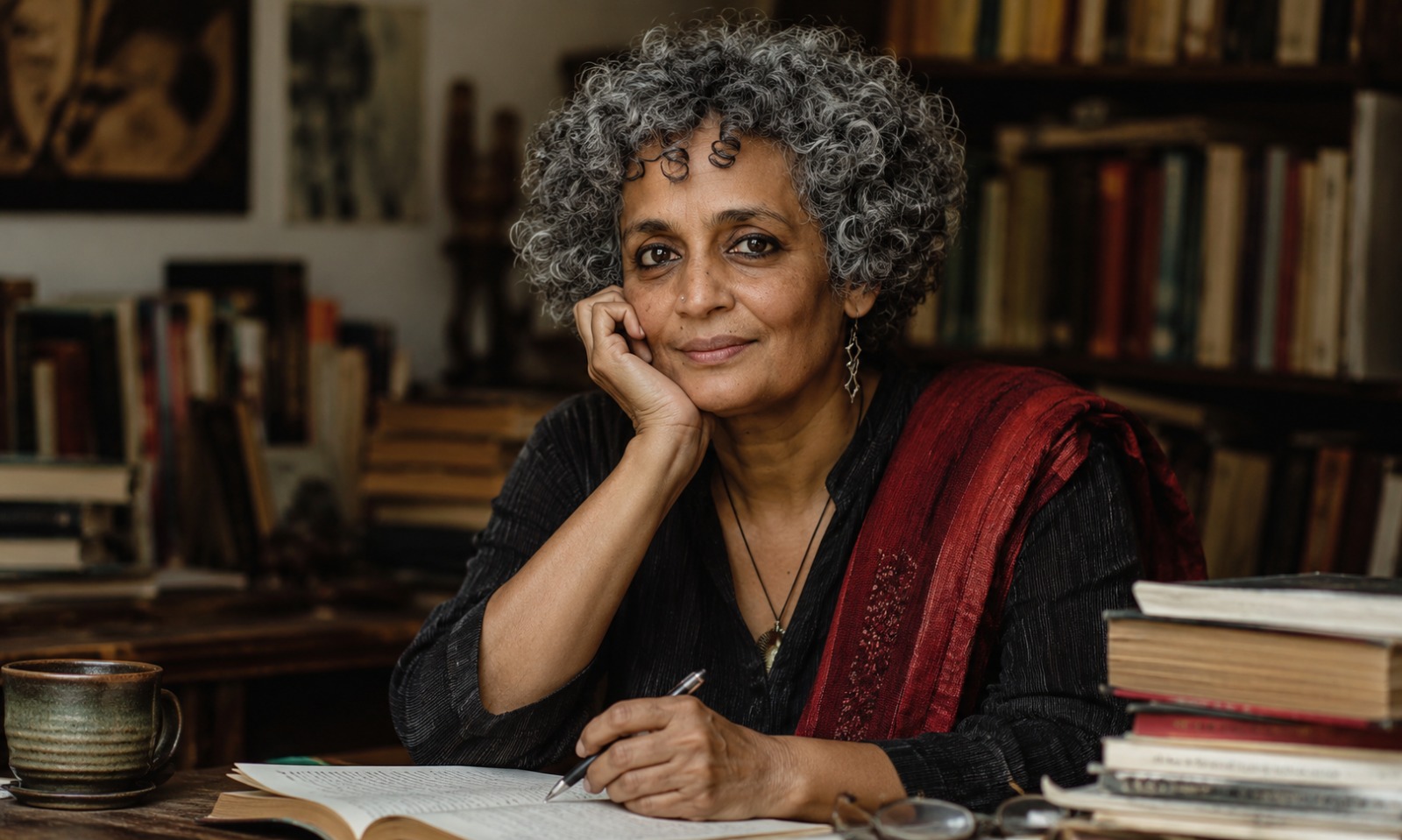
Arundhati Roy
Indian author and activist
Suzanna Arundhati Roy is an Indian author best known for her novel The God of Small Things, which won the Booker Prize for Fiction in 1997 and became the biggest-selling book by a non-expatriate Indian author. She is also a political activist involved in human rights and environmental causes. She was the winner of the 2024 PEN Pinter Prize, given by English PEN. Arundhati Roy was born in Shillong, in Undivided Assam (now in Meghalaya). Her mother, Mary Roy, was a Malayali Christian women’s rights activist from Aymanam, Kerala, and belonged to the Jacobite Syrian denomination. Her father, Rajib Roy, was a Bengali Hindu who later embraced Christianity. He was a tea plantation manager from Kolkata, West Bengal.
Key Factors
Full Name: Suzanna Arundhati Roy
Born: 24 November 1961
Birthplace: Shillong
Roots: Aymanam
Occupation: Author, Essayist, Political Activist, Screenwriter
The rivers of Kerala flow quietly in the fiction of Arundhati Roy, but beneath that quietness lies rage, memory, desire, caste violence, and rebellion. Few Indian writers have travelled such an extraordinary path, from the humid landscapes of Kottayam and Aymanam to the global literary stage, and then into the centre of some of the fiercest political debates of modern India. When The God of Small Things exploded into world literature in 1997, it did more than win the Booker Prize. It announced the arrival of a startling new literary voice, lyrical yet political, intimate yet explosive. But Arundhati Roy refused to remain only a celebrated novelist. She stepped away from literary celebrity and became one of India’s most outspoken and polarising public intellectuals, challenging governments, corporations, militarism, nationalism, and structures of power with unusual ferocity. Admired by many as fearless and morally uncompromising, condemned by others as provocative and anti-establishment, Roy occupies a singular place in Indian cultural life. What remains undeniable is that she is one of the most outstanding literary and political voices to emerge from Kerala and contemporary India, a writer whose words continue to unsettle, provoke, and inspire across the world.
There is a scene in The God of Small Things where rain falls over Ayemenem with hypnotic intensity, soaking banana trees, rivers, insects, grief, and memory alike. That atmosphere, lush and dangerous at the same time, has long defined the imagination of Arundhati Roy. Born far away in Shillong but emotionally rooted in Kerala, Roy emerged first as a novelist of astonishing sensitivity and later as a political dissenter unwilling to soften her voice for public approval. Her journey from architecture student and screenwriter in Delhi to globally celebrated author and activist reads almost like one of her own narratives, fragmented, rebellious, emotionally charged, and impossible to separate from the politics of India itself.
For readers across the world, Roy became synonymous with literary brilliance after the success of The God of Small Things, a novel that transformed Indian English fiction through its fractured chronology, poetic language, and fearless examination of caste, sexuality, childhood trauma, and forbidden love. Yet the Booker Prize was only the beginning. Over the next three decades, Roy evolved into a relentless critic of state violence, environmental destruction, majoritarian politics, militarism, and corporate power. Whether writing about Kashmir, displacement, nuclear nationalism, or global capitalism, she brought the same emotional intensity and literary precision that made her fiction unforgettable.
Childhood, Kerala Roots, and Family Struggles
Arundhati Roy’s childhood carried both instability and fierce independence.
She was born in Shillong in 1961 to Mary Roy, a Malayali Syrian Christian women’s rights activist from Kerala, and Rajib Roy, a Bengali tea plantation manager. The marriage collapsed early under the strain of alcoholism and domestic unhappiness. When Roy was still a child, her mother left the marriage and returned to Kerala with her children.
That return shaped everything.
In Aymanam, near Kottayam, Roy grew up surrounded by the emotional textures that would later define her fiction, rivers, insects, churches, communist politics, caste anxieties, and the silent social hierarchies of Kerala society. Her mother, Mary Roy, became a towering influence. A fiercely independent woman, Mary Roy later fought a landmark legal battle that secured equal inheritance rights for Syrian Christian women in Kerala.
The emotional complexity of Roy’s relationship with her mother would echo through her writing for decades. Love and rebellion coexisted uneasily between them.
Kerala in the 1960s and 1970s was intellectually vibrant but socially conservative. Roy absorbed its contradictions early. She witnessed how caste survived beneath claims of progressiveness, how religion shaped emotional life, and how women negotiated freedom inside deeply patriarchal systems.
These tensions later became central to her literary imagination.
Ayemenem in The God of Small Things was not simply fictional geography. It was memory transformed into literature.
Delhi, Architecture, and Creative Awakening
As a young woman, Roy moved to New Delhi to study architecture at the School of Planning and Architecture. Delhi exposed her to a radically different India, urban, political, chaotic, and intellectually restless.
She lived unconventionally, often struggling financially and existing outside respectable middle-class expectations. Architecture interested her, but storytelling increasingly pulled her elsewhere.
During this period, Roy entered cinema and screenwriting. She wrote and acted in In Which Annie Gives It Those Ones, directed by her then-husband Pradip Krishen. The film, based loosely on student life at architecture school, developed cult status for its wit, political irreverence, and realism. Roy later won the National Film Award for Best Screenplay for the work.
Another screenplay, Electric Moon, continued her satirical exploration of postcolonial India.
These years sharpened her political consciousness. Delhi showed her inequality in brutal proximity, luxury beside homelessness, power beside dispossession. The city’s emotional and ideological turbulence would later shape both her essays and fiction.
The God of Small Things: The Novel That Changed Everything
When Roy began writing The God of Small Things in the early 1990s, few could have predicted the cultural earthquake it would create.
The novel emerged slowly, built from memory fragments, emotional wounds, childhood observation, and literary experimentation. Set largely in Kerala, it tells the story of fraternal twins Estha and Rahel, whose lives are shaped by family trauma, forbidden love, caste violence, and irreversible loss.
The novel’s emotional centre lies in the relationship between Ammu and Velutha, an “Untouchable” carpenter, whose love violates the invisible but brutal caste order of Kerala society.
Roy’s prose moved differently from conventional Indian English fiction.
Sentences bent rhythmically. Time collapsed. Language became playful, wounded, musical. Childhood perception shaped narrative structure. Small details, insects, river sounds, smells, fragments of speech, carried enormous emotional weight.
Critics across the world responded with astonishment.
The novel won the Booker Prize in 1997 and became an international publishing phenomenon. Reviews in publications like The New York Times praised its emotional richness and imaginative force. Readers encountered an India far removed from exotic clichés.
But the book also generated intense controversy in Kerala and India.
Its frank treatment of sexuality, caste, and family tensions provoked conservative outrage. Political figures criticised its portrayal of Kerala society, while obscenity complaints emerged over its sexual passages.
Yet controversy only deepened the novel’s influence.
Today, The God of Small Things remains one of the defining works of modern Indian literature.
From Novelist to Political Firebrand
Many expected Roy to produce another literary blockbuster immediately after her Booker success.
Instead, she turned toward activism.
Over the next two decades, Roy became deeply associated with anti-globalisation politics, environmental movements, anti-war activism, and critiques of state violence. She supported the Narmada Bachao Andolan against large dam projects and argued that development often displaced vulnerable communities in the name of progress.
Her essays attacked nuclear nationalism after India’s Pokhran nuclear tests. She condemned the Iraq War, criticised American foreign policy, and questioned corporate-driven economic growth.
Roy’s nonfiction carried the same lyrical intensity as her fiction, but weaponised toward politics.
Books such as The Cost of Living, Listening to Grasshoppers, and My Seditious Heart transformed her into a globally recognised dissident intellectual.
Supporters admired her willingness to confront power directly.
Critics accused her of ideological extremism and rhetorical excess.
Roy appeared unconcerned with pleasing either side.
Kashmir, Sedition, and National Debate
No issue made Roy more controversial than Kashmir.
She repeatedly argued that Kashmiris must have the right to self-determination and criticised India’s military presence in the region. Her remarks led to fierce backlash from political parties and television commentators. In 2010, sedition charges were filed against her after comments made at a conference on Kashmir.
To critics, Roy crossed the line between dissent and anti-nationalism.
To supporters, she articulated uncomfortable truths that mainstream politics refused to confront.
This polarisation followed her across nearly every political intervention she made, from criticism of Narendra Modi and Hindu majoritarianism to commentary on Palestine, tribal displacement, and state repression.
Roy’s public life became defined by conflict, not only with governments but also with sections of liberal India uncomfortable with the intensity of her critique.
Voice of Dissent and Global Intellectual Influence
Over time, Roy evolved into something larger than a novelist.
She became a transnational voice of dissent.
Universities, literary festivals, activist spaces, and political forums across the world invited her to speak about authoritarianism, militarism, democracy, and human rights. Her essays circulated globally, particularly among younger readers suspicious of nationalism and neoliberal power structures.
In 2024, she received the PEN Pinter Prize, recognising writers who defend freedom of expression.
Even those who disagree with Roy often acknowledge the intensity and consistency of her political commitments.
She writes not from cautious neutrality, but from moral urgency.
Literary Style and Influences
Roy’s writing style remains instantly recognisable.
Her prose combines poetic rhythm with political sharpness. She fragments chronology, allowing memory and emotion to move unpredictably through narrative. Geography in her work is never passive. Rivers, rain, forests, insects, dust, and architecture carry emotional meaning.
Writers such as Gabriel García Márquez, James Baldwin, Toni Morrison, and John Berger influenced her literary imagination.
Yet Roy’s voice remains unmistakably her own, rooted in Kerala’s sensory world while speaking to global anxieties about power, identity, and violence.
Arundhati Roy as an Outstanding Malayali
Though Roy writes primarily in English, Kerala lives at the centre of her imagination.
The rain-soaked landscapes, social tensions, communist politics, caste structures, Christian family life, and emotional contradictions of Kerala appear repeatedly in her work. Even when writing about Kashmir or global imperialism, she carries a distinctly Malayali intellectual sensibility, argumentative, politically alert, emotionally layered, sceptical of authority.
Kerala’s literary culture shaped her profoundly.
Malayalam literature has long embraced political writing, social criticism, and psychological realism. Roy inherited that tradition while transforming it for global audiences.
She became one of the most internationally recognised writers with Malayali roots, carrying Kerala’s emotional and political complexity into world literature.
Criticism, Polarisation, and Public Image
Arundhati Roy occupies an unusual place in Indian public life.
She is admired passionately and criticised intensely.
Political opponents accuse her of romanticising insurgency, undermining nationalism, and exaggerating state violence. Some intellectual critics argue that her rhetoric can become absolutist or theatrical.
Yet many readers continue to admire her precisely because she refuses moderation for acceptability.
Roy rarely chooses politically safe positions. She enters contentious debates fully aware of backlash. That willingness has made her one of India’s most discussed and divisive intellectual figures.
Her public image remains inseparable from confrontation.
Legacy and Continuing Relevance
More than twenty-five years after The God of Small Things, Arundhati Roy continues to occupy a rare position in Indian culture.
She is simultaneously a literary icon, political dissenter, public intellectual, and cultural provocateur.
Few Indian writers have influenced both literature and political discourse with equal intensity. Her fiction transformed Indian English writing stylistically and emotionally, while her essays challenged readers to confront uncomfortable questions about nationalism, democracy, capitalism, caste, militarism, and dissent.
In a deeply polarised world, Roy remains impossible to ignore.
For some, she represents moral courage.
For others, provocation without restraint.
But perhaps her lasting significance lies precisely in that refusal to become easy or comfortable. Like the turbulent rivers and monsoon skies of Kerala that shaped her imagination, Arundhati Roy continues to move through public life with force, unpredictability, beauty, and confrontation. And that is why she remains one of the most outstanding and fiercely influential literary voices modern India has produced.
Awards and recognition
1997 – Booker Prize (The God of Small Things)
1989 – National Film Award for Best Screenplay (In Which Annie Gives It Those Ones) In 2015, she returned the national award in protest against religious intolerance and the growing violence by rightwing groups in India
2002 – Lannan Foundation’s Cultural Freedom Award for her work “about civil societies that are adversely affected by the world’s most powerful governments and corporations”, in order “to celebrate her life and her ongoing work in the struggle for freedom, justice and cultural diversity”.
2003 – “special recognition” as a Woman of Peace at the Global Exchange Human Rights Awards in San Francisco with Bianca Jagger, Barbara Lee, and Kathy Kelly.
2004 – Sydney Peace Prize for her work in social campaigns and her advocacy of non-violence.
2004 – Orwell Award, along with Seymour Hersh, by the National Council of Teachers of English
2006 – Sahitya Akademi Award, a national award from India’s Academy of Letters, for her collection of essays on contemporary issues
2011 – Norman Mailer Prize for Distinguished Writing
2014 – Featured in the list of Time 100, the 100 most influential people in the world
2022 – St. Louis Literary Award by St. Louis University, granted to the “most important writers of our time” to celebrate “the contributions of literature in enriching our lives”
2023 – Lifetime achievement award at the 45th European Essay Prize for the French translation of her book Azadi
2024 – Winner of the annual PEN Pinter Prize, given by the human rights organisation English PEN to a writer who, in the words of late playwright Harold Pinter, casts an “unflinching, unswerving” gaze on the world and shows “fierce intellectual determination … to define the real truth of our lives and our societies”. English PEN chair Ruth Borthwick said Roy tells “urgent stories of injustice with wit and beauty”.
2024 – Roy and Toomaj Salehi shared the Disturbing the Peace Award, a recognition the Vaclav Havel Center accords to courageous writers at risk.
2024 – Roy named imprisoned British-Egyptian activist Alaa Abd El-Fattah as the international “writer of courage” with whom she chose to share the 2024 PEN Pinter Prize, announced at a ceremony at the British Library, where Roy delivered her acceptance speech. Author and journalist Naomi Klein also spoke, praising Roy’s and Abd El-Fattah’s work, and Lina Attalah, editor-in-chief of independent online Egyptian newspaper Mada Masr, accepted the award on Abd El-Fattah’s behalf.
2026 – Roy’s autobiography, Mother Mary Comes to Me won the 2025 National Book Critics Circle Award for Memoir and Autobiography.