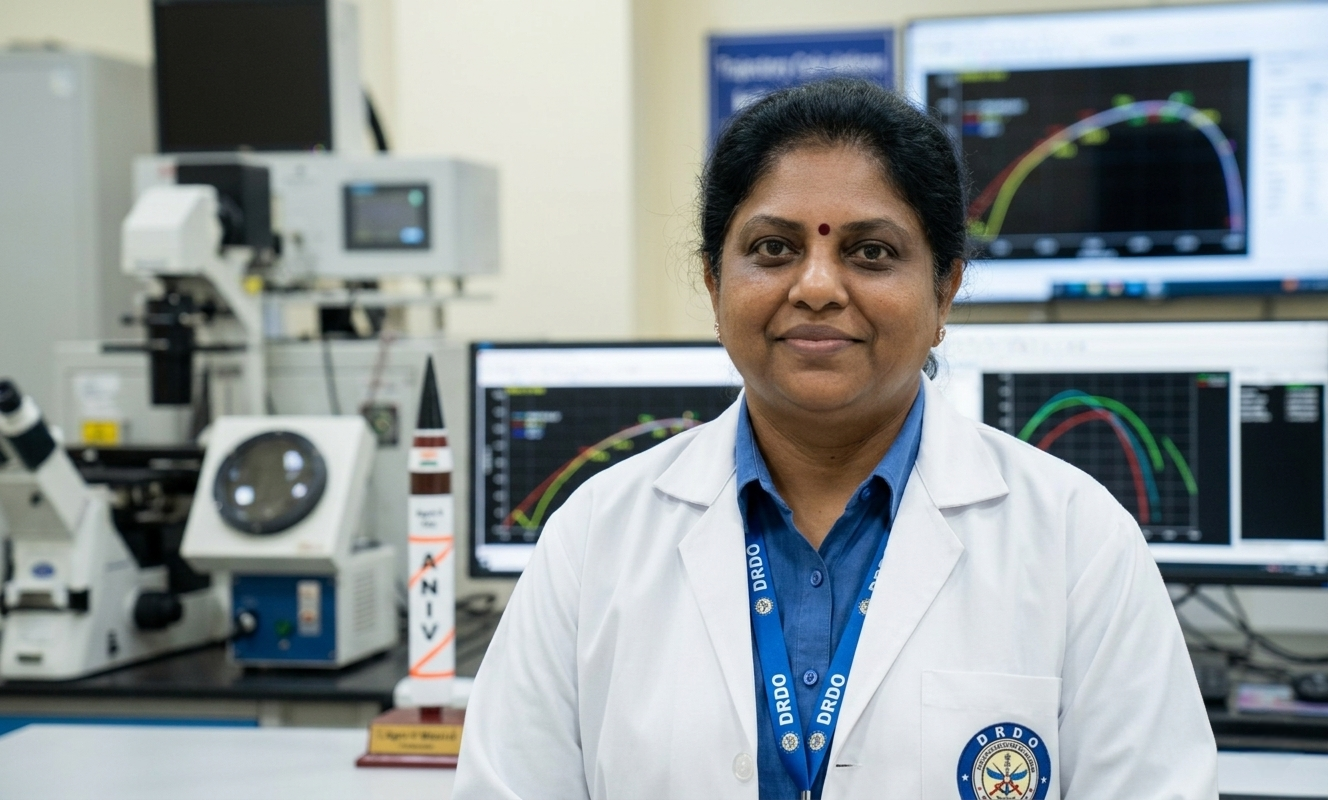
Dr. Tessy Thomas
Missile Woman of India
Born: 1963 (age 63)
Place: Alappuzha, Kerala, India
Title: Project director at DRDO
Known for: Agni Missile Project Director
The Arc of Fire
The countdown is less dramatic than it looks from the outside. Inside the control room, numbers move, telemetry streams in, and decisions compress into seconds. When the missile lifts, it is not just thrust overcoming gravity. It is years of design, iteration, and risk taking form. For Tessy Thomas, moments like these define a career built on precision rather than spectacle. The arc traced across the sky is an outstanding demonstration of control, guidance, propulsion, and re-entry physics working in concert. In India’s strategic programme, such launches are not displays of power alone. They are validations of capability, credibility, and technological autonomy.
From Coastal Kerala to Strategic Science
Tessy Thomas was born in Alappuzha, Kerala, a region shaped by water, trade, and a long-standing engagement with science education. Her early life did not unfold within the infrastructure of elite scientific institutions, but within a context where education functioned as mobility.
Her interest in science developed gradually, influenced by both schooling and a broader national moment. The 1970s and 1980s in India were marked by visible advances in space and defence research, and figures like A. P. J. Abdul Kalam became symbols of scientific aspiration.
She pursued engineering, specializing in electrical and electronics engineering, before advancing into guided missile technology through postgraduate studies at institutions aligned with defence research.
This trajectory is important.
Her entry into strategic science was not accidental. It required navigating competitive academic systems and aligning with a sector that remains highly selective.
Entry into DRDO and Early Career: Learning Within a System
Dr. Tessy Thomas joined the Defence Research and Development Organisation (DRDO) during a period when India’s missile programme was transitioning from foundational research to operational capability.
Her early work involved guidance and control systems, the computational and electronic backbone of missile performance. These systems determine how a missile navigates its trajectory, corrects deviations, and reaches its intended target with precision.
The learning curve was steep.
Missile development is inherently interdisciplinary, combining aerodynamics, propulsion, materials science, electronics, and systems engineering. For a young scientist, this meant not only mastering individual domains but understanding how they integrate.
Mentorship played a role. Senior scientists, including those shaped by the Integrated Guided Missile Development Programme (IGMDP), provided institutional continuity. Yet, the environment remained demanding, defined by tight timelines, high stakes, and limited tolerance for error.
The Agni Programme: Building Strategic Reach
Dr. Tessy Thomas’s most significant contributions are associated with India’s Agni missile series, particularly Agni IV and Agni V.
These systems represent critical components of India’s strategic deterrence framework.
Agni-IV, with a range of approximately 4,000 kilometers, marked a step forward in accuracy, mobility, and survivability. It incorporated advanced navigation systems, improved propulsion stages, and enhanced re-entry vehicle design.
Agni-V extended this capability further, with a range exceeding 5,000 kilometers. This placed India within a limited group of nations capable of developing long-range ballistic missile systems.
Dr. Thomas served in key leadership roles within these programmes, including Project Director for Agni-IV and Associate Project Director for earlier systems.
Her work involved:
- Integration of complex subsystems
- Validation through iterative testing
- Ensuring reliability under extreme conditions
Each test launch was not a singular event but the culmination of multiple developmental cycles, design, simulation, fabrication, and failure analysis.
Leadership and Scientific Authority: Managing Complexity
Leadership in defence research differs from conventional scientific management.
It involves coordinating large, multidisciplinary teams under conditions where failure has both technical and strategic implications.
Dr. Tessy Thomas’s leadership roles within DRDO required:
- Decision making under uncertainty
- Balancing innovation with reliability
- Managing timelines aligned with national objectives
Her later positions, including Director General roles within DRDO, expanded her responsibilities beyond individual projects to broader programme oversight.
In such roles, authority is not performative. It is derived from technical competence and the ability to integrate diverse expertise into functional systems.
Gender, Barriers, and Representation: Beyond Symbolism
The defence research sector in India has historically been male-dominated.
Dr. Tessy Thomas’s rise within this system is often framed through the label “Missile Woman of India.” While the title reflects recognition, it also risks reducing a complex career to symbolic representation.
Her trajectory demonstrates that inclusion in high-level scientific roles is less about visibility and more about sustained competence.
She has navigated Institutional hierarchies, Technical scrutiny and High-pressure environments without positioning gender as a primary narrative.
However, her presence has broader implications. It expands the visible possibilities for women in STEM, particularly in fields associated with defence and strategic technology.
The significance lies not in exceptionality, but in normalization.
Scientific Contribution Explained: How the Systems Work
To understand Dr. Tessy Thomas’s work, it is useful to break down the fundamentals of ballistic missile systems.
A ballistic missile operates in three primary phases. The boost phase involves propulsion, where rocket engines accelerate the missile out of the atmosphere.
The midcourse phase follows, where the missile travels along a ballistic trajectory in space. During this phase, guidance systems ensure that the path remains accurate.
The re-entry phase is the most technically demanding. The warhead re-enters the atmosphere at high velocity, generating extreme heat. Heat shields and re-entry vehicle design are critical to maintaining structural integrity.
Dr. Thomas’s contributions lie particularly in guidance, control, and system integration. These ensure that the missile not only reaches its range but does so with precision.
In strategic terms, accuracy is as important as range.
Public Image and the “Missile Woman” Narrative
Media narratives often simplify complex careers.
The label “Missile Woman” places Dr. Tessy Thomas within a recognizable frame, accessible, symbolic, inspirational. However, such framing can obscure the collaborative nature of defence research.
Missile development is not the work of individuals alone. It is institutional. Her public image, therefore, exists in tension with the reality of collective scientific effort.
She has maintained a relatively low-profile presence, focusing on work rather than public visibility. This aligns with the culture of defence research, where outcomes matter more than narratives.
Precision Without Noise
Dr. Tessy Thomas’s career does not lend itself to dramatic narratives.
It is built on systems, equations, simulations, and tests, processes that rarely attract public attention but define national capability.
Her work exists within a framework where success is measured in reliability and deterrence rather than visibility.
In that sense, her contribution is both technical and structural. She represents a form of scientific leadership that is quiet, methodical, and sustained.
It is an outstanding example of how complex national programmes are shaped, not by singular moments of brilliance, but by years of disciplined work, integration, and the ability to hold together systems that operate at the edge of possibility.
Awards
Lal Bahadur Shastri National Award for contribution for making India self-reliant in the field of missile technology.
2018 – Dr Thomas Cangan Leadership Award at the Faculty of Management Studies – Institute of Rural Management, Jaipur (FMS-IRM)
2023 – ‘Woman pioneer of the year’ award at ETPrime Women Leadership Awards
2023 – Became a laureate of the Asian Scientist 100 by the Asian Scientist.