M. Jayachandran
Indian composer
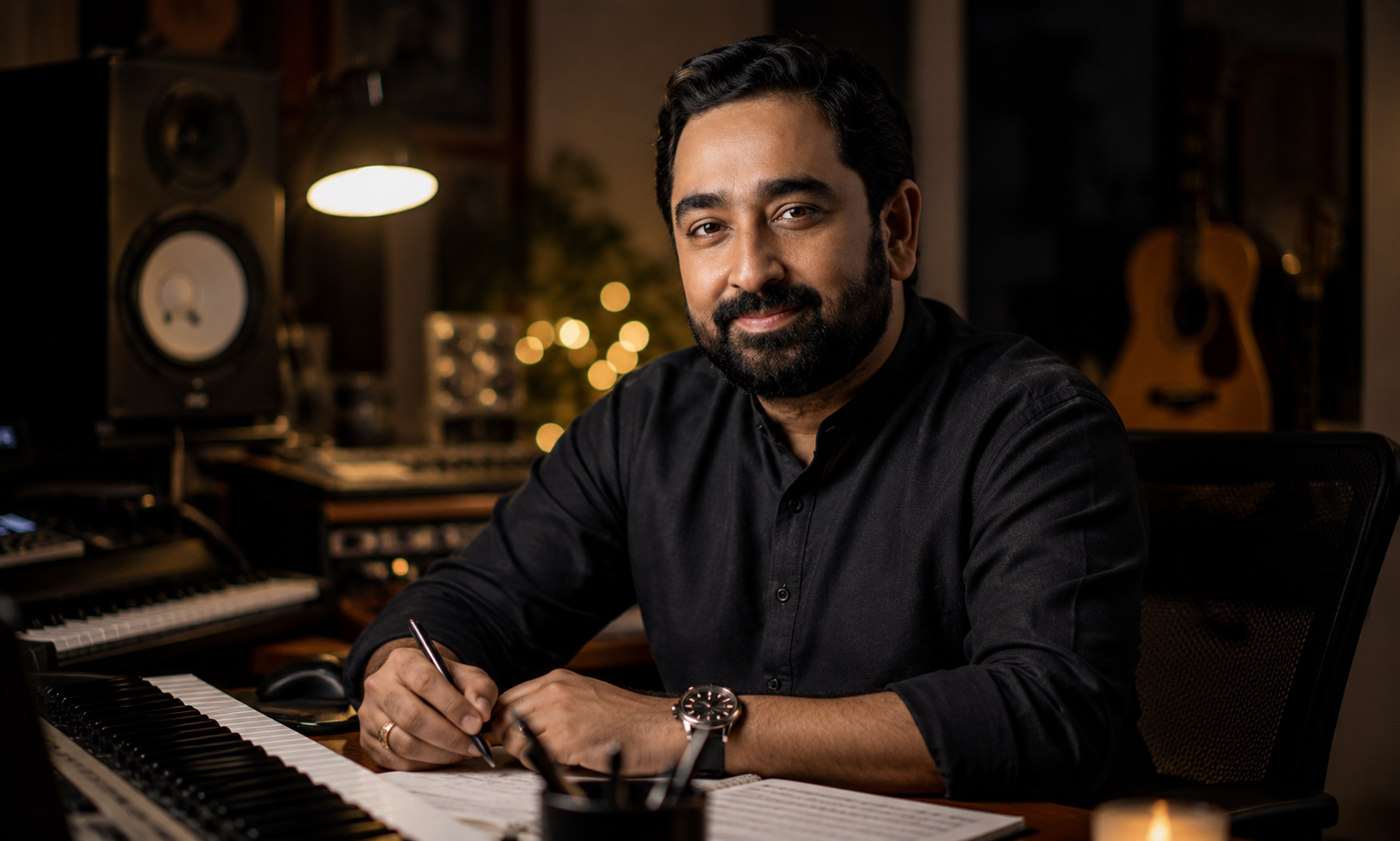
M. Jayachandran is an Indian composer, singer, and musician. Jayachandran was born in Thiruvananthapuram. He began learning Carnatic music at the age of 5 under Attingal Harihara Iyer and later under Perumbavoor G. Raveendranath. Thereafter, he was a student of Neyyattinkara Mohanachandran for 18 years. Jayachandran began his career in the film industry as a playback singer for the movie Vasudha in 1992 and then became an assistant to Malayalam music director G. Devarajan. In 1995, he became an independent music director through the film Chantha.
Key Factors
Full Name: Jayachandran Madhusoodanan Nair
Born: 14 June 1971
Place: Thiruvananthapuram, Kerala, India
Profession / Occupation: Composer, Singer, Music Director, Musician
There are certain songs that seem to belong not merely to films, but to the emotional landscape of Kerala itself. They arrive quietly, settle into memory, and remain there for years, resurfacing during rain-soaked evenings, long drives, temple festivals, heartbreaks, and moments of solitude. Much of that emotional soundtrack over the last three decades has carried the unmistakable musical signature of M. Jayachandran. Rooted deeply in Carnatic tradition yet sensitive to the evolving language of cinema, Jayachandran emerged as one of Malayalam cinema’s most emotionally resonant composers. His music has consistently balanced classical discipline with accessibility, creating melodies that feel intimate, graceful, and enduring. With a record number of Kerala State Film Awards, a National Award, and a body of work that spans romance, devotion, longing, and melancholy, he remains one of the most outstanding Malayali musicians of modern Indian cinema. Yet beyond the accolades lies something even more significant: his ability to compose songs that feel profoundly human.
In the rich musical history of Malayalam cinema, M. Jayachandran occupies a distinctive and deeply respected place. A composer, singer, and musician whose work shaped the emotional identity of contemporary Malayalam film music, he became known for melodies that carried both classical elegance and emotional immediacy. Emerging during a period when Malayalam cinema was undergoing major stylistic transitions, Jayachandran managed to preserve the soul of melody-driven music while adapting to changing cinematic sensibilities. His compositions, whether romantic ballads, devotional songs, or emotionally layered orchestral pieces, often feel rooted in Kerala’s cultural memory. Winning the Kerala State Film Award for Best Music Director a record nine times and the National Film Award for Ennu Ninte Moideen, he built a career defined not by loud experimentation, but by emotional precision and musical sincerity. For Malayali audiences, his songs are not simply popular tracks from films. They are memories, moods, and emotional companions.
Early Life and Musical Roots
Long before he became one of Malayalam cinema’s defining composers, Jayachandran was a young boy in Thiruvananthapuram immersed in Kerala’s deeply rooted classical music culture.
Music entered his life early and with seriousness. At the age of five, he began training in Carnatic music under Attingal Harihara Iyer. Later, he continued learning under Perumbavoor G. Raveendranath before undergoing long and disciplined training under Neyyattinkara Mohanachandran for nearly eighteen years.
That prolonged period of rigorous classical education would eventually shape the emotional and structural foundation of his film compositions.
Kerala during the 1970s and 1980s still possessed a vibrant ecosystem of classical music sabhas, temple performances, radio broadcasts, and university arts festivals. Young musicians emerging from this environment were often trained not merely to perform songs, but to understand raga structures, lyrical sensitivity, and emotional nuance.
Jayachandran excelled in that world.
Between 1987 and 1990, he won the Carnatic vocal competition at the Kerala University Youth Festival four consecutive times, an achievement that established him as one of the most promising young classical vocalists in the state.
Those years were crucial. They gave him technical command, but also something subtler: patience.
Unlike composers shaped entirely by commercial music trends, Jayachandran entered cinema carrying the discipline and introspection of classical training.
That difference would later become audible in almost every composition he created.
The Journey Into Cinema
Breaking into the Malayalam film industry during the early 1990s was not easy.
The industry already had towering musical figures such as Johnson, Raveendran, M. G. Radhakrishnan, and Ouseppachan shaping the soundscape of Malayalam cinema.
Jayachandran’s first entry came not as a composer, but as a playback singer through the film Vasudha in 1992.
Soon after, he worked as an assistant to legendary composer G. Devarajan, one of the foundational figures of Malayalam film music.
For a young musician, assisting Devarajan was not merely professional training. It was immersion into an entire philosophy of composition.
The experience exposed him to orchestration, recording culture, lyrical interpretation, and the delicate relationship between cinema and melody.
In 1995, Jayachandran finally stepped forward as an independent music director with the film Chantha.
The beginning was gradual rather than explosive, but musicians and serious listeners quickly noticed something distinctive in his work.
His melodies breathed.
They carried emotional spaciousness rarely found in aggressively commercial soundtracks.
The Sound of M. Jayachandran
What makes M. Jayachandran’s music enduring is not complexity for its own sake, but emotional clarity.
His compositions often draw heavily from Carnatic ragas, yet they never feel academically rigid. Instead, he adapts classical structures into emotionally accessible cinematic experiences.
There is tenderness in his melodic construction.
Even when orchestrations grow elaborate, the emotional core of the composition usually remains intimate and human.
One of his greatest strengths lies in romantic melodies. Unlike many contemporary composers who rely heavily on production layers or rhythmic hooks, Jayachandran builds songs around emotional progression. His music frequently unfolds slowly, allowing the melody to linger and breathe.
Malayali audiences responded deeply to this approach because it aligned with Kerala’s long-standing lyrical and literary culture.
Songs in Malayalam cinema have traditionally carried poetic and emotional weight. Jayachandran understood that instinctively.
His orchestration style also deserves attention. Rather than overwhelming compositions with excessive instrumentation, he often creates atmosphere through restraint. Strings, flute passages, gentle percussion, and carefully layered harmonies become emotional extensions of the lyrics.
This balance between classical refinement and cinematic accessibility became his signature.
Career-Defining Songs and Films
Over the years, M. Jayachandran composed music for more than 126 films, creating some of Malayalam cinema’s most beloved modern melodies.
Among the most defining moments of his career came with Ennu Ninte Moideen, for which he won the National Film Award for Best Music Direction.
The soundtrack of Ennu Ninte Moideen demonstrated the full range of his artistic maturity. The songs carried longing, nostalgia, romance, and emotional tragedy with remarkable depth. Rather than functioning as isolated tracks, the compositions became inseparable from the emotional architecture of the film itself.
That has often been Jayachandran’s greatest strength: integration.
His songs rarely feel imposed upon a film. Instead, they emerge organically from the emotional rhythm of the narrative.
Across decades, he collaborated with some of Malayalam cinema’s most respected lyricists and singers, creating compositions that remain deeply embedded in Kerala’s collective memory.
His devotional compositions also occupy an important place in his career. Rooted in classical spirituality yet emotionally direct, these songs strengthened his connection with audiences beyond cinema halls.
For many listeners, M. Jayachandran’s music represents emotional sincerity in an increasingly fast and fragmented musical landscape.
Awards, Recognition, and Legacy
Awards alone cannot define artistic influence, but Jayachandran’s recognition reflects the consistency and depth of his contribution.
Winning the Kerala State Film Award for Best Music Director a record nine times places him among the most celebrated composers in the history of Malayalam cinema.
His National Award for Ennu Ninte Moideen brought wider national recognition, but within Kerala, he had already achieved something arguably more meaningful: emotional trust from audiences.
Listeners associated his music with authenticity.
Even critics who differed on stylistic choices often acknowledged his command over melody and emotional composition.
In an industry increasingly shaped by changing musical trends, Jayachandran preserved the centrality of melody without appearing outdated.
That balance is extraordinarily difficult.
M. Jayachandran Beyond Music
Beyond composing, Jayachandran became a familiar public presence through Malayalam television.
As a judge on musical reality shows, he occupied an important cultural role during the rise of televised talent competitions in Kerala. These programs introduced younger audiences to classical influences, playback traditions, and musical discipline.
Unlike purely entertainment-driven television personalities, Jayachandran often approached these shows with seriousness toward musical craft.
His feedback to contestants frequently reflected technical understanding as well as emotional sensitivity.
He also became an important mentor figure for younger singers entering Malayalam cinema and television music circuits.
Through these appearances, audiences encountered not only the composer, but the teacher.
Personal Life
Away from recording studios and film sets, Jayachandran has generally maintained a relatively grounded and private personal life.
He married Priya on 12 November 1995, and together they have two sons.
Before fully committing to music direction, he worked at Asianet News, a detail that reflects the uncertain realities many musicians face before establishing themselves in cinema.
Those who have worked closely with him often describe him as disciplined, introspective, and deeply committed to musical practice.
That sense of discipline perhaps explains the emotional consistency visible across his long career.
Why M. Jayachandran Remains Special
In the constantly changing landscape of Indian film music, where trends rise and disappear rapidly, M. Jayachandran’s work continues to endure because it speaks to something timeless.
His music values emotional honesty over spectacle.
It trusts melody.
It respects silence.
It allows listeners to feel rather than merely consume.
For Malayalis across generations, his songs have become woven into the emotional fabric of life itself, playing during weddings, journeys, heartbreaks, festivals, prayer, and solitude.
That is why his legacy extends far beyond awards or filmography.
He helped preserve a certain emotional and musical sensibility within Malayalam cinema, one rooted in poetry, melody, and cultural memory.
And perhaps that is what makes M. Jayachandran such an outstanding Malayali artist, not merely his success, but his ability to compose music that continues to live quietly inside the hearts of listeners long after the film has ended and the screen has faded to black.
Awards
National Film Awards:
- 2015 – Best Music Director – Ennu Ninte Moideen (“Kathirunnu Kathirunnu”)
Honorary
- 2012 – Swaralaya Yesudas Award
Kerala State Film Awards:
- 2003 – Best Music Director – Gaurisankaram
- 2004 – Best Music Director – Perumazhakkalam and Kathavasheshan
- 2005 – Best Play Back Singer – Nottam (“Melle Melle”)
- 2007 – Best Music Director – Nivedyam
- 2008 – Best Music Director – Madampi
- 2010 – Best Music Director – Karayilekku Oru Kadal Dooram
- 2012 – Best Music Director – Celluloid
- 2016 – Best Music Director – Kamboji
- 2021 – Best Music Director- Sufiyum Sujatayum
- 2023 – Best Music Director- 19aam Noottandu
Kerala Film Critics Association Awards
- 2003 – Best Music Director – Balettan, Gaurisankaram, Kanninum Kannadikkum
Asianet Film Awards:
- 2003 – Best Music Director Award Gaurisankaram
- 2004 – Best Music Director Award Perumazhakkalam, Mampazhakkalam
- 2007 – Best Music Director Award Nivedyam
- 2011 – Best Music Director Award Pranayam
Filmfare Awards South
- 2004 – Filmfare Award for Best Music Director – Malayalam – Perumazhakkalam
- 2011 – Filmfare Award for Best Music Director – Malayalam – Pranayam
- 2013 – Filmfare Award for Best Music Director – Malayalam – Celluloid
- 2015 – Filmfare Award for Best Music Director – Malayalam – Ennu Ninte Moideen
Asiavision Awards
- 2013 – Asiavision Awards – Best Music Director
Mirchi Music Awards South
- 2009 – Best music director
- 2009 – Album of the year
- 2009 – Song of the year
- 2010 – Best music director
- 2010 – Album of the year
- 2010 – Song of the year
- 2011 – Song of the year
- 2011 – Album of the year
- 2011 – Best music director
Asianet Television Awards
- 2017 – Manninte Manamulla Sangeetham ( Honorary awards)
- 2017 – Best Music Director
Vijay Television Awards
- 2018 – Vijay Television Awards for Special Jury Award
Mazhavil Mango Award
- 2021 – Best Music director