N. A. Naseer
wildlife photographer
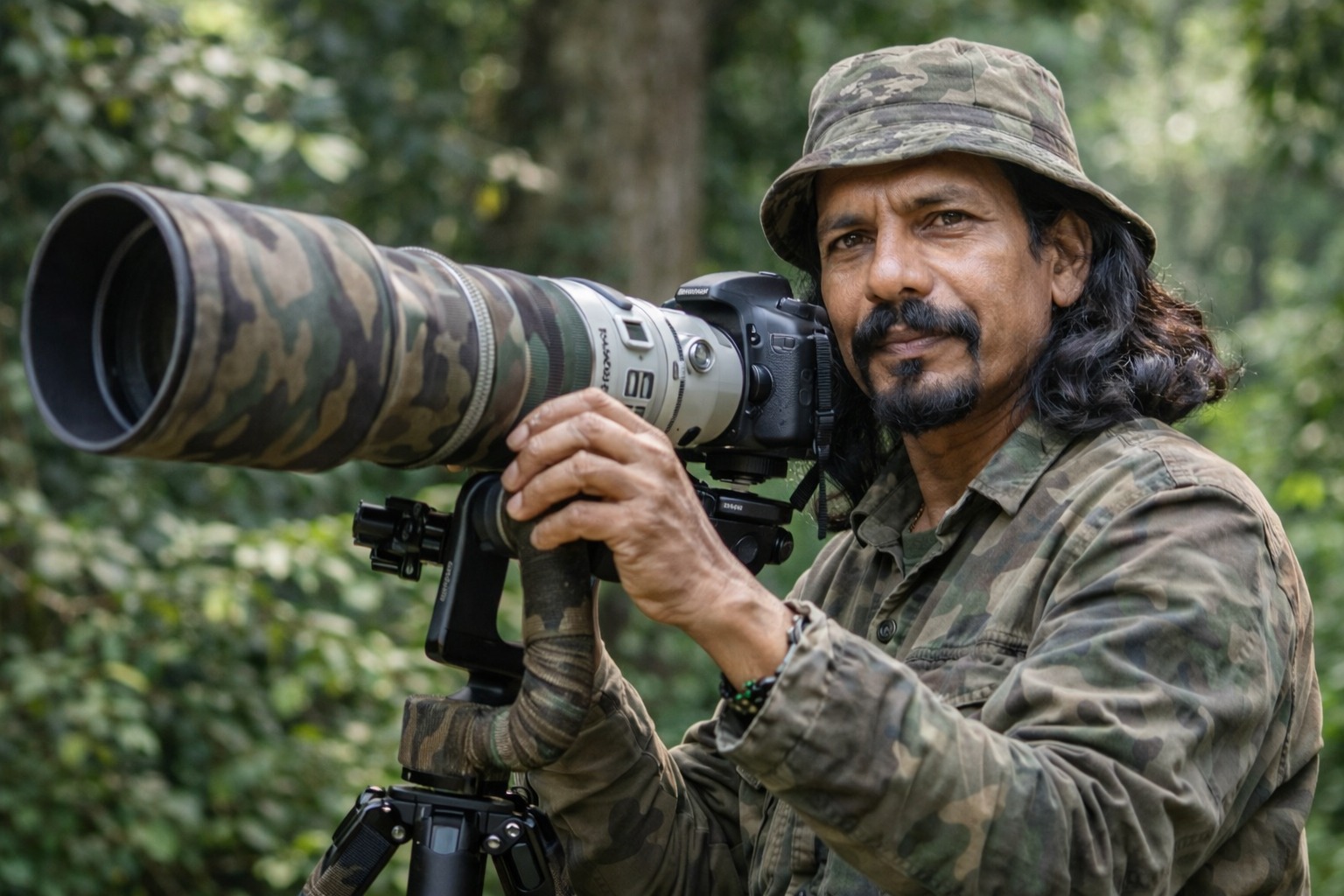
N. A. Naseer is a wildlife photographer and naturalist from Kerala known for capturing the quiet beauty of forests and birds. Through patience and deep observation, he brings the unseen rhythms of the wild closer to everyday life.
Born: 10 June 1962 (age 63)
Place: Ernakulam district, Kerala State, India
Known for: Wildlife photography, conservation of nature, and authoring books
The Frame Before the Photograph
The forest does not announce what it is about to give.
It holds still, humid and layered, as if withholding its secrets on purpose. Somewhere in the Western Ghats, a faint rustle breaks the pattern, then disappears. N. A. Naseer does not move. The camera remains lowered. The waiting continues. In wildlife photography, the image is often mistaken for the work. But the work is this, the patience before the moment, the discipline of not intervening, the decision to let the subject arrive on its own terms. When the frame finally appears, a bird emerging from shadow, an insect suspended mid-motion, it feels less like capture and more like permission. It is an outstanding practice, built not on pursuit, but on attention.
Learning to Look Before Learning to Shoot
N. A. Naseer’s journey into wildlife photography did not begin with equipment. It began with proximity.
Growing up in South India, in landscapes where human settlement and biodiversity intersect closely, his early experiences were shaped by observation rather than intention. Forest edges, wetlands, and semi-urban green spaces provided a living archive of species that often go unnoticed.
Unlike photographers who arrive at wildlife through formal training, Naseer’s entry was gradual. His engagement with nature preceded his engagement with photography. This distinction is important. It shaped his approach, one that prioritizes understanding over image-making.
His early influences were not limited to photography. Field naturalists, local ecological knowledge, and the rhythms of seasonal change contributed to a way of seeing that would later define his work.
Photography came later, as a tool to document what he was already noticing.
Journey into Wildlife Photography: From Observation to Practice
The transition from amateur observer to committed wildlife photographer is rarely linear.
For Naseer, it involved navigating both technical and environmental challenges. Wildlife photography in India demands more than access to equipment. It requires knowledge of habitats, species behavior, and the ability to work within unpredictable conditions.
Early attempts are often defined by failure, missed frames, poor light, subjects that disappear before focus is achieved. These are not setbacks but part of the learning process.
Over time, his work began to reflect a deeper understanding of ecosystems. He moved beyond photographing easily visible species toward more nuanced subjects, smaller fauna, less documented species, and moments that required extended observation.
This shift marked a transition from image collection to ecological documentation.
Signature Work and Style: Beyond the Obvious Frame
Naseer’s work is characterized by restraint.
He does not rely on dramatic compositions or high-impact imagery alone. Instead, his photographs often emphasize context, how a species exists within its environment rather than isolated from it.
- Ecosystems as Subjects
The Western Ghats, a biodiversity hotspot, features prominently in his work. But his approach avoids treating it as a backdrop. The ecosystem itself becomes part of the narrative.
Wetlands, forest understories, and transitional habitats appear not as scenic elements but as active spaces that shape species behavior.
- Attention to Lesser-Seen Species
While large mammals often dominate wildlife photography, Naseer’s portfolio includes significant attention to birds, amphibians, reptiles, and insects. This reflects an ecological awareness that values biodiversity beyond charismatic species.
- Composition and Light
His use of natural light is deliberate. Rather than manipulating scenes extensively, he works within available conditions, early morning diffused light, filtered canopy shadows, reflective water surfaces.
The result is imagery that feels grounded, less constructed, more observed.
Fieldcraft and Philosophy: Ethics as Method
Wildlife photography is often associated with pursuit, tracking, approaching, positioning for the perfect shot. Naseer’s approach is notably different.
His fieldcraft emphasizes non-intrusion. This means:
- Maintaining distance from subjects
- Avoiding disturbance of natural behavior
- Resisting the urge to manipulate environments for better frames
Such practices are not just ethical choices. They are methodological decisions that shape the kind of images produced.
By allowing subjects to behave naturally, his photographs capture authenticity rather than performance.
Patience becomes a primary tool. Hours, sometimes days, are spent waiting for conditions to align. This temporal investment is not visible in the final image, but it defines its integrity.
Conservation and Impact: Photography as Documentation
The impact of wildlife photography extends beyond aesthetics.
Naseer’s work contributes to biodiversity awareness by documenting species and habitats that are often overlooked. In regions like the Western Ghats, where ecological pressures from development and climate change are increasing, such documentation becomes valuable.
His photographs have been part of exhibitions and publications that engage both specialized and general audiences. These platforms allow images to function as entry points into larger conversations about conservation.
However, the relationship between photography and conservation is complex.
Images can raise awareness, but they do not automatically translate into policy change or habitat protection. Naseer’s work operates within this tension, contributing to visibility while recognizing the limits of representation.
Challenges in Indian Wildlife Photography: Between Access and Integrity
Wildlife photography in India involves multiple layers of challenge.
Terrain is often difficult, dense forests, wetlands, unpredictable weather conditions. Access to certain areas is regulated, requiring permits and adherence to conservation guidelines.
Financial constraints also play a role. High-quality equipment, travel, and time investment are significant, and not all photographers have institutional support.
The digital era introduces additional pressures.
Social media platforms favor visually striking images, often prioritizing impact over context. This can lead to trends where photographers seek increasingly dramatic or rare subjects, sometimes at the cost of ethical considerations.
Naseer’s work resists this trend to an extent. His focus on ecological context and less sensational subjects positions him outside purely attention-driven frameworks.
The Discipline of Quiet Work
Colleagues and observers often describe Naseer as patient and methodical.
His approach to photography reflects a broader mindset, one that values observation over intervention, consistency over visibility.
He does not position himself as a central figure in the narrative. The subject remains primary.
This orientation shapes both his work and his public presence. Unlike photographers who build strong personal brands around their imagery, Naseer’s identity remains closely tied to the ecosystems he documents.
His perspective on nature aligns with a recognition of interdependence. Species are not isolated subjects but part of complex ecological systems.
Legacy and Future Outlook: Documenting What Remains
N. A. Naseer’s place within Indian wildlife photography is defined by his emphasis on ecological integrity.
He represents a strand of practice that prioritizes documentation and understanding over spectacle. In a field that is increasingly influenced by digital visibility, this approach offers an alternative model.
His influence is visible among emerging photographers who seek to engage more deeply with ecosystems rather than focusing solely on iconic species.
Looking ahead, the relevance of his work is likely to increase.
As biodiversity faces growing threats, the need for accurate, respectful, and context-rich documentation becomes more urgent. Photographers like Naseer contribute to this effort by creating visual records that extend beyond aesthetics.
His future work will likely continue along this trajectory, deepening engagement with specific habitats, refining his approach, and contributing to a broader understanding of India’s natural history.
The Practice of Attention
In the end, N. A. Naseer’s work is not about capturing the wild.
It is about waiting for it.
His photographs emerge from a practice that values time, observation, and restraint. They resist the immediacy often associated with photography, asking instead for patience, from the photographer and the viewer.
It is an outstanding form of attention, one that aligns with the rhythms of the ecosystems he documents. In that alignment lies the significance of his work, not as isolated images, but as part of an ongoing effort to see, record, and understand what continues to exist, often quietly, at the edges of human awareness.
Awards and honours
2013 – KR Devanand Memorial Award
2011 – Excellency in Photography award by All Kerala Photography Association