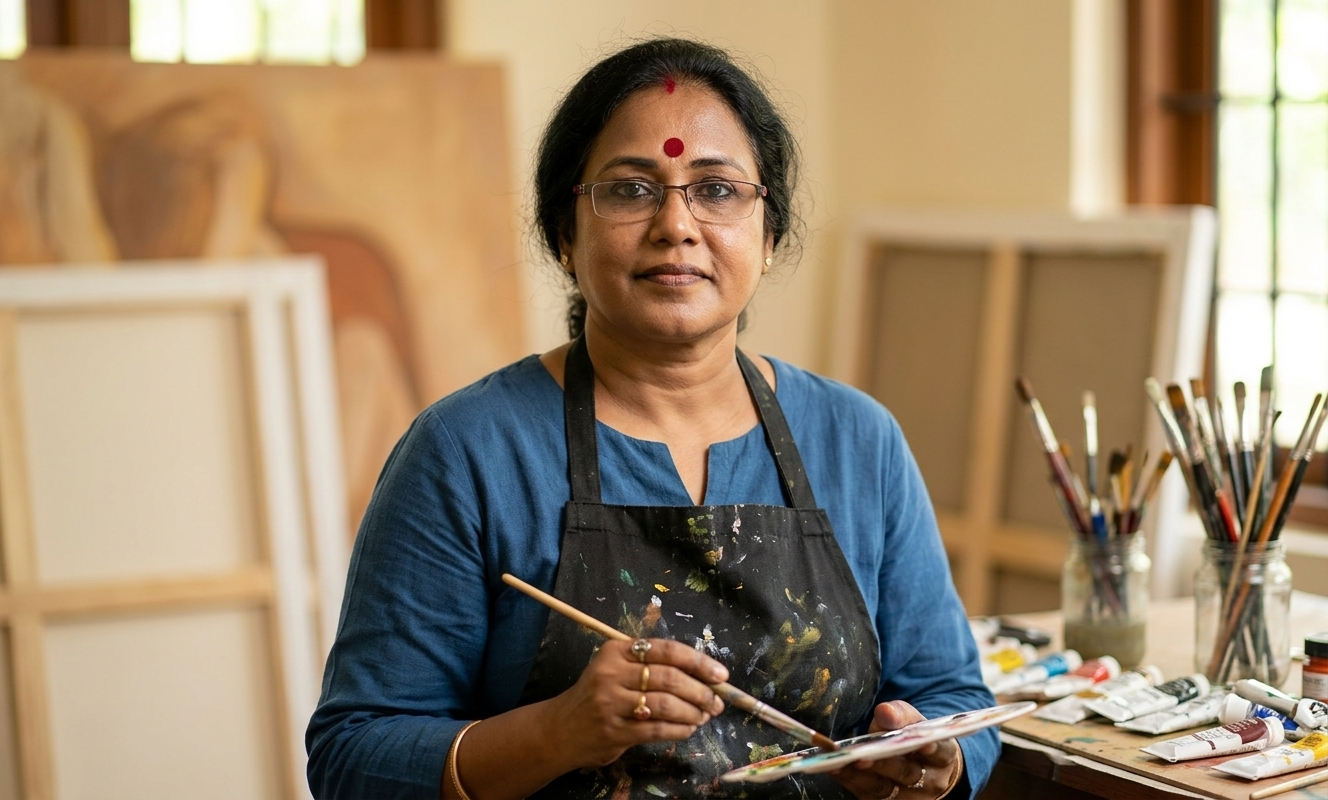
Sajitha R Shankhar
internationally acclaimed contemporary artist from India
Born: 9 December 1967
Place: Kumaranalloor, Kottayam, Kerala
Website: sajithashankar.com
Figures That Refuse to Settle
The body appears first as a line, hesitant, searching, then thickens into a form that is neither fully human nor entirely abstract. Limbs extend and retract, torsos dissolve into texture, and faces refuse the comfort of recognizable expression. In the works of Sajitha R Shankhar, the body is not depicted, it is negotiated. The surface carries marks that feel less like drawing and more like excavation, as if each figure is being retrieved from beneath layers of memory and erasure. It is an outstanding visual language, unsettling, intimate, and resistant to closure. These are not images that seek to please. They insist on being encountered, on forcing the viewer into a space where discomfort becomes a form of recognition.
Kerala, Identity, and Early Influences
Sajitha R Shankhar was born in Kerala, a region with a strong visual and literary culture but also deeply embedded social expectations, particularly around gender and artistic practice. Her early inclination toward art emerged within this tension, between an internal compulsion to create and an external environment that did not always validate such pursuits, especially for women.
Her formal training at the Government College of Fine Arts, Thiruvananthapuram, provided technical grounding but also exposed her to a broader history of art, both Indian and global. Yet, even within institutional spaces, the frameworks available to her were limited. The dominant narratives of art often centered male perspectives, leaving little room for the kind of introspective, body-centered work she would later develop.
This early phase is important not because it produced a defined style, but because it established a condition of resistance. Her work would not emerge comfortably within existing categories. It would have to carve its own space.
Becoming an Artist Against the Grain: Life as Material
The trajectory of Sajitha’s career cannot be separated from her personal life.
Marriage, domestic responsibilities, and the expectations placed upon her as a woman created interruptions and fractures in her artistic journey. These were not incidental obstacles. They became central to the evolution of her work.
Periods of silence, where she was unable to produce art consistently, later re-emerged as thematic material. The body in her work often carries this sense of interruption, of being constrained, fragmented, or partially erased.
Her move to the Cholamandal Artists’ Village marked a turning point. Cholamandal, with its history as a self-sustaining artists’ commune, offered both physical space and a sense of artistic community. Here, she was able to re-engage with her practice more fully, away from some of the constraints that had previously shaped her life.
Yet, even in this environment, her work remained solitary in its intensity. It did not align neatly with prevailing trends. It remained deeply inward.
International Exposure and Artistic Evolution: Expanding the Frame
Residencies and exhibitions across Europe and Asia exposed Sajitha to broader contemporary art discourses. These experiences did not radically alter her thematic concerns, but they expanded her formal vocabulary.
Her engagement with international spaces allowed her to situate her work within global conversations around embodiment, trauma, and identity. At the same time, it reinforced the specificity of her perspective.
Unlike some artists who adapt their work to fit global expectations, Sajitha’s practice retained its rootedness. The textures, the rawness, the emphasis on the female body as a site of negotiation, these remained central.
What changed was scale and confidence. Her works grew larger, more assertive, and more willing to occupy space.
Major Series and Artistic Language: Archetypes and Alterbodies
Two bodies of work, Archetypes and Alterbodies, are central to understanding Sajitha’s artistic language.
In Archetypes, she engages with inherited images of womanhood, mythological figures, cultural symbols, and reworks them through distortion and layering. These are not direct representations of known archetypes but reinterpretations that question their stability.
The figures appear both ancient and immediate, carrying traces of myth while resisting fixed identity.
Alterbodies, on the other hand, moves further into abstraction. Here, the body becomes fluid, mutable, often unrecognizable. Limbs merge, dissolve, or extend beyond anatomical logic.
Material and Process
Her use of charcoal, acrylic, and organic materials contributes to the tactile quality of her work. Charcoal, in particular, allows for both precision and erasure, a medium that aligns with her thematic focus on presence and absence.
The surfaces of her works often appear worked over, layered, scraped, reworked. This process is visible, not hidden, reinforcing the idea that the body is not a fixed entity but a site of continuous transformation.
Feminism, Body Politics, and Resistance: Beyond Representation
Sajitha’s work operates within feminist discourse, but it does not align with overtly declarative or slogan-driven approaches.
Her engagement with feminism is embodied rather than articulated.
The female body in her work is not idealized, nor is it presented for consumption. It resists the traditional gaze. It is often uncomfortable, fragmented, and unresolved.
This places her in dialogue with earlier Indian women artists such as Amrita Sher-Gil and Nalini Malani, who also reconfigured the representation of the female body. However, Sajitha’s approach is more internalized, less narrative, more focused on sensation and memory than on external storytelling.
Her work challenges patriarchal structures not through direct critique but through refusal, refusal to conform to aesthetic expectations, to produce easily readable images, or to offer closure.
Recognition and Institutional Presence: Visibility Without Dilution
Sajitha R Shankhar’s work has been included in significant institutional collections, including the National Gallery of Modern Art and the Indira Gandhi National Centre for the Arts.
She has received international recognition, including the Pollock-Krasner Foundation Grant and the Charles Wallace Fellowship, both of which have supported her practice and facilitated her engagement with global art networks.
Critical reception of her work often emphasizes its intensity and refusal of easy categorization. She is not an artist who produces easily marketable images. Her work demands time, attention, and often discomfort.
Spaces, Teaching, and Community: Building Outside Institutions
Beyond her individual practice, Sajitha has contributed to the creation of alternative artistic spaces.
Through initiatives like the Gowry Art Institute, she has engaged with younger artists, offering mentorship and creating environments that prioritize experimentation over conformity.
These spaces function outside traditional institutional frameworks, allowing for more fluid, process-driven engagement with art.
Her role here is not that of a formal educator but of a facilitator, someone who understands the importance of space, both physical and psychological, in sustaining artistic practice.
The Artist in the Present Moment: Continuity and Expansion
Sajitha’s recent work continues to explore the body, but with increasing openness to new materials and forms.
There is a sense of expansion, not in abandoning earlier concerns but in deepening them. The figures become more layered, the surfaces more complex, the boundaries between form and abstraction more fluid.
In contemporary discourse, where issues of gender, identity, and embodiment are increasingly foregrounded, her work remains sharply relevant.
It does not follow trends. Instead, it anticipates and intersects with them.
critical Positioning: An Unresolved Presence
Sajitha R Shankhar occupies a distinctive position within Indian contemporary art.
She is not easily categorized within movements or trends. Her work resists alignment with dominant narratives, whether market-driven or institutional.
This resistance is precisely what makes it enduring.
Her contribution lies not in creating a recognizable style that can be replicated, but in opening a space, a way of engaging with the body as a site of memory, conflict, and transformation.
In comparison with other Indian women artists, her work stands out for its inwardness, its refusal to resolve into narrative clarity, and its commitment to process over product.
Her legacy is still unfolding, but it is already clear that her work has expanded the possibilities of how the body can be represented, not as an object, but as an experience.
It is an outstanding and necessary body of work, one that continues to unsettle, question, and redefine the boundaries of contemporary Indian art.
As an artist
Member of the Lalit Kala Akademi, Kerala, from 2002-2011
Governing body member of Vyloppilli Samnkruti Bhavan, Kerala from 2006-2011.
Founded the Gowry Art Institute on the banks of the Vamanapuram river in Kallar in 2007
Awards
2009-2011 – Charles Wallace Fellowship, Senior Fellowship from the Dept of Culture, Govt of India
2006-2007 – French Scholarship for an Artists Residency in Paris
1997 – Senior Award at the special exhibition to celebrate the Golden Jubilee of Indian Independence held in Tamil Nadu
1995 – Grand Prize at the Cleveland International Drawing Biennale, UK
Kerala Lalit Kala Academy award
Lions Club Award
2017 – Pollock-Krasner Foundation Grant
Sajitha Shankar was one of the 14 leading women artists honoured by the National Legal Service Authority in 2008.