
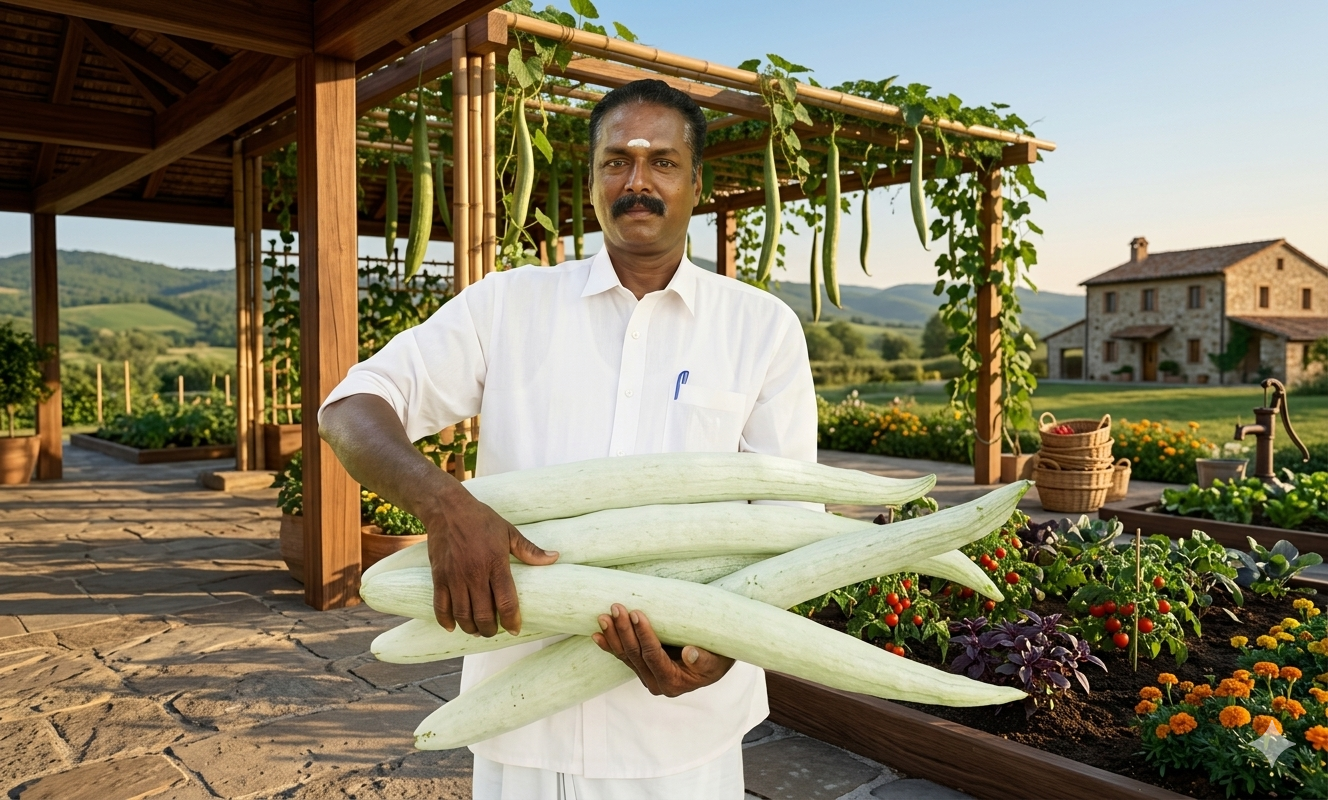
Sivadasan
A Kerala farmer became millionaire in 8 months
R. Sivadasan is a farmer from Kerala who gained widespread attention after reportedly earning over ₹1 crore through vegetable farming within just eight months. His success story became an inspiring example of how modern farming, careful planning, and hard work can turn agriculture into a profitable profession.
Full Name: R. Sivadasan (widely known as Sivadasan)
Known for: Kerala farmer who reportedly earned ₹1 crore through vegetable farming in just 8 months
Place: Elavancherry, Palakkad, Kerala, India
Profession: Farmer, Vegetable cultivator
Specialisation: Bitter gourd, snake gourd, cowpea farming
Farming Area: Around 18 acres (owned + leased land)
Recognition: Became a symbol of profitable modern farming in Kerala after his success story gained statewide attention in 2025
When news spread that Sivadasan had become a millionaire in just eight months through vegetable farming, many reacted with scepticism. Across online platforms, people dismissed it as a “lie” or even a “scam.” Critics who had long argued that vegetable cultivation in Kerala is not profitable pointed to Tamil Nadu as a better model.
However, the records of the quantity of vegetables cultivated and sold by Sivadasan over these eight months are available with the Vegetable and Fruit Promotion Council Keralam (VFPCK). These documents validate his achievement. This is also a historic moment for VFPCK markets in the state, marking the first time such a large amount has been paid to a farmer within a single financial year. It is not just one crore either. As of December 6, the total amount credited to Sivadasan for vegetables alone is Rs 1,00,41,576. He adds that the current harvest will continue until the end of February, and he expects the total earnings to rise by another Rs 8–10 lakh.
Sivadasan points out that, apart from occasional price fluctuations, vegetable prices have not changed much over the past decade. For example, cowpeas sold for Rs 40–50 per kg ten years ago, and the rates remain almost the same today. Expecting a major price rise for essential food crops is unrealistic. Therefore, the only practical way to increase farm income is by reducing production costs and improving productivity. This can be achieved through scientific methods like precision farming and the use of hybrid seeds. Most importantly, farmers must plan based on market demand, right from selecting seeds to harvesting.
Precision in practice
According to Sivadasan, precision farming is the backbone of his success. In April, the land is prepared by adding goat manure, chicken manure, and powdered cow dung, enough to support two cropping seasons. A drip irrigation system is then installed, followed by laying plastic mulch over the beds. This setup ensures that micronutrients are delivered efficiently along with water. Precision farming focuses on controlled water use and accurate fertilizer application.
The mulch layer prevents fertilizers from being washed away during rain. It also helps maintain soil structure and improves air circulation, which supports better root growth.
At the same time, mulch controls weed growth, reducing both fertilizer loss and labour costs for weeding. With better management, plant health improves, which lowers the chances of pest attacks and reduces pesticide expenses. Sivadasan says that because watering and fertilization have become simpler, they have been able to expand cultivation. Currently, farming is carried out on 10 acres of leased land and 8 acres of owned land. There are plans to lease another 5 acres next year, aiming for a turnover of Rs 1.5 crore.
Understanding the market
High-quality seeds play a key role in successful farming, with hybrid seeds being especially important. At the same time, there is a growing preference for indigenous varieties. However, relying only on native varieties, which usually give lower yields, is not advisable. Instead, farmers should ensure that there is a market for such crops.
Efforts are made to identify high-yielding indigenous varieties like the bitter gourd ‘Preethi’ and the snake gourd ‘Kaumudi,’ both developed by Kerala Agricultural University. These varieties can compete with hybrids. To meet the demand of consumers who prefer native varieties, some area is allocated to them. But larger portions of land are dedicated to high-yield hybrids such as the Maya variety of bitter gourd and the white, short hybrid snake gourd, which perform well under proper care.
In the snake gourd market, traders and many consumers prefer the small, white, short variety that can be stored without cutting. For cowpea, the Arka Mangala variety is considered suitable. However, Sivadasan warns against complete dependence on hybrid seeds. One kilogram of bitter gourd seeds costs around Rs 2,500, while hybrid seeds cost about Rs 16,000, and the same applies to snake gourd. This year, hybrid seeds for snake gourd were not even available. Hence, he suggests focusing on reliable, high-yielding options rather than depending entirely on private suppliers.
Nearly two-thirds of the vegetables grown in Elavancherry are sent to southern districts. Consumer preferences vary by region. For instance, people in Chengannur may prefer the Preethi variety, while those in Thiruvananthapuram may choose Maya. The VFPCK market plays a key role in assessing demand, guiding farmers on how much of each variety to grow, and ensuring proper distribution.
Farmers in Palakkad usually favour pandhal crops but also cultivate other varieties. Sivadasan refers to the saying about chasing two rabbits and losing both. This does not mean growing only one crop, but rather focusing on crops that guarantee consistent returns instead of spreading efforts thin across many. As a result, bitter gourd, snake gourd, and cowpea have become the main crops.
He notes that the price of Preethi bitter gourd rarely falls below Rs 40 per kg, while the Maya variety usually sells at Rs 30–32. Snake gourd prices typically stay between Rs 15–20 per kg. Cowpea has an average price of Rs 50, and during Onam it can go above Rs 70. To meet trader demand, smaller quantities of ridge gourd, pumpkin, and ash gourd are also grown along the edges of the fields.
Farmers who struggle to find markets may doubt these price figures. This highlights the importance of having a stable market and bargaining strength. The VFPCK market at Panangattiri in Elavancherry, along with the Palakkad district office, has played a major role in Sivadasan’s success.
Strength of the farmers’ market
This year, the Elavancherry VFPCK market has recorded a turnover of Rs 15 crore so far, with 5,500 tonnes of vegetables sold. The availability of multiple products in one place attracts traders. It is possible for them to purchase large quantities of the same item from a single farm in one day.
Traders understand the benefits of storage and are willing to buy at reasonable rates. Because the market maintains strong connections with traders across regions, it can track demand fluctuations in real time. Based on this, farmers are advised to adjust daily harvest quantities, which improves their bargaining position.
Having served three terms as president of the Elavancherry market, Sivadasan believes that when farmers stay united and build strong markets, traders are compelled to offer fair prices.
First season advantage
Sivadasan follows two farming seasons. The first begins with sowing in early April, harvesting starts by mid-May, and continues until Onam. This period is often called the “lottery” season because of favourable market prices. After the trawling ban and during the Onam season, vegetable prices, especially for bitter gourd, snake gourd, and cowpea, tend to rise sharply.
Bitter gourd and snake gourd are planted in early April, while cowpea is sown later in the month. Early sowing can result in harvest completion before Onam, while slight delays can ensure a good supply during the festival, leading to higher returns.
The second season begins in September. During this time, snake gourd and cowpea are grown on the same bed. Cowpea is planted first, followed by snake gourd after a month. Snake gourd is harvested only after the cowpea crop is completed. The leftover cowpea residue acts as natural fertilizer. If both crops are planted together, the faster-growing snake gourd can suppress cowpea growth, reducing yield.
Changing dynamics with Tamil Nadu
Sivadasan says that the growth of vegetable farming in Kerala, especially in Palakkad, has started to concern farmers in Tamil Nadu. Instead of competing directly, they are moving towards coordination.
Earlier, their harvest used to arrive at the same time as Kerala’s first-season produce, which led to price drops for both. Now, they have adjusted their cultivation calendar so that their first season ends by May. The second season has also been rescheduled accordingly. Sivadasan sees this as an example of how organized farming can help regulate markets and improve returns.
Costs and returns
Setting up infrastructure costs around Rs 2 lakh per acre. A permanent structure made with GI wire and concrete supports lasts up to 15 years. A drip irrigation system costs about Rs 50,000 per acre and remains usable for at least five years. Though the initial investment is high, it reduces long-term maintenance costs. Land lease rates range from Rs 35,000 to Rs 40,000 per acre annually.
The cost of manure, fertilizers, mulch, lime, and machinery comes to about Rs 75,000 per acre. Hybrid seeds cost around Rs 15,000 per acre, while university-developed seeds cost about Rs 2,500. Altogether, the first-season expense per acre is roughly Rs 2 lakh. Since the same beds are used in the second season, only costs for seeds, irrigation, and harvesting are incurred. The total cost across both seasons averages Rs 3 lakh per acre.
For the Maya variety of bitter gourd, yields range between 25 and 30 tonnes per acre. At an average price of Rs 30 per kg, income comes to Rs 7.5–9 lakh per acre. Snake gourd yields about 25 tonnes across two seasons, generating around Rs 5 lakh per acre at Rs 20 per kg. Cowpea produces about 15 tonnes per acre, bringing in Rs 7.5 lakh at Rs 50 per kg.
Taking into account variations in weather, market prices, and lease costs, Sivadasan estimates a profit margin of 30–35 percent of total income per acre. Over his 38 years in farming, he has achieved several milestones. Through agriculture, he has built a house, acquired more land, and continues to reinvest significantly each year to expand his operations.