P.T. Usha
Indian sports administrator, parliamentarian and retired track and field athlete
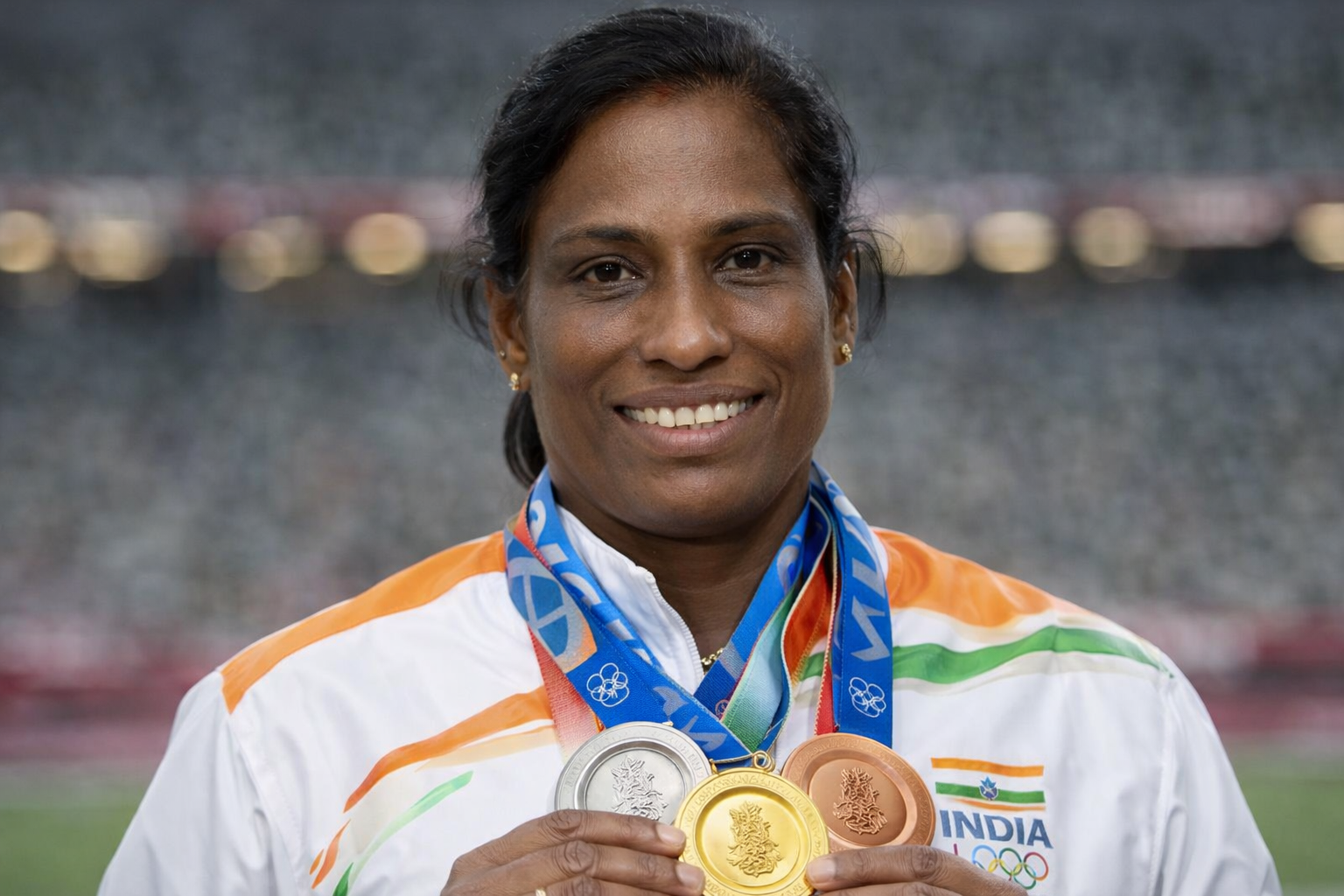
P. T. Usha is one of India’s greatest athletes, celebrated for bringing international recognition to Indian track and field through her speed, discipline, and determination. Popularly known as the “Payyoli Express,” she inspired generations of young athletes and later dedicated her life to training future sports stars through the Usha School of Athletics.
Born: 27 June 1964 (age 61)
Nickname: Golden Girl, Payyoli Express
Nationality: Indian
Place: Koothali, Perambra, Kerala, India
Years active: 1976–2000
Occupation: Indian sports administrator, parliamentarian and retired track and field athlete
Title: 13th President of the Indian Olympic Association, Member of Parliament, Rajya Sabha
Before India learned to dream of Olympic podiums, there was a girl from coastal Kerala who simply ran. Not for glory at first, not even for records, but because speed felt like freedom. In the quiet village of Payyoli, where the Arabian Sea breathes against the shore and mornings arrive with salt and sunlight, a thin teenager began chasing distances that the country had never imagined crossing.
Years later, in Los Angeles in 1984, the world would watch her miss an Olympic medal by one hundredth of a second, the cruellest sliver of time sport can measure. Yet that moment did not diminish her story. If anything, it sharpened it. P.T. Usha did not merely run races; she expanded the horizon of Indian athletics itself, carrying a nation’s fragile hopes on the rhythm of her stride.
The Making of the Payyoli Express
Pilavullakandi Thekkeparambil Usha was born in 1964 in a modest household in Kozhikode district, Kerala. Speed arrived quietly in her life, noticed first by coaches who saw in the shy teenager a natural rhythm that could not be taught.Her training began seriously in the mid-1970s under coach O. M. Nambiar, who recognised both her raw athletic instinct and her fierce discipline. By the late 1970s, she was already dominating junior athletics. India, however, had little infrastructure for elite track athletes. Tracks were rough, facilities were minimal, and international exposure was rare.What Usha possessed instead was hunger. And an unusual ability to turn exhaustion into momentum.
The Race That Broke Hearts
The defining image of P.T. Usha’s career still lives in a fraction of a second.
At the 1984 Los Angeles Olympics, she lined up for the final of the 400-metre hurdles, becoming the first Indian woman ever to reach an Olympic athletics final. The race was tight, explosive, and relentless. When it ended, Usha finished fourth, missing the bronze medal by just 1/100th of a second. It was heartbreak. But it was also a revelation.
For the first time, India realised that an Olympic medal in athletics was not a distant fantasy. It was within reach, measured in a hundredth of a second.
Asia’s Sprint Queen
If the Olympics gave Usha global visibility, Asia gave her dominion.
Through the 1980s, she ruled the continent’s tracks with startling authority. Her performance at the 1986 Asian Games in Seoul became the stuff of sporting folklore. Usha won four gold medals and one silver, an extraordinary feat in sprinting and hurdles. The victories were not isolated flashes. Across Asian championships and international meets, she accumulated dozens of medals, including numerous golds that established her as the undisputed queen of Asian track and field.
Her running style became iconic, long, powerful strides that seemed to glide rather than strike the track. Spectators soon gave her a name that would follow her forever: The Payyoli Express.
The Discipline Behind the Speed
Her training routines were famously demanding. Endless sprint drills under Kerala’s humid skies, repeated hurdle practice, and a relentless focus on endurance shaped the athlete who would dominate Asian tracks. More importantly, she ran at a time when women in Indian sports had little visibility, fewer resources, and almost no institutional backing. Each race she won quietly challenged those limitations.
For a generation of young Indian women, she transformed possibility into something visible.
A New Role: Building the Next Generation
When Usha retired from competitive athletics in 2000, she chose not to leave the track behind. Instead, she built the Usha School of Athletics in Kerala, a training institution dedicated to identifying and nurturing young talent from rural India. The idea was simple, but radical: give promising athletes the coaching, nutrition, and facilities she herself never had. Her commitment to sport later expanded into leadership. In 2022, she was nominated to the Rajya Sabha, India’s upper house of Parliament, and soon after became the first woman president of the Indian Olympic Association. The sprinter who once carried India’s expectations now helps shape its sporting future.
Reflection
Time measures runners with brutal precision, but history is kinder. The clock remembers that P.T. Usha missed an Olympic medal by a hundredth of a second. The country remembers something else entirely, the moment it realised it could run with the world.
On dusty school tracks, on synthetic stadium lanes, in every young sprinter who believes that the impossible is only a starting line away, the echo of her footsteps still travels forward. And perhaps that is the truest measure of speed, not how fast you run, but how far your courage carries others.
Asian Track Dominance
- Multiple medals at Asian Championships
- 5 Gold medals at the 1985 Asian Track & Field meet
- Over two decades in competitive athletics
- One of Asia’s most decorated sprinters
National Records
- 400m hurdles national record: 55.42 seconds
- Held multiple national records in sprint events
- Known for powerful stride technique
- Set benchmarks for Indian track athletes
Awards & Recognition
- 1984 – Arjuna Award
- 1985 – Padma Shri
- 2000 – Honorary doctorate (D.Litt) by Kannur University
- 2017 – Honorary doctorate (D.Sc) by IIT Kanpur
- 2018 – Honorary doctorate (D.Litt) by University of Calicut
- 2019 – IAAF Veteran Pin
- Honorary doctorate (D.Litt) by Central University of Kerala
From Track to Leadership
- Founded Usha School of Athletics
- Nominated to the Rajya Sabha in 2022
- First woman president of the Indian Olympic Association
- Transitioned from athlete to sports policymaker
- Voice for athlete welfare in India