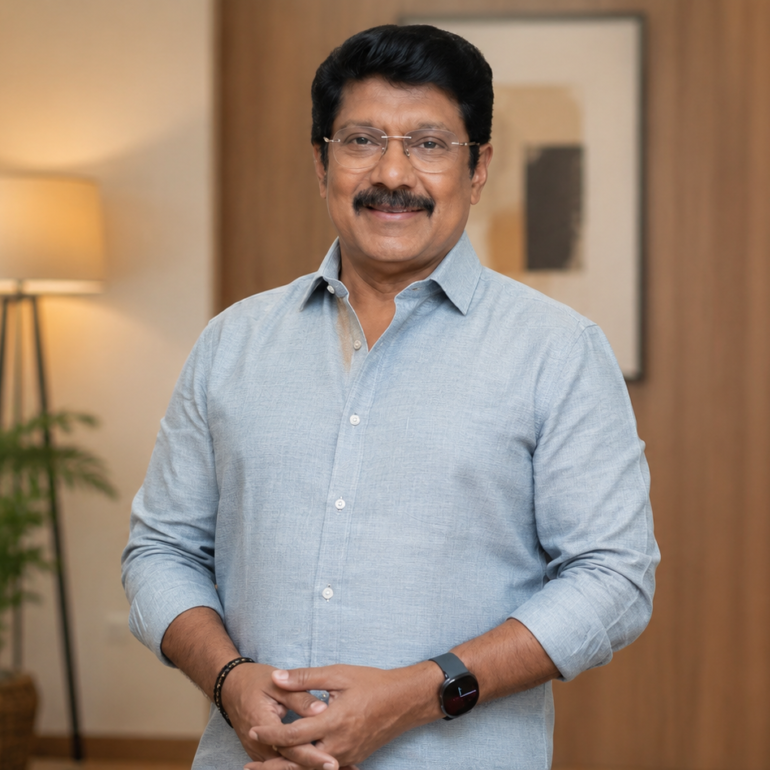
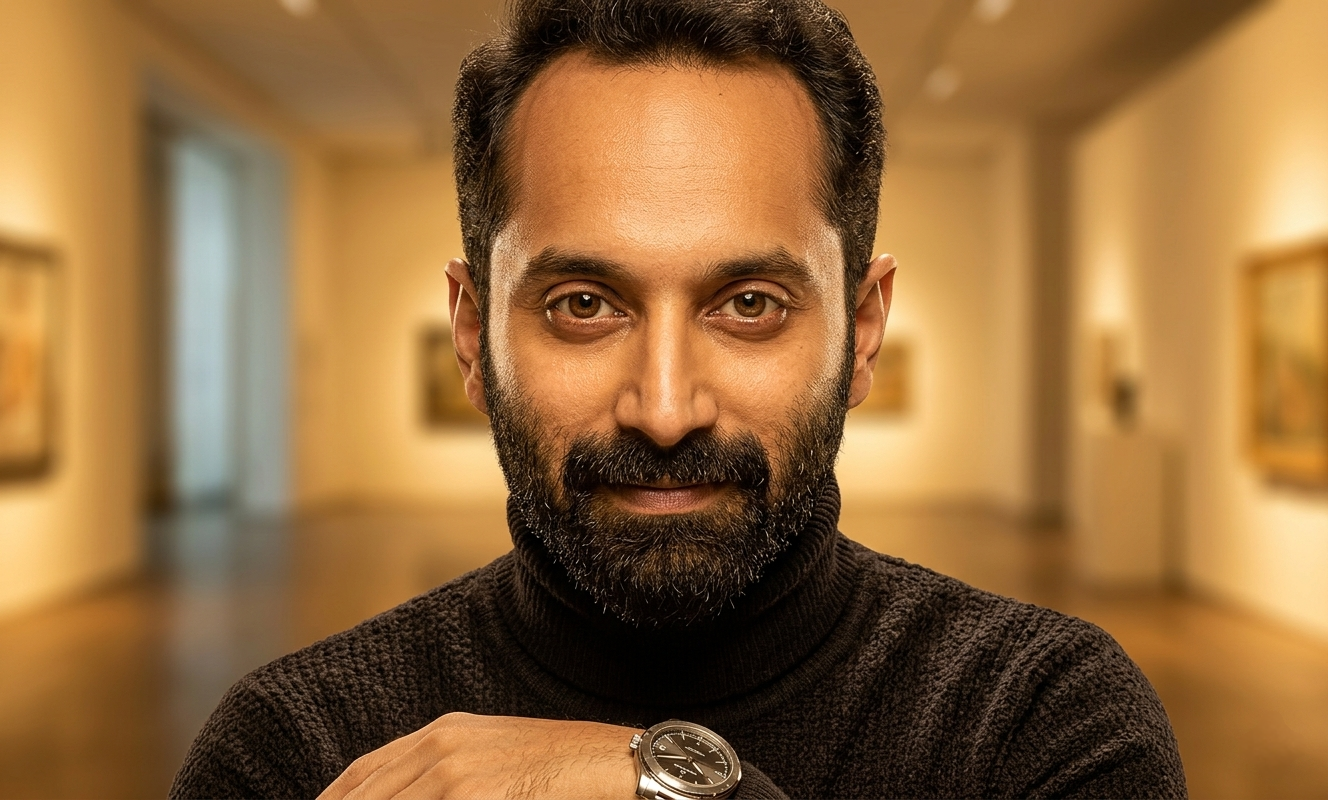
Fahadh Faasil
Indian actor and film producer
Fahadh Faasil is one of the most versatile actors in Indian cinema, celebrated for his intense performances, natural acting style, and unconventional choice of characters. From psychological thrillers to emotionally layered dramas, he has redefined modern Malayalam cinema with performances that feel deeply real and unpredictable.
Born: 8 August 1982 (age 43)
Place: Alappuzha, Kerala, India
Other names: FaFa, Shaanu
Education: Sanatana Dharma College, Alappuzha, University of Miami
Title: Actor, Producer
Years active: 2002–present
Organizations: Fahadh Faasil and Friends, Bhavana Studios
Fahadh Faasil: The Outstanding Malayalam Actor
There is something unsettling about watching Fahadh Faasil on screen. Not because he is loud or theatrical, but because he is not. His performances arrive quietly, almost invisibly, and then linger, long after the scene has ended. He does not demand attention. He pulls you in, slowly, deliberately, until you are no longer watching a character, but studying a mind.
In an industry that often celebrates spectacle, Fahadh represents something rarer, an outstanding restraint. His face, often still, carries layers of conflict. His silences feel louder than dialogue. And in that stillness, he has built one of the most compelling bodies of work in contemporary Indian cinema.
This is not a conventional rise-to-fame story. It is a narrative shaped by failure, withdrawal, reinvention, and an almost obsessive pursuit of authenticity. Fahadh Faasil did not become a star by fitting into the system. He became one by quietly dismantling it.
Born Into Cinema, Not Defined By It
Born on August 8, 1982, in Alappuzha, Fahadh Faasil grew up in a household where cinema was both profession and atmosphere. His father, Fazil, is one of Malayalam cinema’s most respected directors, known for shaping narratives that balance emotional depth with commercial appeal.
For Fahadh, cinema was never distant. It was present in conversations, in scripts, in the rhythm of daily life. Yet, proximity did not translate into readiness.
His education took him beyond Kerala, exposing him to different cultural contexts. But unlike many star children who are groomed for the screen, Fahadh’s early years lacked a clear cinematic direction. There was curiosity, yes, but not yet clarity.
That ambiguity would define his initial steps into cinema, steps that would lead not to success, but to one of the most important failures in Malayalam film history.
The Necessary Collapse
In 2002, Fahadh made his debut with Kaiyethum Doorath, directed by his father. The film failed, critically and commercially. More importantly, Fahadh’s performance was met with harsh criticism.
For a young actor, the impact was devastating.
Unlike many who persist through early setbacks, Fahadh chose withdrawal. He stepped away from cinema, not for months, but for years. It was a period of silence, of distance, of introspection. In an industry that moves quickly, absence often means irrelevance. But for Fahadh, it became preparation.
During this time, he recalibrated himself. He observed cinema differently, studied performances, and, perhaps most crucially, understood his own limitations. When he returned, it was not as a hopeful newcomer, but as someone who had dismantled and rebuilt his approach to acting.
His comeback began with the anthology film Kerala Cafe. It was not a grand return, but it was a precise one. There was a noticeable shift, in confidence, in control, in awareness.
Fahadh was no longer trying to perform. He was trying to inhabit.
Rise of an Unconventional Star: Breaking the Hero Mold
The years that followed established Fahadh as one of the most exciting actors in Malayalam cinema. But his rise was unconventional.
In 22 Female Kottayam, he played a morally ambiguous character, unsettling, manipulative, and far removed from traditional heroism. It was a bold choice, one that signaled his willingness to challenge audience expectations.
Diamond Necklace further reinforced this shift. His character was flawed, insecure, and deeply human. There was no attempt to sanitize or glorify.
Then came Maheshinte Prathikaaram, a film that redefined simplicity. Fahadh’s performance was understated yet deeply affecting, capturing the quiet dignity of an ordinary man.
By this point, Fahadh had redefined the idea of a leading actor. He was not interested in heroism. He was interested in humanity.
Master of Characters: The Psychology of Performance
Fahadh Faasil’s greatest strength lies in his psychological precision.
His acting is minimal, almost surgical. He removes excess, leaving behind only what is essential. This creates performances that feel intimate, often uncomfortable, as if the audience is intruding on a character’s inner world.
In Kumbalangi Nights, he portrayed Shammi, a character whose menace is masked by normalcy. It is a performance built on subtlety, on the quiet suggestion of instability.
In Joji, inspired by Shakespearean tragedy, Fahadh delivers a performance that is both restrained and devastating. His Joji is not a dramatic villain, but a man consumed by quiet ambition.
Trance sees him in a completely different space, flamboyant, chaotic, and deeply layered. It is a performance that showcases his range without abandoning his core minimalism.
What unites these roles is complexity. Fahadh is drawn to characters who are flawed, ambiguous, and psychologically rich. He does not simplify them for audience comfort. Instead, he invites viewers to engage, to interpret, to question.
Pan-India Breakthrough & New Phase
Fahadh’s transition to pan-India recognition came with Pushpa: The Rise, where he played the calculating and unpredictable Bhanwar Singh Shekhawat. The role introduced him to a wider audience, showcasing his ability to command attention even in larger-than-life narratives.
In Vikram, alongside Kamal Haasan, he delivered a performance that balanced intensity with restraint, further cementing his reputation beyond Malayalam cinema.
These roles marked a new phase, one where Fahadh was no longer just a regional star, but a national presence. Yet, even in this expanded space, he retained his core identity, an actor driven by craft, not spectacle.
Producer & Industry Influence
As a producer, Fahadh has played a crucial role in shaping new-age Malayalam cinema. Films like Kumbalangi Nights reflect a commitment to storytelling that prioritizes authenticity over formula.
He has supported emerging filmmakers, enabling narratives that might otherwise struggle to find backing. This contribution extends his influence beyond performance, positioning him as a key figure in the industry’s evolution.
The Private Public Figure
Fahadh is married to Nazriya Nazim, and together they form one of Malayalam cinema’s most beloved couples.
Yet, unlike many stars, Fahadh maintains a distance from the public eye. He rarely engages in media spectacle, preferring privacy over visibility. This restraint contrasts sharply with the intensity of his on-screen presence.
It is this duality, silence off-screen, intensity on-screen, that adds to his mystique.
Redefining Performance
Fahadh Faasil’s impact on Malayalam cinema is profound.
He has shifted the focus from star power to performance. He has demonstrated that audiences are willing to embrace complexity, ambiguity, and realism. In doing so, he has influenced an entire generation of actors and filmmakers.
While legends like Mohanlal and Mammootty defined earlier eras, Fahadh represents a new paradigm, one where acting is less about projection and more about introspection.
The Quiet Revolution
Fahadh Faasil’s journey is not a story of uninterrupted success. It is a narrative shaped by failure, silence, reinvention, and an unwavering commitment to craft.
From a rejected debutant to an outstanding force in Indian cinema, he has redefined what it means to be a star. Not louder, not bigger, but deeper.
And in that depth lies his greatest achievement.
Awards & Recognition
National Film Awards
2022 – National Film Award – Best Supporting Actor (Pushpa: The Rise (Part 1))
Kerala State Film Awards
2011 – Best Supporting Actor (Chaappa Kurishu)
2013 – Best Actor Artist (North 24 Kaatham)
2015 – Best Actor (Maheshinte Prathikaaram)
2017 – Best Actor (Thondimuthalum Driksakshiyum)
Filmfare Awards South
2012 – Best Supporting Actor – Malayalam (Chaappa Kurishu)
2014 – Best Actor – Malayalam (North 24 Kaatham)
2016 – Best Actor – Malayalam (Maheshinte Prathikaaram)
2018 – Best Actor – Malayalam (Thondimuthalum Driksakshiyum)
2019 – Critics Award for Best Actor – Malayalam (Kumbalangi Nights)
South Indian International Movie Awards (SIIMA)
2014 – Best Actor (Critics) – Malayalam (North 24 Kaatham)
2017 – Best Actor – Malayalam (Maheshinte Prathikaaram)
2018 – Best Actor – Malayalam (Thondimuthalum Driksakshiyum)
Asianet Film Awards
2013 -Best Actor (North 24 Kaatham)
2016 – Best Actor (Maheshinte Prathikaaram)
2017 – Best Actor (Thondimuthalum Driksakshiyum)
Vanitha Film Awards
2013 – Best Actor (North 24 Kaatham)
2016 – Best Actor (Maheshinte Prathikaaram)
2017 – Best Actor (Thondimuthalum Driksakshiyum)