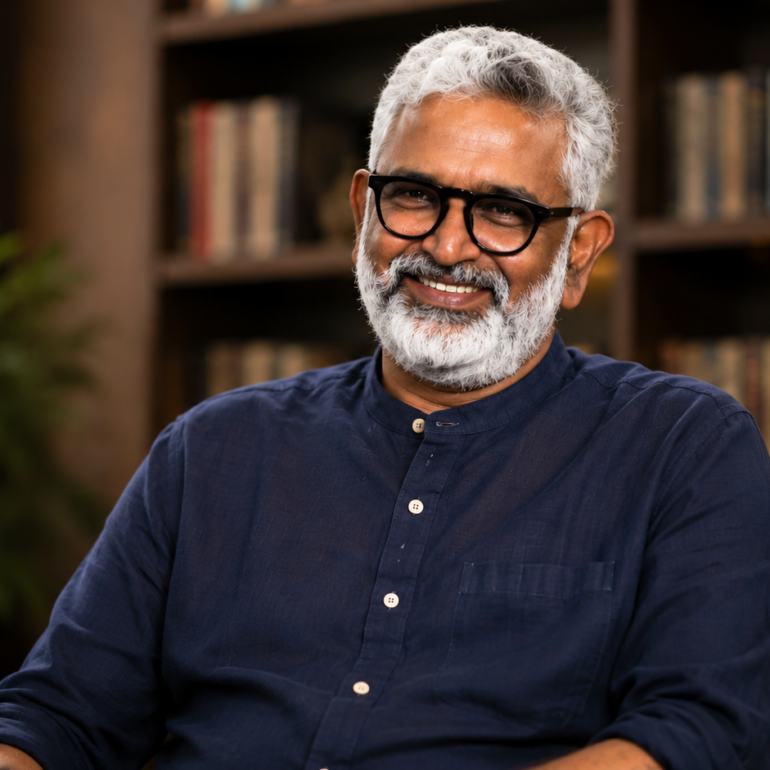

Vineeth Sreenivasan
Indian Actor, Director, Producer, Screenwriter, Playback Singer & Lyricist
Vineeth Sreenivasan is an Indian actor, director, producer, dubbing artist, screenwriter, playback singer and lyricist who predominantly works in Malayalam cinema. He is the eldest son of late veteran actor, director and screenwriter Sreenivasan. His younger brother, Dhyan Sreenivasan is also an actor. He attended Rani Jai Higher Secondary School. He graduated in mechanical engineering from KCG College of Technology, Chennai.
Key Factors
Full Name: Vineeth Sreenivasan
Date of Birth: 1 October 1984
Birthplace: Chennai, Tamil Nadu, India
Occupation: Playback Singer, Actor, Director, Screenwriter, Lyricist
Vineeth Sreenivasan occupies a uniquely emotional space in Malayalam cinema. While he is widely celebrated as a filmmaker, actor, lyricist, and writer, it is perhaps his voice, warm, conversational, youthful, and deeply human, that forged one of the strongest emotional connections with Malayali audiences over the last two decades. Unlike conventionally grand playback singers, Vineeth arrived with a voice that sounded intimate and familiar, as though it belonged not to a distant celebrity but to someone listeners already knew.
Across romantic melodies, campus songs, nostalgic ballads, and playful folk-infused hits, he became the musical companion of an entire generation that grew up alongside changing Malayalam cinema in the 2000s and 2010s. Songs like “Karale Karalinte,” “Entammede Jimikki Kammal,” “Aluva Puzhayude,” and “Anuragathin Velayil” did more than top charts. They entered memory, hostel corridors, college festivals, road trips, wedding videos, and heartbreak playlists. Over time, Vineeth Sreenivasan evolved into something rare in modern cinema, a singer whose emotional sincerity mattered as much as technical perfection.
The Voice That Grew With a Generation
How Vineeth Sreenivasan became Malayalam cinema’s most emotionally relatable musical soul
At a packed college festival somewhere in Kerala, the opening beats of “Entammede Jimikki Kammal” begin playing through giant speakers. Within seconds, the crowd erupts. Students scream the lyrics before the singer even reaches the microphone. Phones rise into the air. Friends dance without coordination. Somewhere in the middle of the noise, nostalgia quietly begins forming in real time.
That has always been the strange power of Entammede Jimikki Kammal and, by extension, Vineeth Sreenivasan himself.
His music rarely feels manufactured for stardom. Instead, it feels lived-in, casual, emotionally immediate. Over the years, Vineeth’s voice became attached to some of the most outstanding emotional memories in contemporary Malayalam culture, first loves, late-night drives, engineering college friendships, heartbreaks, weddings, hostel corridors, and the bittersweet transition into adulthood.
Unlike many playback singers whose appeal comes from vocal grandeur, Vineeth built his identity through emotional familiarity. His singing sounds conversational rather than performative. There is softness in his phrasing, vulnerability in his pauses, and an almost unguarded sincerity in the way he delivers lyrics. For Malayali audiences who came of age during the changing cinematic landscape of the 2000s and 2010s, Vineeth’s voice became deeply personal.
It is difficult to discuss modern Malayalam film music without discussing him.
Growing Up Inside Stories
Being born into the household of Sreenivasan meant growing up around stories long before understanding cinema as an industry.
Vineeth’s childhood was filled with writers, actors, directors, music rehearsals, film discussions, and the chaotic warmth of Malayalam cinema culture. Yet despite being the son of one of Malayalam cinema’s most respected writers and actors, his artistic personality developed with remarkable humility.
His relationship with his younger brother Dhyan Sreenivasan also became part of Kerala’s popular cultural imagination later, the contrast between Vineeth’s gentle introspection and Dhyan’s spontaneous irreverence creating an almost cinematic sibling dynamic.
Interestingly, Vineeth did not initially seem destined exclusively for cinema. Like many middle-class Malayali youngsters of his generation, he pursued engineering. There was practicality in his upbringing alongside creativity. But art remained impossible to escape.
Music, especially, slowly became central to his identity.
Unlike singers trained to dominate compositions, Vineeth approached music like storytelling. Perhaps that instinct came naturally from growing up inside narratives.
A Different Kind of Playback Singer
When Vineeth first entered Malayalam cinema as a singer in the early 2000s, his voice sounded noticeably different from traditional playback standards.
Malayalam playback music had long celebrated technically commanding voices, singers capable of immense classical complexity and vocal authority. Vineeth arrived with something gentler.
Initially, that softness surprised audiences.
But very quickly, listeners began connecting deeply with it.
Songs like “Karale Karalinte” revealed a voice that felt emotionally transparent rather than formally polished. Instead of theatrical expression, he offered intimacy. Instead of vocal acrobatics, he offered emotional realism.
For younger listeners especially, his singing felt relatable.
It sounded like someone speaking directly to them.
At a time when Malayalam cinema itself was gradually shifting toward more grounded, emotionally natural storytelling, Vineeth’s musical style fit perfectly within the cultural moment.
The Voice of Youth, Love, and Nostalgia
To understand Vineeth Sreenivasan’s impact as a singer, one must understand the emotional ecosystem of Malayalam youth culture during the late 2000s and 2010s.
This was a generation growing up alongside Orkut scraps, engineering college festivals, early Facebook romance, bus-stop friendships, hostel loneliness, and changing urban Kerala identities. Malayalam cinema was simultaneously becoming more intimate and youthful.
Vineeth’s voice became the soundtrack to that transition.
Songs like “Ente Khalbile,” “Anuragathin Velayil,” and “Aluva Puzhayude” carried extraordinary emotional accessibility. They sounded less like cinematic performances and more like memories unfolding through melody.
Then came Thattathin Marayathu.
Few films transformed modern Malayalam musical nostalgia as powerfully as this one. The film’s songs, atmosphere, and emotional innocence created a cultural phenomenon. Vineeth’s involvement as director and musical voice gave the film unusual emotional coherence.
Even years later, “Anuragathin Velayil” and “Shyamambaram” continue to trigger instant nostalgia among Malayali audiences.
Later, “Manikya Malaraya Poovi” and “Entammede Jimikki Kammal” demonstrated another side of Vineeth’s musical identity, playful, socially viral, culturally infectious. These songs escaped cinema entirely and entered everyday life
Weddings adopted them. Social media exploded with covers. International audiences danced to them. College campuses transformed them into ritual.
Few Malayalam playback singers have bridged intimacy and mass popularity so effortlessly.
Music as Emotional Storytelling
What separates Vineeth from many contemporaries is his deep understanding of narrative rhythm.
Because he is simultaneously a writer, actor, lyricist, and filmmaker, he approaches songs differently. He rarely sings merely for melody. He sings for emotional context.
His phrasing often mirrors spoken emotion. There is hesitation where characters might feel uncertainty, softness where scenes require vulnerability, and conversational warmth where romance feels grounded rather than cinematic.
This quality becomes especially visible in romantic tracks.
Unlike overly stylized playback traditions, Vineeth’s romantic songs often feel emotionally domestic. Listeners can imagine themselves inside the songs.
That relatability became central to his popularity.
Even technically, his singing favors emotional clarity over ornamental excess. Lyrics remain understandable. Expressions remain restrained. The listener is invited into the song rather than overwhelmed by it.
In many ways, Vineeth helped redefine what a Malayalam playback voice could sound like for a younger generation.
Collaborations and Musical Identity
Over the years, Vineeth collaborated with several composers who understood the emotional specificity of his voice.
Whether working with Shaan Rahman, Gopi Sundar, Bijibal, or Hesham Abdul Wahab, his songs consistently retained certain emotional signatures, nostalgia, tenderness, youthful longing, and emotional sincerity.
His collaborations often flourished especially in coming-of-age cinema and romance-heavy narratives because his voice naturally carried vulnerability.
Even energetic songs performed by Vineeth tend to contain emotional warmth beneath the rhythm.
This is perhaps why many of his tracks survive culturally beyond their original films. They remain emotionally usable in everyday life.
Malayali audiences do not merely listen to Vineeth Sreenivasan songs.
They live inside them.
Beyond Playback Singing
Though singing remains central to his identity, Vineeth’s contribution to Malayalam cinema expanded significantly through filmmaking and acting.
Films like Malarvadi Arts Club, Thira, Jacobinte Swargarajyam, and Hridayam helped shape contemporary Malayalam cinema’s emotional and visual language.
What connects all his creative work, whether direction, acting, or singing, is emotional sincerity.
His films frequently revolve around memory, friendship, longing, growing up, and ordinary emotional experiences. Unsurprisingly, his songs carry the same thematic DNA.
Even as an actor, he maintains the same approachable, emotionally grounded energy that defines his singing voice.
Why Audiences Continue to Connect With Him
Part of Vineeth Sreenivasan’s enduring appeal lies in his refusal to become emotionally distant from audiences.
He still feels accessible.
His artistic image remains deeply “boy-next-door,” not in a manufactured sense, but because his music consistently reflects ordinary emotional life. Love, embarrassment, nostalgia, friendship, awkwardness, hope, and heartbreak exist naturally within his songs.
This relatability helped his music survive across changing media landscapes.
His songs continue living through Instagram reels, college cover performances, road-trip playlists, wedding videos, and YouTube nostalgia compilations. Younger listeners discover him continuously through digital culture while older audiences revisit him through memory.
That intergenerational emotional continuity is rare.
Conclusion
Vineeth Sreenivasan’s greatest achievement as a singer may not be technical brilliance alone, though his musical instincts are undeniable. It is emotional trust.
Listeners trust his voice because it feels honest.
Across romantic melodies, playful folk songs, deeply nostalgic tracks, and emotionally vulnerable compositions, he created a musical identity rooted in sincerity rather than spectacle. His songs became companions to everyday life in Kerala, woven quietly into love stories, friendships, travel memories, heartbreaks, and growing-up years.
In many ways, Vineeth’s music captured the emotional transition of an entire generation of Malayalis navigating modernity while still longing for intimacy and emotional simplicity. That is why his songs continue to feel alive long after their cinematic moments pass.
Years from now, when people revisit the emotional soundscape of contemporary Malayalam cinema, Vineeth Sreenivasan’s voice will remain impossible to separate from it, gentle, nostalgic, deeply human, and enduringly outstanding.