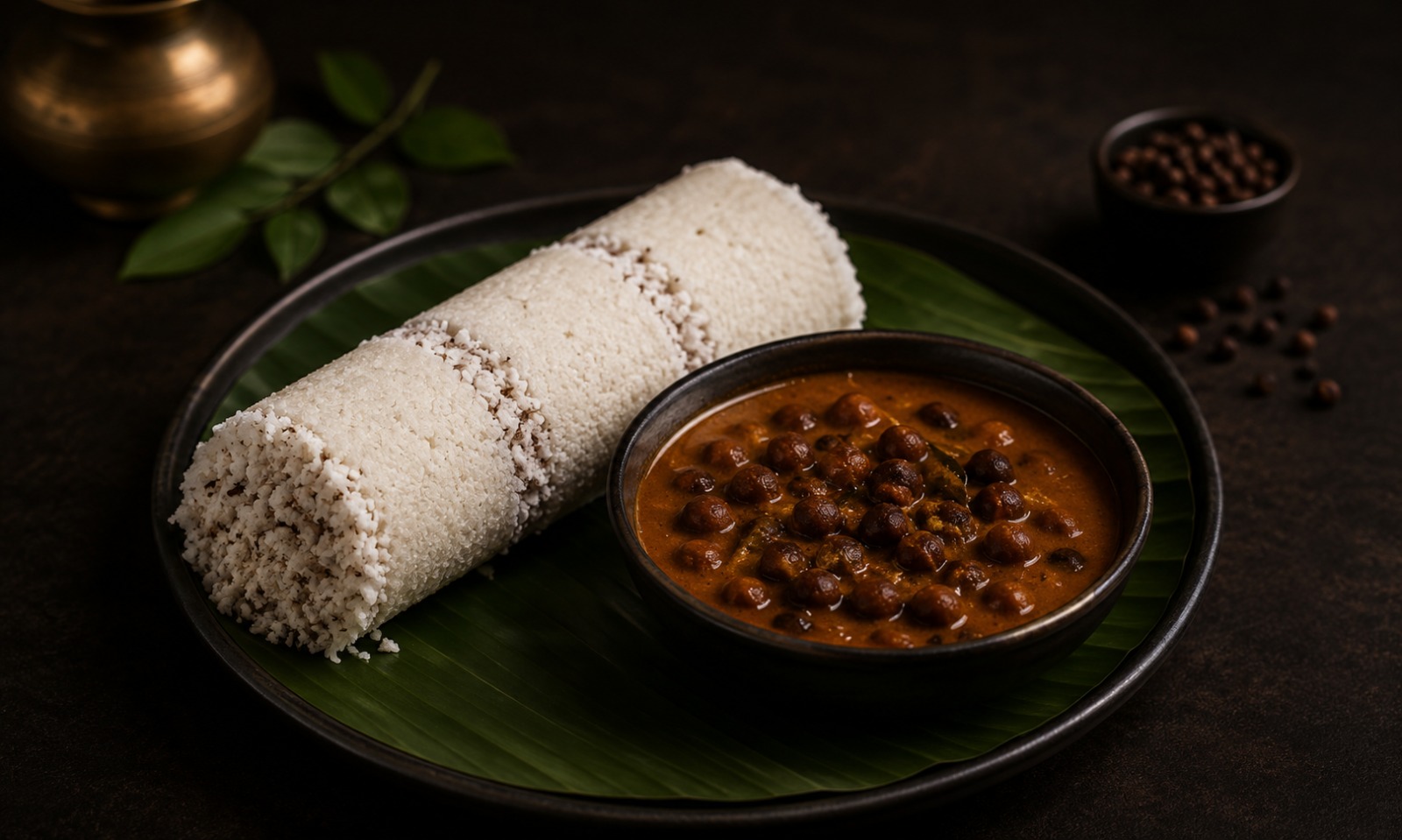
Puttu and Kadala Curry is one of Kerala’s most popular traditional breakfast combinations and an important part of the state’s food culture. Made with steamed rice flour and grated coconut, puttu is usually served with spicy black chickpea curry. Simple, filling, and widely enjoyed across Kerala, this classic breakfast reflects the everyday flavours and cooking traditions of the state.
The Classic Kerala Breakfast That Never Goes Out of Style
For Malayalis, Puttu and Kadala Curry is not reserved for celebration or luxury. Its beauty lies in its familiarity. It belongs equally to roadside tea shops, ancestral homes, railway canteens, and city apartments. Simple in ingredients yet layered in flavor, the dish reflects Kerala itself, humble, generous, and quietly unforgettable.
A Kerala morning often begins before sunrise. Somewhere in the kitchen, water begins to boil in a steel pot while coconut is freshly grated by hand. Curry leaves hit hot coconut oil with a sharp crackle, releasing an aroma that slowly fills the house. Outside, rainwater still clings to banana leaves from the previous night’s monsoon shower.
Then comes the steam.
Fresh puttu emerges from the *puttu kutti*, the cylindrical steamer central to Kerala kitchens for generations. The soft white layers arrive almost cloud-like, carrying the warm fragrance of rice and coconut. Nearby, kadala curry simmers in a blackened *cheenachatti*, thick and dark with roasted coconut gravy and black chickpeas.
At tea shops across Kerala, these scenes repeat every dawn. Workers stop for breakfast before long bus rides. Families gather briefly before school and office routines begin. Stainless steel plates move quickly across counters while glasses of hot chai appear beside them. Puttu and Kadala Curry is not rushed food. Even in busy spaces, it invites pause.
Puttu itself is deceptively simple. Roasted rice flour is lightly moistened with salted water until it reaches the texture of damp sand. Inside the steamer, layers of this flour alternate with grated coconut. As steam rises through the cylinder, the mixture slowly transforms into soft, delicate columns that hold together while remaining airy and loose.
The texture is unlike most breakfast dishes. It is neither bread nor cake, neither noodle nor rice. Instead, puttu feels almost weightless when broken apart by hand. Each grain retains softness while carrying the faint sweetness of coconut.
More than a dish, puttu reflects Kerala’s agricultural history. Rice cultivation shaped the food culture of the region for centuries, while coconut became inseparable from daily cooking. Together, they created a breakfast rooted deeply in the land itself.
Yet if puttu is comfort, kadala curry is character.
Kadala curry brings depth, spice, and warmth to the plate. Black chickpeas are soaked overnight and slow-cooked until tender before being folded into a thick gravy made from roasted coconut, onions, curry leaves, mustard seeds, tomatoes, and Kerala spices.
The roasting of coconut is what gives Kerala-style kadala curry its distinctive soul. The coconut darkens slowly, releasing a nutty aroma before being ground into a paste that thickens the curry beautifully. Black pepper, coriander, fennel, dried red chillies, and garam masala create layers of flavor that feel earthy rather than aggressive.
When paired together, the contrast becomes unforgettable. The soft neutrality of puttu absorbs the intense, spiced richness of the curry perfectly. One balances the other. Neither dominates.
There is also something deeply democratic about Puttu and Kadala Curry in Kerala. It cuts across religion, class, and geography with unusual ease. Hindu, Muslim, and Christian households all embrace it in their own ways. In Malabar, the curry may carry bolder spice notes. In central Kerala, coconut richness often takes center stage. But the emotional connection remains universal.
Nutritionally, the dish also reflects practicality. Black chickpeas provide protein and fiber, while steamed rice flour offers sustained energy without excessive oil. For generations of working families, it became the ideal breakfast, affordable, filling, and capable of carrying people through long days.
Even today, despite changing food habits and fast-food culture, puttu remains remarkably relevant. Modern cafés now serve ragi puttu, wheat puttu, and even fusion variations alongside reinterpretations of kadala curry. Yet the traditional version continues to hold emotional power that modern reinventions rarely replicate.
Travelers visiting Kerala often remember the dish long after their trip ends. Perhaps because it does not feel manufactured for tourists. It feels lived-in. Authentic. The flavors arrive without performance or decoration. A plate of puttu and kadala curry offers something increasingly rare in modern travel, a genuine taste of everyday culture.
And maybe that is why the dish endures.
Puttu and Kadala Curry is not simply breakfast in Kerala. It is the scent of coconut rising with steam before sunrise. It is the sound of steel plates in crowded tea shops. It is grandparents eating slowly on rainy mornings while children wait impatiently beside them. Through generations, this outstanding dish has remained one of Kerala’s strongest culinary symbols, carrying within it the warmth of home, the rhythm of ordinary life, and the enduring taste of tradition.