Mohammed Afsal
Indian Athlete
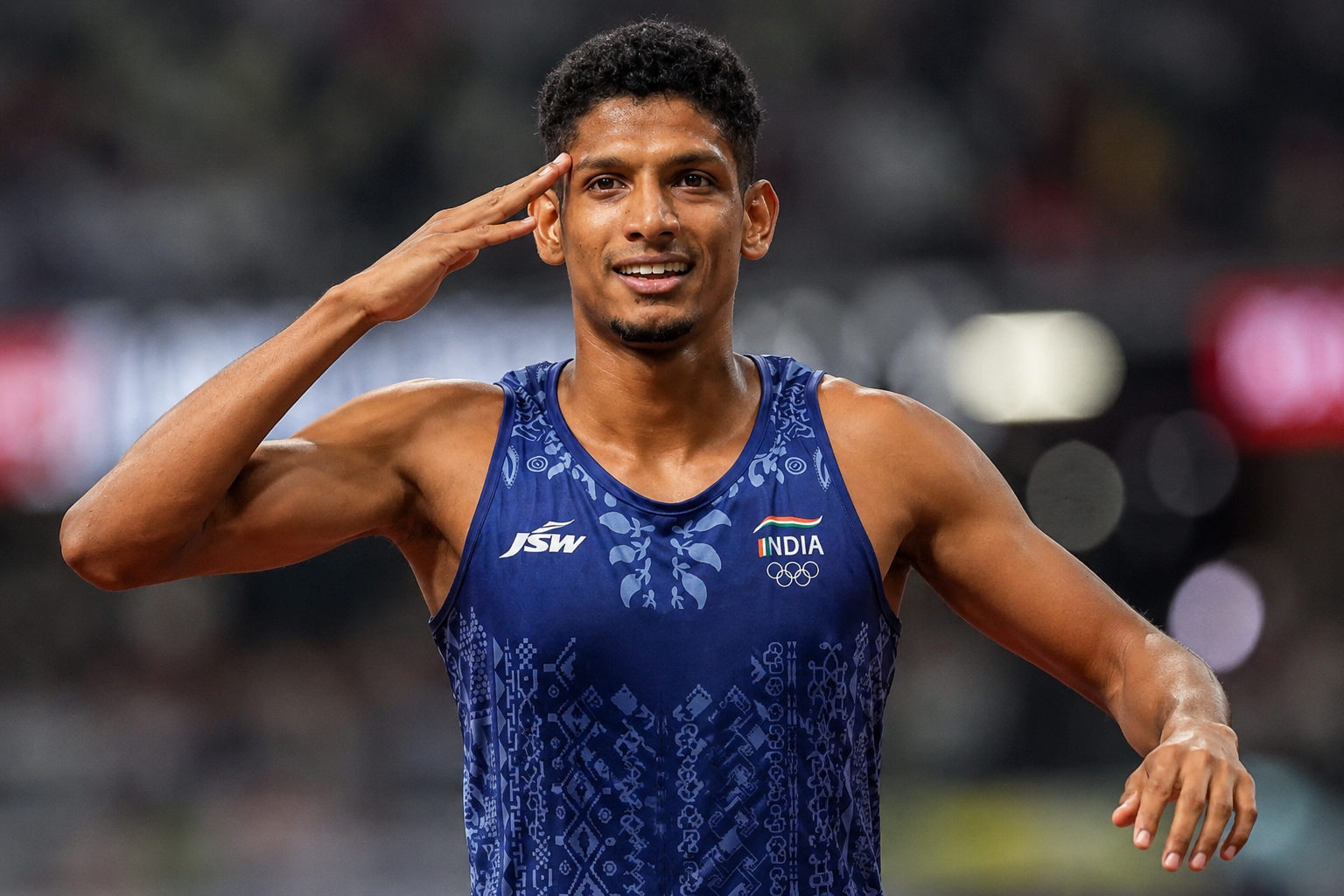
Mohammed Afsal Pulikkalakath is an Indian track and field athlete who specializes in 800 metres. He rose to prominence after winning the silver medal in the men’s 800 m event at the 2022 Asian Games. In 2025, Afsal set the 800 m national record with a time of 1:44.93. Afsal hails from Palappuram, Ottapalam, Palakkad, Kerala. He did his schooling at Parali High School, Parali. He is supported by Reliance Foundation. He works as Junior Warrant Officer in Indian Air Force.
Key Factors
Full Name: Mohammed Afsal Pulikkalakath
Date of Birth: 3 February 1996
Birthplace: Palappuram, Ottapalam, Palakkad, Kerala, India
Sport: Athletics
Specialization: 800 metres
Occupation: Athlete, Junior Warrant Officer in the Indian Air Force
Mohammed Afsal Pulikkalakath has emerged as one of the defining faces of modern Indian athletics, a runner whose rise from the dusty tracks of Kerala to the international stage reflects both personal determination and the evolving ambition of Indian middle-distance running. Specialising in the demanding 800 metres, Afsal built his career through years of relentless training, tactical intelligence, and emotional resilience before announcing himself to the nation with a silver medal at the 2022 Asian Games and later rewriting history by clocking the Indian national record in the event.
At a time when Indian athletics is increasingly searching for global competitiveness beyond sprint relays and javelin, Afsal represents something significant: a new generation of Indian runners willing to challenge long-standing barriers in middle-distance racing. Balancing life as an athlete and a member of the Indian Air Force, his journey is not merely about medals or timings, but about endurance, discipline, sacrifice, and the quiet mental battles hidden behind every lap of an 800-metre race.
The Runner
From the village tracks of Kerala to the fastest 800 metres ever run by an Indian, Mohammed Afsal’s journey is a story of endurance, discipline, and the relentless pursuit of seconds
The stadium noise in Hangzhou rose sharply as the runners entered the final bend. Eight hundred metres is a cruel event. It begins like a sprint, unfolds like a tactical chess match, and ends in complete physical collapse. By the final 100 metres of the 2022 Asian Games men’s 800m final, every athlete on the track was running through pain.
Among them was Mohammed Afsal Pulikkalakath, shoulders tightening, lungs burning, stride shortening, but refusing to surrender rhythm. As the finish line approached, he pushed through exhaustion and crossed in silver-medal position, delivering one of India’s most emotionally significant middle-distance performances in recent years.
For most viewers, it was a medal-winning race.
For Afsal, it was the culmination of years spent running in silence, long before cameras arrived.
Years later, when he broke the Indian national record in the 800 metres with a timing of 1:44.93, he did more than rewrite statistics. He altered the imagination of Indian middle-distance running itself.
Growing Up in Kerala’s Athletics Landscape
Afsal’s story begins in Palappuram near Ottapalam in Kerala’s Palakkad district, a region where athletics has long occupied an important cultural space. Kerala’s sporting culture differs from many other parts of India. In schools across the state, athletics is not viewed as an occasional extracurricular activity. It is woven into institutional pride, local identity, and community aspiration.
Born on 3 February 1996, Afsal grew up in an environment where school sports meets mattered deeply. Dusty grounds, inter-school competitions, local coaches shouting lap timings, and district meets under harsh sunlight formed the emotional geography of his childhood.
He studied at Parali High School, where his athletic ability began attracting attention early. Kerala’s school athletics system, though imperfect, has historically produced disciplined runners through rigorous competition at the grassroots level. For many children from smaller towns, athletics became both ambition and escape.
Afsal belonged to that ecosystem.
The early years were not glamorous. Training facilities were limited compared to global standards. Exposure to elite competition was minimal. Yet the state’s culture of competitive athletics created mental toughness early. Young runners learned quickly that success depended less on talent alone and more on repetition, endurance, and discipline.
Middle-distance running, especially the 800 metres, demands unusual psychological resilience. It punishes hesitation immediately.
Afsal understood this early.
Learning to Run the Hardest Race
Among track events, the 800 metres occupies a strange and brutal middle ground. Sprinters consider it too long. Distance runners consider it too fast.
Athletes must combine the explosive acceleration of a sprinter with the endurance of a long-distance runner. Tactical awareness becomes critical. Pace judgment can decide victory or collapse within seconds.
One mistake ruins everything.
For Afsal, mastering the event required years of physiological adaptation and mental conditioning. Training involved endless interval sessions, lactate-threshold workouts, endurance runs, strength conditioning, and tactical race simulations.
There is also immense loneliness in middle-distance training.
Unlike team sports, progress is measured quietly, through stopwatch readings, training logs, recovery patterns, and microscopic improvements invisible to outsiders.
Afsal gradually developed into a tactically mature runner known for composure and finishing strength. Coaches and athletics observers began recognizing his ability to control race rhythm rather than panic under pressure.
One of his earliest major breakthroughs came in 2013, when he won gold at the Asian School Track and Field Championships in Malaysia. For a young athlete from Kerala, international success carried psychological importance. It proved he could compete beyond domestic circuits.
But middle-distance running careers are rarely built through one breakthrough alone.
They require relentless accumulation.
Building an International Athlete
Over the next several years, Afsal evolved steadily rather than explosively. That gradual development became one of the defining strengths of his career.
Indian middle-distance runners historically struggled because of limited exposure to elite international racing environments. European circuits, where athletes routinely compete against high-quality fields, often determine whether runners progress beyond national level.
Afsal’s exposure trips to Europe became crucial.
Racing internationally taught him pace discipline, tactical patience, and competitive aggression. Events like the Watford Open Graded Meeting helped sharpen his racing instincts against stronger competition.
He began improving not only in the 800 metres but also across 200m, 400m, and 1500m timings, reflecting growing athletic maturity. His performances in Belgium and other European meets signaled an athlete learning how to operate at international speed standards.
Back home, he won gold at the National Games of India in Gujarat, strengthening his position among India’s leading middle-distance runners.
What stood out about Afsal’s rise was consistency.
He was not merely chasing isolated fast timings. He was building competitive endurance season after season.
The Asian Games Race That Changed His Career
By the time the Asian Games arrived, expectations had grown significantly.
Middle-distance races at continental championships are rarely straightforward. Unlike paced meets focused purely on timing, championship races are tactical, physical, and psychologically volatile.
The Hangzhou final unfolded cautiously at first. Athletes watched each other carefully, conserving energy for the final lap. Then the pace accelerated sharply.
Afsal remained composed.
That composure became decisive.
As runners faded in the final stretch, he sustained momentum through exhaustion and secured silver, delivering one of India’s strongest recent performances in the event. The medal carried emotional significance because Indian athletics has often struggled to sustain global competitiveness in men’s middle-distance running.
The race transformed public recognition around him.
Suddenly, Afsal was no longer merely a national-level athlete. He had become a symbol of possibility within Indian athletics.
Breaking the National Record
Then came the performance that permanently placed him in Indian athletics history.
In 2025, Mohammed Afsal clocked 1:44.93 in the men’s 800 metres, breaking the Indian national record. For casual observers, the difference between records may appear marginal.
In elite middle-distance running, fractions of seconds represent years of work.
Breaking below 1:45 is psychologically and internationally significant. It signals entry into a higher competitive tier. The performance reflected not only speed, but sophisticated race execution, conditioning, recovery management, and tactical intelligence.
More importantly, it demonstrated that Indian athletes could begin approaching international standards previously considered distant.
The record also symbolized broader progress in Indian athletics infrastructure, sports science support, nutrition awareness, and exposure to international competition.
Afsal’s achievement was deeply individual, but also collective.
Life Beyond Medals
Away from stadiums, Afsal’s life reflects another defining aspect of Indian athletics: institutional support through the armed forces.
Serving as a Junior Warrant Officer in the Indian Air Force, he balances military discipline with elite sport. The structure of service life, punctuality, physical conditioning, accountability, often complements the demands of athletics.
He has also received support from organisations like the Reliance Foundation, whose investment in athletics development has become increasingly significant in India.
Yet even with institutional backing, elite athletics remains emotionally demanding.
Training cycles are exhausting. Injuries threaten momentum constantly. Careers are fragile. Public attention arrives suddenly and disappears quickly.
Athletes learn to survive uncertainty.
Kerala’s Athletic Tradition
Kerala occupies a unique place in Indian athletics history.
From P. T. Usha to numerous Olympians, relay runners, jumpers, and middle-distance athletes, the state has consistently produced elite performers despite limited resources.
Part of this success emerges from school-level competition culture. Part comes from social respect attached to athletics achievement. And part stems from Kerala’s disciplined coaching ecosystem.
Afsal now belongs to that lineage.
For younger athletes in Palakkad and across Kerala, his journey offers something powerful: proof that global-level performances can emerge from ordinary beginnings.
The Road Ahead
Middle-distance running remains brutally competitive internationally. Global standards continue rising. Maintaining consistency at elite level requires exceptional planning, injury management, and tactical evolution.
For Afsal, the next challenge is sustainability.
Olympic qualification, global championship competitiveness, and long-term consistency demand another level entirely. The margins become thinner. The pressure becomes heavier.
Yet Indian athletics now views him differently.
Not merely as a medal winner, but as an athlete capable of redefining expectations.
Conclusion
In middle-distance running, races are measured in minutes, but greatness is built over years of invisible effort.
Every lap Mohammed Afsal runs carries traces of rural Kerala training grounds, early morning workouts, national camps, military discipline, injuries, disappointments, and relentless repetition. From Palappuram to international stadiums, his journey reflects the quiet determination behind Indian athletics, a sport where success rarely arrives dramatically and almost always demands sacrifice.
When he crossed the finish line to claim Asian Games silver and later shattered the national record, he did more than create personal milestones. He expanded the horizon of what Indian middle-distance runners could realistically aspire to become.
And somewhere in Kerala today, on another dusty school track at sunrise, a young runner is probably chasing that same dream because Mohammed Afsal Pulikkalakath made it feel possible.