
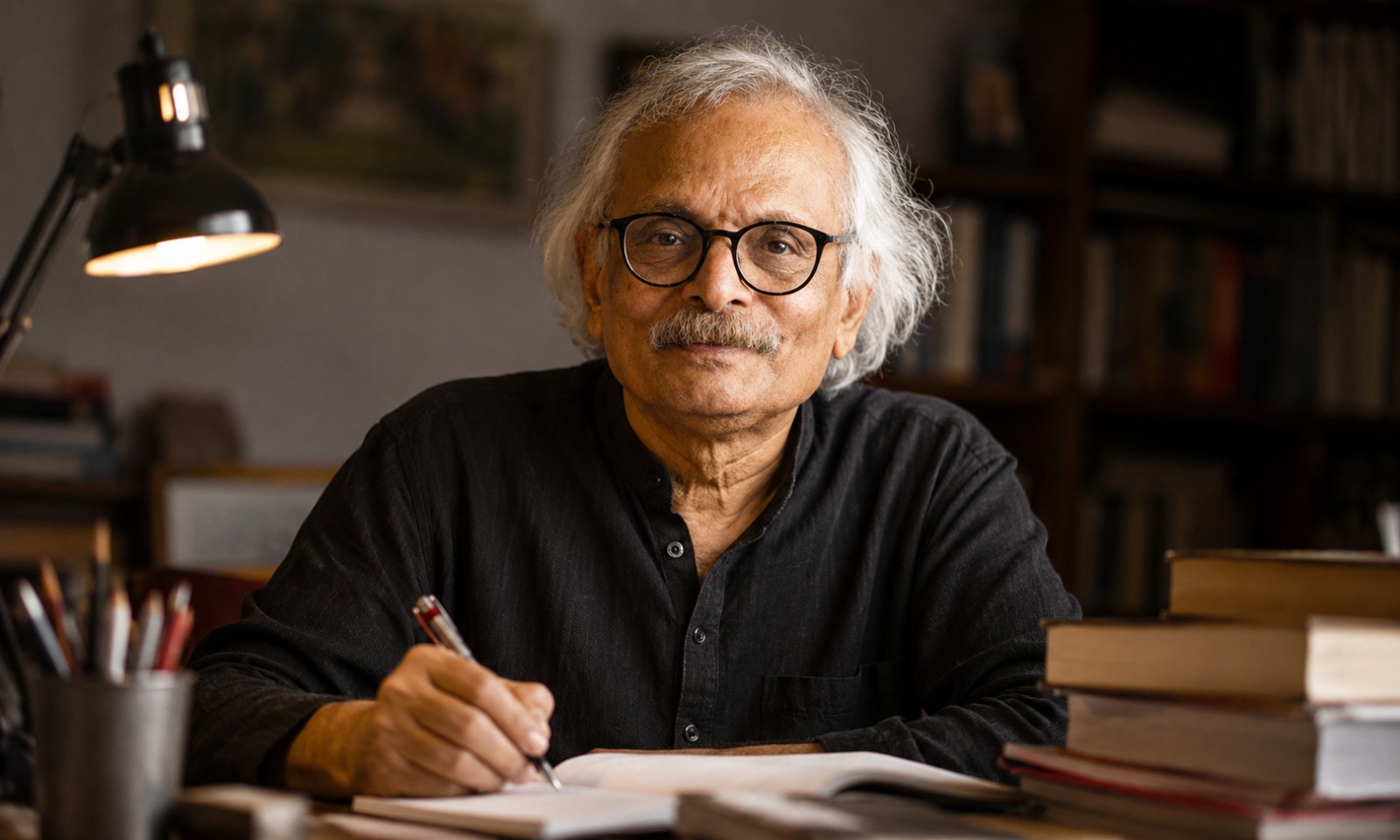
M. Mukundan
Indian writer
M Mukundan is an Indian author of Malayalam literature and a former diplomat. Mukundan was born in Mahe, then a French overseas territory and now a part of the union territory of Puducherry in South India.[2] Mukundan served as a cultural attaché at the New Delhi office of the Embassy of France from 1961 to 2004. He concurrently worked as an author.
Key Factors
Full Name: Maniyambath Mukundan
Born: 10 September 1942
Place: Mahe (Mayyazhi), Puducherry, India
Titles: Mayyazhiyude Kathakaaran, Pioneer of Modern Malayalam Literature
Occupation: Writer, Novelist, Short Story Writer, Former Diplomat, Screenwriter
In the narrow streets of Mahe, where the Arabian Sea carries the memory of colonial ships and old revolutions, literature once found one of its most haunting voices. The river of Mayyazhi, flowing quietly through the former French enclave, would eventually become more than geography in the hands of M. Mukundan. It became memory, exile, longing, politics, mythology, and human loneliness. Across more than six decades of writing, Mukundan transformed the emotional landscape of Malayalam literature by giving voice to displaced souls, failed dreamers, restless migrants, and people trapped between history and identity. He emerged not merely as a novelist but as a chronicler of psychological modernity in Kerala. At a time when Malayalam fiction was still shaped heavily by realism and social romanticism, Mukundan introduced fractured inner worlds, existential unease, and experimental narrative forms. His stories carried the scent of rain-soaked Mahe streets, the alienation of Delhi apartments, and the silent grief of men and women caught between memory and migration. Today, he remains one of the most outstanding Malayali literary figures of modern India, a writer whose works continue to echo across generations of readers searching for belonging in an unsettled world.
Few writers are so deeply associated with a place that the geography itself begins to feel inseparable from their imagination. For M. Mukundan, that place is Mayyazhi, or Mahe, the small former French territory on the Malabar coast that shaped nearly every emotional current of his literary universe. Often called Mayyazhiyude Kathakaaran, the storyteller of Mayyazhi, Mukundan redefined Malayalam fiction by combining memory, politics, migration, desire, and existential reflection in ways that felt radically modern. His novels moved beyond traditional storytelling structures, embracing fragmented emotions, philosophical unease, and psychological complexity. Whether writing about lonely clerks in Delhi, fading revolutionaries, uprooted Malayalis, or ordinary people haunted by history, Mukundan brought extraordinary emotional depth to the lives of seemingly ordinary characters. His literary journey stretched from French-ruled Mahe to the diplomatic corridors of New Delhi, yet his writing never lost its intimacy with Kerala’s social and emotional realities. Across landmark works such as Mayyazhippuzhayude Theerangalil, Daivathinte Vikrithikal, Kesavante Vilapangal, and Pravasam, he transformed Malayalam literature into a space where memory and modernity could coexist with haunting beauty.
Early Life and the Soul of Mayyazhi
To understand M. Mukundan, one must first understand Mayyazhi.
Born in 1942 in the French-controlled enclave of Mahe, Mukundan grew up in a territory unlike the rest of Kerala. The influence of French colonial culture existed alongside Malayalam traditions, political unrest, Catholic institutions, revolutionary movements, and deep social contradictions. Mahe was small in geography but immense in emotional texture.
For the young Mukundan, this landscape became a permanent literary memory.
The sea, the river, colonial buildings, political gossip, taverns, loneliness, and the strange cultural hybridity of Mahe would later flow through his fiction with extraordinary emotional precision. Unlike writers who merely used places as backdrops, Mukundan transformed Mayyazhi into a living psychological universe.
In his novels, Mahe breathes. It mourns. It remembers.
The atmosphere of colonial transition profoundly shaped his worldview. He witnessed a society negotiating identity after the collapse of French rule, and this awareness of displacement and historical transition remained central to his writing for decades.
Even after spending most of his adult life away from Mahe, the town never left him.
Instead, he carried it into literature.
The Writer Who Redefined Malayalam Modernism
Malayalam literature underwent a major transformation during the 1960s and 1970s. Kerala was politically vibrant, intellectually restless, and increasingly exposed to world literature and modernist ideas.
Into this changing literary climate entered M. Mukundan.
His early stories and novels departed sharply from conventional narrative styles. Instead of straightforward realism, he explored fragmented consciousness, emotional alienation, urban anxiety, and existential uncertainty. Characters in Mukundan’s fiction often drifted through life carrying invisible wounds, struggling with memory, ideology, sexuality, migration, and loneliness.
This was a new emotional vocabulary for Malayalam fiction.
Writers like O. V. Vijayan and M. T. Vasudevan Nair had already begun reshaping Malayalam literature in different ways, but Mukundan brought a distinctly urban and psychologically modern sensibility.
His writing questioned certainty. It distrusted grand narratives.
It embraced emotional ambiguity.
The result was literature that felt startlingly contemporary.
Young readers saw themselves in his characters, particularly those struggling with displacement and ideological confusion in rapidly changing post-independence India.
Delhi Years and the Diplomat’s Perspective
In 1961, Mukundan joined the French Embassy in New Delhi as a cultural attaché, a position he would hold until 2004.
Delhi transformed him as deeply as Mahe had.
If Mayyazhi represented memory and rootedness, Delhi represented alienation and movement. Living for decades in India’s vast political capital exposed Mukundan to migration, bureaucracy, loneliness, cosmopolitanism, and cultural dislocation.
This dual existence, emotionally tied to Kerala while physically immersed in Delhi, became central to his fiction.
Novels such as Delhi, Delhi Gadhakal, and Pravasam reflect this sense of exile with remarkable sensitivity.
Mukundan observed Delhi not as a triumphant national capital, but as a city of wandering souls. Government clerks, intellectuals, migrants, writers, and Malayalis living far from home populate his fiction with quiet melancholy.
The diplomat’s life also widened his literary horizons. Exposure to French culture and European literary traditions deepened his engagement with modernist and postmodern narrative forms.
Yet despite these international influences, his writing remained emotionally rooted in Malayalam cultural experience.
Masterpieces That Changed Malayalam Literature
Among Mukundan’s many achievements, Mayyazhippuzhayude Theerangalil remains perhaps his most iconic work.
The novel is more than historical fiction about French-ruled Mahe. It is a deeply lyrical meditation on memory, colonialism, identity, and human fragility. Through richly drawn characters and poetic realism, Mukundan transformed a small town into a universal emotional landscape.
Readers did not merely read Mayyazhi.
They inhabited it.
Then came Daivathinte Vikrithikal, one of the most philosophically layered novels in Malayalam literature. The work explores decay, absurdity, suffering, and existential helplessness with haunting intensity. Critics praised its emotional depth and symbolic richness, while readers were struck by its unsettling psychological atmosphere.
The novel eventually earned him the prestigious Sahitya Akademi Award in 1992.
Kesavante Vilapangal revealed another dimension of Mukundan’s brilliance. Through the figure of Kesavan, the novel examines politics, ideology, memory, and literary self-consciousness. It became one of the defining Malayalam novels of the early 21st century and won the Vayalar Award.
Meanwhile, Pravasam captured the emotional geography of migration long before globalization became central to Kerala’s public discourse. The novel spoke deeply to Malayalis living away from home, navigating foreign cities while carrying fragments of Kerala within them.
Mukundan’s Literary Style
Mukundan’s prose possesses an unusual balance between clarity and emotional complexity.
He writes with poetic realism, yet his narratives frequently fracture into memory, reflection, and philosophical uncertainty. Time in his novels is rarely linear. Characters drift between past and present, reality and imagination, history and private grief.
His fiction also carries strong psychological depth.
Unlike traditional social novels driven primarily by plot, Mukundan’s stories often unfold through emotional atmosphere and interior consciousness. Silence matters in his writing. So does absence.
There are traces of existential literature in his work, but also deep compassion for ordinary human vulnerability.
Politically, his writing remained observant without becoming simplistic propaganda. He understood ideology, but he also understood the loneliness hidden beneath political conviction.
This emotional intelligence made his fiction enduring.
The Human Beings Inside His Stories
One of Mukundan’s greatest strengths lies in the tenderness with which he writes human beings.
His protagonists are rarely heroic.
They are lonely clerks, failed revolutionaries, migrants, dreamers, lovers, alcoholics, aging intellectuals, and emotionally exhausted urban dwellers.
Yet he treats them with dignity.
Mukundan understands failure intimately. He understands the emotional fatigue of displacement and the quiet desperation of people searching for meaning in indifferent systems.
Even when his characters collapse psychologically or morally, he never reduces them to caricatures.
This empathy explains why generations of readers continue returning to his novels.
His literature does not judge human weakness.
It listens to it.
Awards, Recognition, and Global Respect
Over the decades, Mukundan accumulated some of the highest honours in Indian literature.
The Kerala Sahitya Akademi Award recognised his literary excellence early in his career. The Sahitya Akademi Award for Daivathinte Vikrithikal confirmed his national stature.
Later came the Crossword Book Award, the JCB Prize for Literature for Delhi: A Soliloquy, and Kerala’s highest literary honour, the Ezhuthachan Puraskaram.
Perhaps symbolically significant was France honouring him with the Ordre des Arts et des Lettres, reflecting the unusual bridge his life created between Kerala and French cultural history.
These awards matter not merely as decorations, but as recognition of a writer who fundamentally altered Malayalam literary consciousness.
M. Mukundan as an Outstanding Malayali
For many Malayalis, M. Mukundan represents something larger than literature.
He represents memory itself.
Through his fiction, Mayyazhi became immortal in the Malayalam imagination. Generations who never lived under French rule came to emotionally understand that world through his stories.
At the same time, Mukundan captured the anxieties of modern Kerala, migration, ideological conflict, urban loneliness, and the emotional fragmentation of contemporary life.
He became a literary bridge between Kerala and the wider world.
Unlike writers who remained confined within regional nostalgia, Mukundan carried Malayalam literature into global conversations about identity, exile, and belonging while preserving its linguistic intimacy.
His works continue to resonate because they speak to emotional truths that transcend geography.
Legacy and Continuing Relevance
Today, younger readers continue discovering Mukundan through translations, literary discussions, university studies, and renewed interest in modern Malayalam fiction.
What makes his work enduring is its emotional relevance.
In an era defined by migration, loneliness, political uncertainty, and fractured identities, Mukundan’s characters feel remarkably contemporary. His fiction anticipated many emotional realities of modern life long before they became dominant public conversations.
More importantly, he preserved the emotional history of Kerala without romanticising it.
He wrote about memory, but also about decay.
About belonging, but also exile.
About dreams, but also disillusionment.
And perhaps that is why M. Mukundan remains such an outstanding Malayali literary presence. His novels do not merely tell stories. They preserve entire emotional worlds, allowing readers to walk once more through the rain-soaked streets of Mayyazhi, carrying with them the fragile, restless humanity that defines both Kerala and the modern human condition.
Awards and honours
1973 – Kerala Sahitya Akademi Award (Ee Lokam Athiloru Manushyan)
1992 – Sahitya Akademi Award (Daivathinte Vikrithikal
N.V. Puraskaram (Daivathinte Vikrithikal
1998 – Chevalier des Arts et des Lettres of the Government of France
1998 – Muttathu Varkey Award
2003 – Vayalar Award (Kesavante Vilapangal) (Kesavan’s Lamentations)[19] and three years later, the Kesavan’s Lamentations
2006 – Crossword Book Award (English translation of Kesavante Vilapangal)
2018 – Ezhuthachan Puraskaram
2018 – Kerala Sahitya Akademi Fellowship
2017 – M. P. Paul Award
2017 – T. K. Ramakrishnan Award
2017 – Abu Dhabi Sakthi Awards
2021 – JCB prize for literature (Delhi: A Soliloquy)
2022 – Basheer Award (Nritham Cheyyunna Kudakal)
2023 – Thakazhi Award
2023 – Padmarajan Award (Ningal )