The Enduring Magic of Kashi Art Café
Kashi Art Café in Fort Kochi is a popular destination that brings together art, food, and contemporary café culture. Known for its relaxed atmosphere, creative setting, and diverse menu, the café has become an important part of Kochi’s cultural landscape.
Contact Number: 04842215769
Location: Kashi Art Café, Fort Kochi
Website: Kashi Art Café Official Website
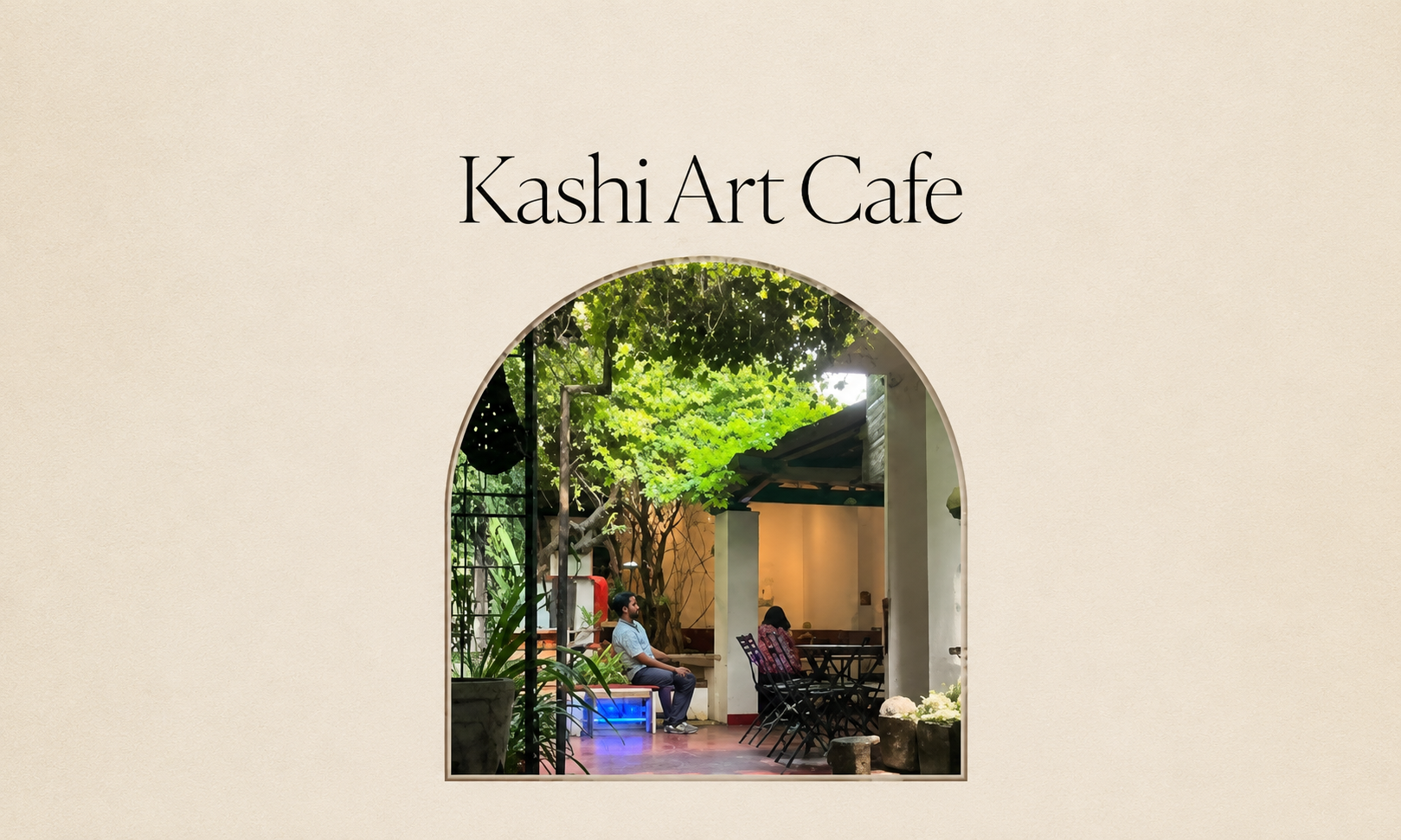
Morning arrives differently in Fort Kochi. The streets do not rush awake. They unfold slowly, through the sound of distant bicycle bells, sea breeze moving through colonial verandas, and cafés opening their wooden doors to the smell of coffee and wet earth. Inside Kashi Art Café, sunlight falls gently across whitewashed walls layered with paintings, handwritten notes, old conversations, and the quiet residue of decades spent nurturing Kochi’s creative spirit. A traveler sits with a notebook beneath the courtyard trees. An artist studies sketches between sips of cold coffee. Somewhere in the background, plates carrying French toast and fish steaks move slowly through the room. The café does not attempt to impress through spectacle. Its atmosphere emerges naturally, almost accidentally, from years of accumulated memory.
Few places in Kerala possess this kind of emotional permanence. Kashi Art Café is not simply a restaurant serving breakfast in Fort Kochi. It is an outstanding cultural landmark that helped redefine how Kerala understood cafés, creativity, and urban social life. Long before café culture became fashionable across Indian cities, Kashi transformed dining into something slower, more reflective, and deeply intertwined with art, literature, travel, and conversation. To enter Kashi is to enter the emotional geography of Fort Kochi itself.
The Soul of Fort Kochi
Fort Kochi has always existed at the intersection of worlds.
For centuries, the historic coastal neighborhood absorbed influences from Arab traders, Portuguese settlers, Dutch merchants, Jewish communities, and British colonial administration. Unlike many modern tourist destinations shaped primarily by commerce, Fort Kochi evolved through layered encounters between cultures. Its streets still carry traces of that history in fading colonial facades, spice warehouses, churches, art galleries, and weathered homes facing the Arabian Sea.
Kashi Art Café emerged organically from this environment rather than being artificially inserted into it.
Tucked within one of Fort Kochi’s quieter lanes, the café feels inseparable from the neighborhood’s rhythm. Visitors do not usually “arrive” at Kashi dramatically. They drift into it while walking through the colonial streets, often guided by instinct, curiosity, or recommendation from another traveler. The entrance itself remains understated, almost resistant to commercial flamboyance.
Inside, the pace changes immediately.
There is silence, though not emptiness. It is the silence of a place comfortable with unhurried time. Ceiling fans rotate lazily above conversations that stretch for hours. Light moves gradually through open courtyards. People read, sketch, write, or simply sit without pressure to leave quickly. In a tourism economy increasingly dominated by speed and image-making, Kashi retains the rare ability to slow people down.
That quality mirrors Fort Kochi itself.
The neighborhood has long attracted those searching for spaces that feel slightly detached from urban urgency, artists, filmmakers, backpackers, academics, musicians, and travelers who value atmosphere as much as destination. Kashi became their unofficial meeting point not because it aggressively cultivated exclusivity, but because it offered refuge.
Its emotional connection to Fort Kochi runs deeper than architecture or cuisine. The café captures the neighborhood’s central contradiction: deeply historic yet continuously evolving, cosmopolitan yet intimate, artistic without pretension.
Where Art Meets Food
The word “art” in Kashi Art Café is not decorative branding. It defines the space fundamentally.
From its earliest years, the café functioned as more than a dining establishment. Paintings hung alongside dining tables. Local artists treated it as an informal gathering place. Writers discussed manuscripts over breakfast. Travelers exchanged stories beneath courtyard trees. Exhibitions rotated through the café walls, transforming meals into encounters with Kochi’s evolving creative scene.
This integration of art and daily life became central to Kashi’s identity.
Unlike galleries that can sometimes feel intimidating or culturally distant, Kashi democratized artistic experience. Paintings coexisted with coffee cups and conversations. Creativity felt lived-in rather than curated exclusively for elite consumption. Visitors could engage with art casually, naturally, while eating breakfast or lingering over dessert.
The café’s timing also mattered historically.
Kashi developed during a period when Kochi’s contemporary art ecosystem was still emerging into wider visibility. Long before the Kochi-Muziris Biennale transformed the city into an internationally recognized art destination, spaces like Kashi quietly nurtured local creative communities. Artists needed gathering spaces, informal salons where ideas could circulate freely outside institutional structures. Kashi became one of those spaces.
Even today, the café retains that atmosphere of ongoing cultural exchange. A filmmaker discussing edits at one table may sit beside European backpackers studying maps, while nearby a local painter sketches absentmindedly between conversations. The diversity of people matters as much as the food itself.
The café never separates artistic life from ordinary life. That is its genius.
A Café That Changed Kerala’s Dining Culture
It is difficult now to remember how functional Kerala’s restaurant culture once was.
For decades, most eateries across the state focused primarily on efficiency and familiarity. Restaurants existed to serve food quickly and reliably. Ambience mattered less than practicality. Social interaction certainly occurred inside these spaces, but restaurants were rarely designed as cultural environments or creative destinations.
Kashi challenged that model quietly but decisively.
Long before café culture became widespread across Indian cities, Kashi introduced the idea that dining could also involve atmosphere, aesthetic identity, intellectual exchange, and emotional experience. It did not merely sell coffee or breakfast. It sold slowness, reflection, and conversation.
This was especially significant in Kerala, where urban café culture evolved relatively late compared to cities like Bengaluru or Mumbai. Kashi helped create a new vocabulary for public social space in Kochi. Young people, artists, travelers, and professionals increasingly began viewing cafés not only as eating spaces but as environments for creative and personal engagement.
Importantly, Kashi achieved this without imitating Western café culture superficially.
Its cosmopolitanism remained grounded in Kochi itself. The café absorbed international influences naturally because Fort Kochi historically functioned as a crossroads of cultures. European-style breakfasts existed comfortably beside Kerala-inspired dishes. Homemade cakes shared menu space with local seafood preparations. The result felt organic rather than artificially globalized.
Many cafés across Kerala today owe something, directly or indirectly, to the cultural space Kashi created.
The Food Philosophy
Kashi’s menu reflects the layered identity of Kochi itself.
Continental café cuisine forms the foundation, but Kerala’s culinary influence appears constantly, sometimes subtly, sometimes directly. What distinguishes the food is restraint. The café avoids unnecessary complexity or trend-driven experimentation. Instead, it prioritizes freshness, comfort, and atmosphere.
The French toast with banana has become iconic for precisely this reason.
Served warm and delicately caramelized, it captures the café’s balance between familiarity and local adaptation. The sweetness of banana integrates naturally into the dish rather than feeling ornamental. It is indulgent without heaviness, comforting without excess.
The fish steaks reveal another side of the menu’s philosophy. Fort Kochi’s relationship with seafood shapes much of its culinary identity, and Kashi embraces that heritage through carefully prepared coastal dishes that remain elegant without becoming overly stylized. Fresh fish arrives lightly seasoned, allowing texture and natural flavor to remain central.
Coffee culture also occupies a special place at Kashi.
The cold coffee, particularly beloved among regulars, feels almost symbolic of the café’s atmosphere, relaxed, slightly nostalgic, designed for lingering rather than hurried consumption. Unlike aggressively commercial café chains focused on standardization, Kashi’s beverages retain a handmade quality that suits the environment perfectly.
Then there are the Kerala-style breakfasts.
These dishes anchor the café locally even as international travelers fill its tables. Traditional flavors appear without performance or exoticization. Kashi understands that authenticity does not require theatrical presentation. It simply requires sincerity.
Desserts, meanwhile, contribute quietly to the café’s emotional identity. Homemade cakes resting behind glass counters feel less like commercial products and more like extensions of the café’s domestic warmth.
Food at Kashi rarely tries to shock diners. Instead, it creates emotional familiarity through atmosphere, texture, and rhythm.
The Atmosphere That Made It Legendary
People often remember Kashi less through specific dishes than through feelings.
The architecture contributes enormously to this emotional memory. Open courtyards allow sunlight and rain to become part of the dining experience. White walls amplify natural light while also functioning as informal gallery spaces. Wooden furniture, plants, stone pathways, and shaded corners create intimacy without artificial design excess.
Nothing feels aggressively manufactured.
The café’s beauty comes from accumulated texture, age, repetition, conversations layered over years. Even silence feels intentional there. Unlike many contemporary cafés designed primarily for visual branding or social media photography, Kashi still prioritizes lived experience.
The relaxed pace matters deeply.
Customers linger for hours without discomfort. Conversations unfold gradually. Travelers pause between explorations of Fort Kochi. Artists work quietly in corners. The café resists the transactional rhythm dominating much of urban dining culture.
This atmosphere explains why Kashi became emotionally significant to generations of visitors.
For some, it represents creative freedom. For others, nostalgia. Many remember the café through specific personal moments, a monsoon afternoon, a first visit to Kochi, a long conversation beneath the courtyard trees, a solitary breakfast before catching a ferry.
Kashi became legendary because it understands something increasingly rare: ambience is not decoration. It is emotional architecture.
Kashi and the Identity of Modern Kochi
As Kochi transformed into one of India’s most culturally dynamic cities, Kashi evolved alongside it.
The rise of heritage tourism, boutique hospitality, independent art spaces, and eventually the Kochi-Muziris Biennale reshaped Fort Kochi’s identity dramatically over the past two decades. International visitors increased. Creative professionals began viewing Kochi differently, not merely as a historical destination but as a contemporary cultural city.
Kashi occupied a central place within this transformation.
The café became part of Kochi’s intellectual and artistic ecosystem, appearing repeatedly in travel writing, cinema culture, literary discussions, and visual storytelling about the city. Journalists covering Kochi’s evolving creative identity often returned to Kashi because the café condensed so many elements of the city’s character into one space.
It represented cosmopolitanism without detachment from locality.
Even during periods when tourism accelerated rapidly and commercialization threatened to flatten Fort Kochi’s character, Kashi largely retained its emotional authenticity. That continuity matters profoundly in a city negotiating the pressures of global visibility and cultural preservation simultaneously.
Today, younger cafés across Kerala may possess more contemporary interiors or trend-focused menus, but few command the same cultural affection. Kashi’s importance extends beyond culinary success. It helped define what modern Kochi feels like emotionally.
And perhaps that is why people continue returning.
Not merely for the coffee or the fish steaks or the French toast, but for the atmosphere of possibility the café still offers. In a rapidly accelerating world, Kashi Art Café remains one of the few places where time seems willing to pause briefly beneath courtyard light and whitewashed walls. Its legacy lies not simply in influencing Kerala’s café culture, but in proving that restaurants can also become spaces of memory, creativity, and human connection. Decades after it first opened its doors in Fort Kochi, Kashi remains outstanding precisely because it continues to feel less like a business and more like a conversation that never truly ended.