
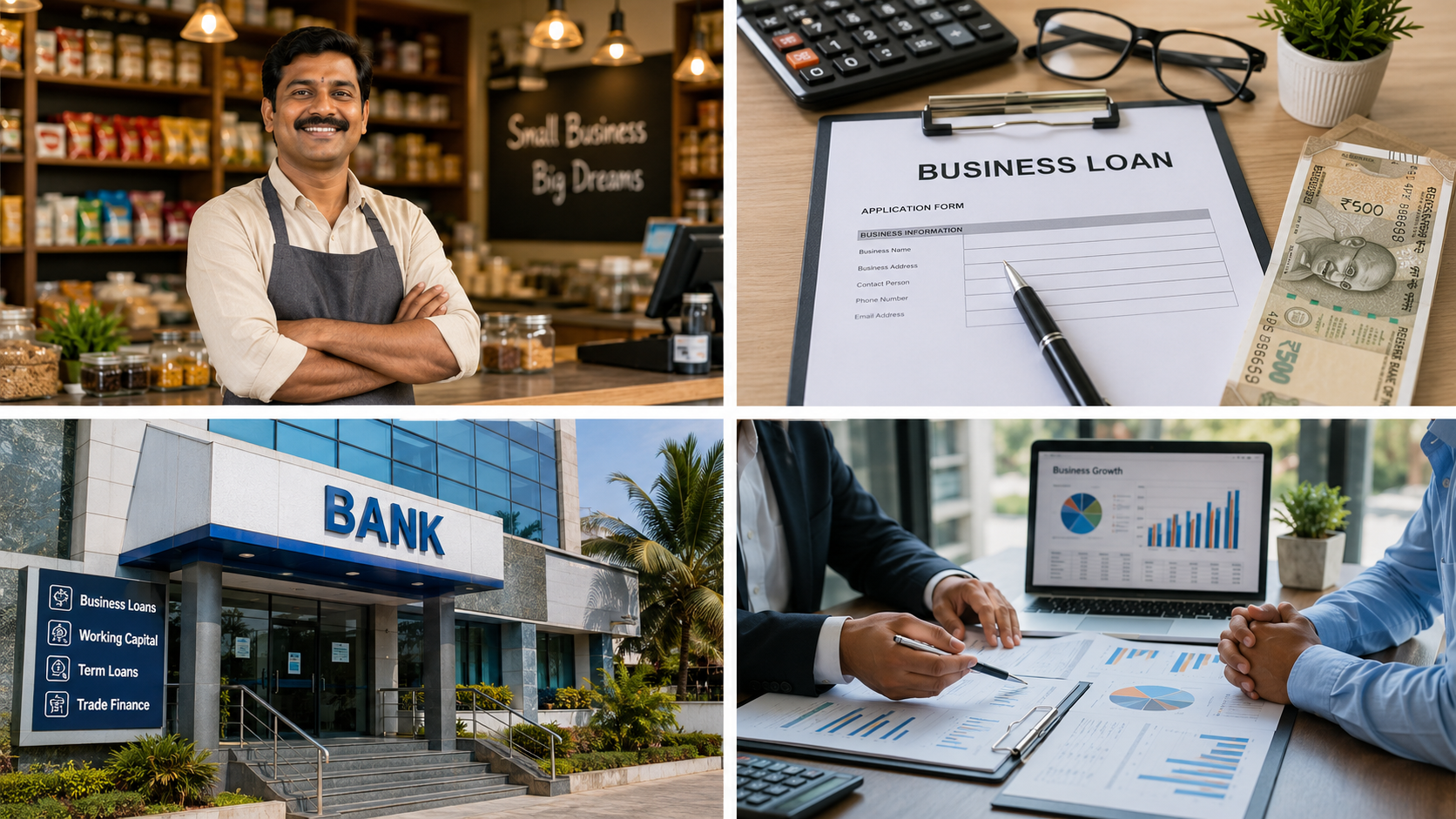
Walk through any town in Kerala today—from Kasaragod to Thiruvananthapuram—and you’ll find evidence of a quiet entrepreneurial movement. New cafés are opening, manufacturing units are expanding, online businesses are emerging, and returning Gulf Malayalis are investing in fresh ventures.
Yet for many entrepreneurs, one challenge remains constant: access to capital.
The good news is that Kerala’s business financing ecosystem has evolved significantly. In 2026, entrepreneurs have more options than ever, ranging from government-supported loan schemes and startup funding programs to specialized MSME financing and collateral-free lending.
The First Step: Register Your Business Properly
Many entrepreneurs start searching for loans before completing basic registrations.
In reality, most financing opportunities in Kerala require:
* Udyam (MSME) registration
* GST registration where applicable
* Business bank account
* Basic financial records
* Project report or business plan
Without these fundamentals, access to institutional finance becomes difficult.
Many loan schemes offered by the state specifically require Udyam registration before an application can be processed.
Kerala Entrepreneur Loan Scheme: One of the Most Attractive Options
Among the most entrepreneur-friendly initiatives currently available is the Kerala Entrepreneur Loan Scheme (KELS).
Introduced through the Department of Industries and Commerce in coordination with banks, the scheme aims to make financing affordable for new and growing MSMEs.
The key attraction is the government’s interest support mechanism. Eligible entrepreneurs can receive term loans and working capital loans with an effective interest rate reduced through state-backed interest subvention. The scheme is available for manufacturing, trading, and service-sector enterprises, including business expansion projects.
For many small businesses, this can significantly reduce financing costs during the critical early years.
The Entrepreneur Support Scheme (ESS)
Many entrepreneurs focus only on loans and overlook subsidies.
That can be a costly mistake.
Kerala’s Entrepreneur Support Scheme (ESS) provides capital investment assistance for eligible MSMEs. Depending on the entrepreneur category, sector, and location, support can range from 15% to 45% of eligible fixed capital investment. Women entrepreneurs, young entrepreneurs, SC/ST entrepreneurs, and Non-Resident Keralites often receive enhanced benefits.
Unlike a loan, a subsidy reduces the entrepreneur’s own investment burden.
For businesses investing in machinery, buildings, electrification, and fixed assets, ESS can become a major financial advantage.
One Family One Enterprise: Encouraging Grassroots Entrepreneurship
Kerala’s “One Family One Enterprise” initiative is designed to encourage business creation at the household level.
Under the scheme, eligible MSMEs can receive interest support on term loans and working capital loans obtained from approved institutions including commercial banks and state-backed financial institutions.
The program specifically aims to increase entrepreneurship across Kerala while making business financing more affordable. Notably, the scheme targets strong participation from women entrepreneurs as well.
Kerala Financial Corporation: A Major Source of Business Finance
For decades, the Kerala Financial Corporation has played a major role in supporting entrepreneurs across the state.
In recent years, KFC has expanded several financing programs for MSMEs, startups, and growing enterprises.
One of its newer initiatives focuses on machinery financing, allowing eligible MSMEs to modernize operations through loans covering a significant portion of machinery costs. Some schemes also provide collateral-free support through guarantee mechanisms.
For entrepreneurs looking to expand manufacturing capacity, automate processes, or upgrade technology, KFC has become an increasingly important financing partner.
Startup Funding Through Kerala Startup Mission
Not every entrepreneur needs a traditional bank loan.
Technology startups often require seed capital before generating significant revenue.
This is where Kerala Startup Mission plays an important role.
KSUM offers multiple funding pathways, including:
* Early-stage grants
* Seed funding
* Scale-up support
* Startup investor connections
Its Early Stage Funding program helps innovators move from concept to prototype, while the Scaleup Seed Fund supports revenue-stage startups seeking expansion capital.
For technology founders, this can be a more suitable route than conventional borrowing.
What Banks Want to See
Many entrepreneurs believe banks reject applications because of collateral.
In reality, lenders often focus on three questions:
Can the business generate revenue?
Can the entrepreneur manage cash flow?
Can the loan be repaid consistently?
Strong applications usually include:
* Clear business plans
* Market analysis
* Revenue projections
* Existing customer base
* Healthy banking transactions
* Good credit history
Entrepreneurs who prepare detailed project reports often enjoy much higher approval rates than those who apply with incomplete information.
Common Mistakes Kerala Entrepreneurs Make
Financial advisors frequently identify several recurring issues:
Borrowing Too Late
Many entrepreneurs wait until cash flow problems become severe before approaching lenders.
At that stage, obtaining finance becomes more difficult.
Ignoring Subsidies
Kerala offers multiple subsidy and support programs, yet many business owners focus only on loans.
Poor Documentation
Incomplete records remain one of the most common reasons for delays and rejections.
Mixing Personal and Business Finances
Maintaining separate accounts improves credibility and simplifies loan assessment.
The Future of Entrepreneur Financing in Kerala
Kerala’s business ecosystem is changing rapidly.
Government initiatives such as KELS, ESS, One Family One Enterprise, Mission 1000, and various Kerala Startup Mission programs indicate a broader effort to strengthen entrepreneurship throughout the state.
The focus is no longer simply on providing loans.
The goal is to create sustainable enterprises that generate employment, strengthen local economies, and encourage innovation.
Final Thought
For Kerala entrepreneurs in 2026, funding opportunities are no longer limited to traditional bank loans.
Between government-backed interest subsidies, startup grants, MSME support programs, and specialized financing institutions, the challenge is often not the absence of funding—but knowing where to look.
The businesses that succeed are usually those that prepare early, maintain proper documentation, understand available schemes, and treat finance as a growth tool rather than emergency support.
In today’s Kerala, a good business idea still matters. But a well-planned financing strategy can be just as important.