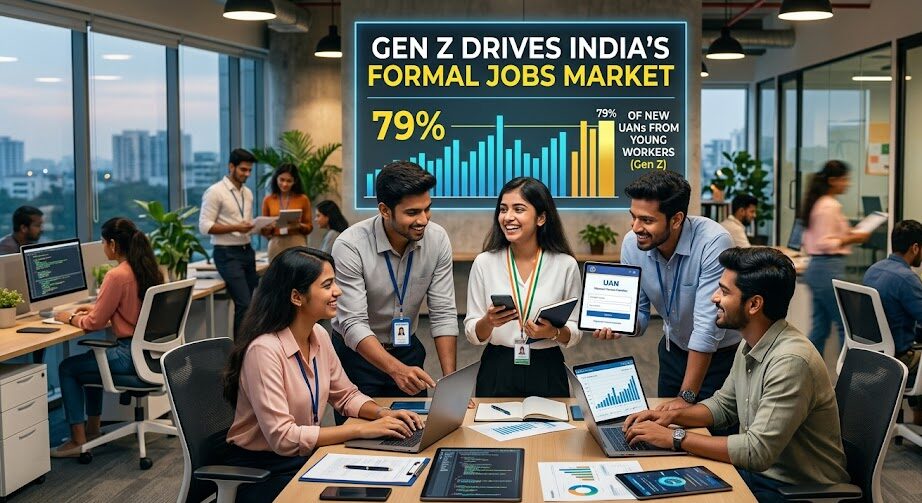
India’s formal employment landscape is becoming increasingly youthful, with workers aged 18 to 30 accounting for 79% of new Universal Account Numbers (UANs) generated during FY2026, according to Quess Corp’s latest Pulse FY2026 workforce report.
More than 57,000 new UANs were generated during the financial year, with workers aged 21 to 25 making up more than 35% of the total. This makes the 21-25 age group the largest individual cohort entering formal employment during the period.
The findings point to a growing role for younger workers in India’s organised employment ecosystem. The Quess report draws on data from the Employees’ Provident Fund Organisation (EPFO), the Periodic Labour Force Survey (PLFS), industry sources and other publicly available datasets.
Women accounted for nearly 28% of the new UANs created during FY2026, while they represented 26% of apprenticeship contracts facilitated under the National Apprenticeship Promotion Scheme (NAPS). The figures highlight continued participation by women in formal employment, alongside the broader expansion of the young workforce.
Apprenticeships are also emerging as an important pathway into organised employment. Nearly 64,000 apprenticeship contracts were facilitated through NAPS, with the automotive sector accounting for more than 51% of those contracts. Companies are increasingly using apprenticeship programmes and skills-based hiring to help bridge the transition from education to employment.
Another notable trend is the growing contribution of smaller cities. Around 69% of the workforce covered in the report was deployed across Tier-2 and Tier-3 cities, indicating that organised employment is expanding beyond India’s traditional metropolitan centres.
The education profile of the workforce is also changing. About 96% of workers had completed at least Class 10, while 61% had completed Class 12 or higher. Around 30% held graduate or postgraduate qualifications, reflecting rising educational attainment among workers entering the organised economy.
The findings suggest that India’s employment growth is increasingly being shaped by younger workers, expanding opportunities in smaller cities and stronger industry-linked pathways such as apprenticeships. For employers, the trend also places greater emphasis on developing job-ready skills and building sustainable talent pipelines as a new generation enters the formal workforce.