
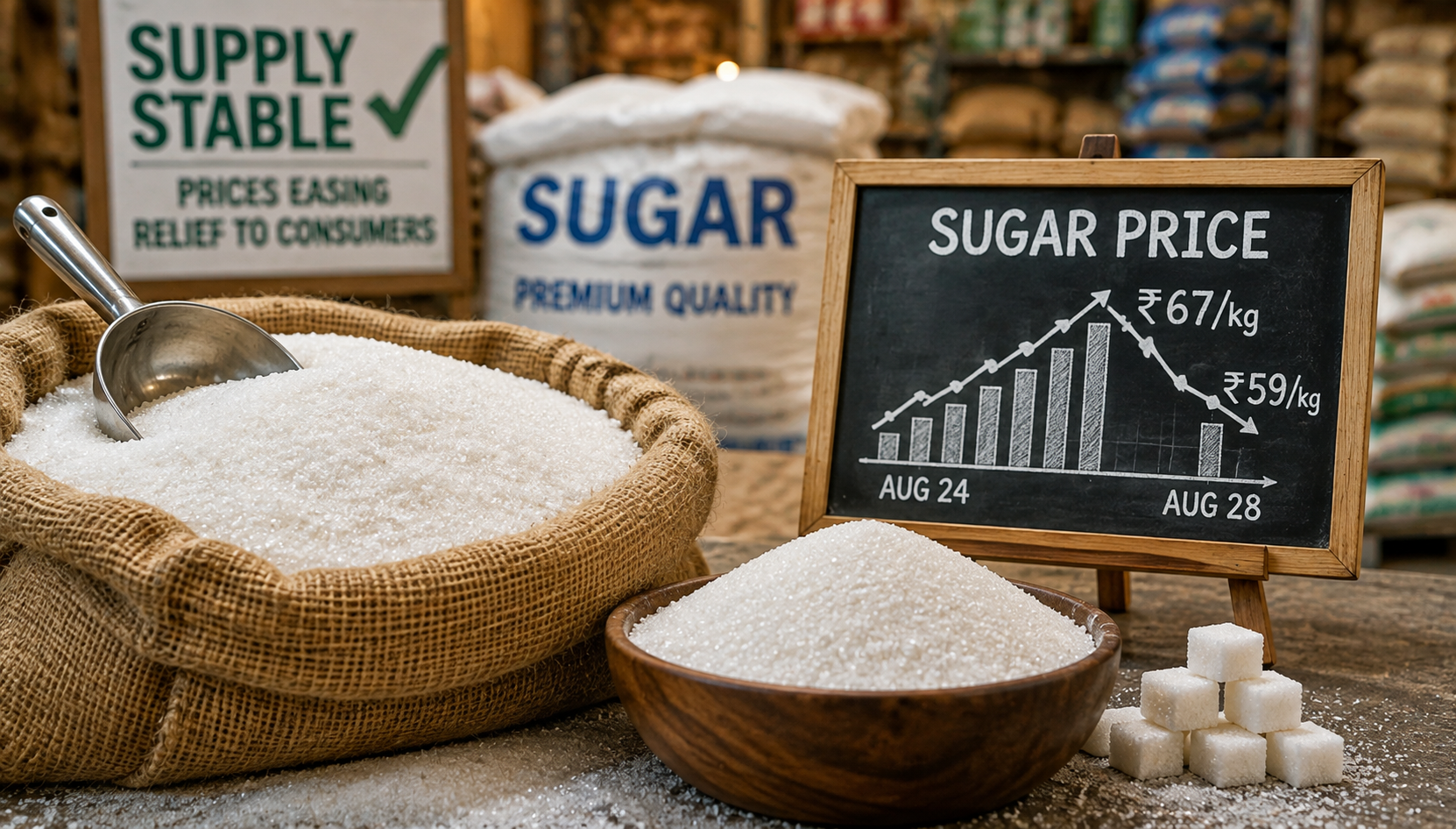
Sugar prices, which surged sharply across Kerala’s wholesale and retail markets in August, have started showing signs of easing, offering some relief to traders and consumers ahead of the upcoming festive season.
Wholesale prices, which climbed to a record ₹67 per kg around August 24, have declined in recent days. According to traders in the Aluva market, the wholesale rate fell from around ₹62 per kg on August 27 to ₹59 per kg on August 28. Retail prices are currently around ₹65 per kg in many markets.
The recent correction has raised hopes that prices could become more stable in the coming days, although traders do not expect them to return to the ₹46-47 per kg levels seen at the beginning of last month.
Market expected to stabilise
Traders expect sugar prices to settle at around ₹50-52 per kg in the wholesale market if the recent easing continues. While that would still be higher than previous levels, it would represent a significant improvement from the peak of ₹67.
Importantly, traders say Kerala is not currently facing an actual shortage of sugar. Continued supplies from major producing states and measures taken by the government are expected to help improve market stability.
Kerala largely sources its sugar from Karnataka and Maharashtra. The two states supply different varieties according to the requirements of consumers and businesses.
Maharashtra sugar, generally available in larger crystals, is widely used for household consumption. Karnataka’s S3 variety, which is finer and whiter, is particularly popular among bakeries because of its suitability for cakes and other confectionery products.
Festive demand puts pressure on supplies
The sharp price increase has come ahead of a major festive period in India, when demand for sweets and bakery products typically rises.
Businesses including bakeries and other bulk consumers increased purchases in preparation for the festive season, adding pressure to the market. The upcoming celebrations, including Vinayaka Chaturthi, Dussehra and Diwali, are expected to keep demand firm.
The impact has also been visible on quick-commerce platforms. Some major online grocery services have temporarily restricted the quantity of sugar customers can purchase in a single order.
Such restrictions indicate that retailers are closely managing inventory while the market adjusts to higher demand and tighter availability.
Government steps aim to improve availability
The government has taken several steps to increase domestic availability and contain price pressures.
Sugar exports have been restricted until September 30, while approval has been given for the duty-free import of up to 1 million metric tonnes of raw sugar. Stock limits have also been introduced for dealers, with a maximum inventory level of 400 tonnes.
These measures are expected to support domestic availability at a time when the market is dealing with lower production and increased seasonal demand.
Brazil, the world’s largest sugar producer, could also become an important source of imports as India looks for additional supplies. Thailand, another major producer, is itself facing production challenges.
Lower domestic production behind the price rise
One of the key factors behind the recent price movement has been lower-than-expected domestic sugar production.
India had initially projected production of around 343 lakh metric tonnes. Actual production is estimated to have fallen to approximately 306 lakh metric tonnes, creating a substantial gap between expectations and output.
Weather-related challenges have added to the pressure. Major sugarcane-producing states such as Maharashtra, Karnataka, Uttar Pradesh and Gujarat have experienced various agricultural difficulties, including heavy rainfall, flooding and water shortages. Crop diseases and pests, including red rot and top borer, have also affected sugarcane cultivation in some areas.
There has also been debate over the role of sugarcane diversion towards ethanol production. While the central government has maintained that ethanol diversion is not responsible for the current price increase, the issue remains part of the broader discussion around India’s sugar supply and production policy.
A more stable market could benefit businesses
For Kerala’s retailers, bakeries and food businesses, the recent fall in wholesale prices is a positive development, particularly as the festive season approaches.
A combination of government intervention, additional import availability and uninterrupted movement of supplies could help prevent the temporary price spike from becoming a prolonged disruption.
For consumers, prices remain above last month’s levels, but the move down from the ₹67 wholesale peak provides an encouraging signal. If supplies continue normally and the government’s measures begin to take effect, the sugar market could gradually move towards a more manageable and stable price range.
For businesses that depend heavily on sugar, particularly Kerala’s bakery and confectionery sector, greater price stability would also make it easier to plan production costs and festive-season inventory.